



Elevating Dialysis Safety: Advanced Chlorine Sensing Sets a New Standard
In 2022, more than 30,000 patients in the UK were receiving dialysis. For each of these patients, the purity of the water they rely on is not an afterthought—it is a critical safety requirement. Dialysis machines draw on large volumes of treated water, and any residual contaminants can be delivered straight into a patient’s bloodstream. Chlorine, a common disinfectant in municipal supplies, is one of the most dangerous residuals in this context.
While chlorine is indispensable for preventing microbial contamination in drinking water, even trace amounts of free chlorine or chloramines can damage red blood cells, trigger haemolysis, and lead to serious harm for dialysis patients. Consequently, dialysis water treatment systems must not only remove chlorine efficiently but also provide real‑time verification that removal is effective.
The Role of Carbon Filters in Dialysis Water Treatment
Granular activated carbon (GAC) filters remain the industry’s go‑to solution for eliminating chlorine in dialysis plants. Installed upstream of reverse osmosis membranes and the dialysis machine itself, GAC filters adsorb chlorine—and in many cases, chloramines—protecting both patients and sensitive downstream equipment. They also ensure a continuous supply of purified water.
However, GAC filters are consumable assets. Their performance degrades over time based on inlet chlorine concentration, flow rate, and total throughput. When a filter becomes saturated without detection, sudden chlorine breakthrough can occur, posing a severe risk to patients. This reality makes vigilant monitoring indispensable.
Best practice requires measuring chlorine both before and after the carbon filter. Operators must understand the incoming chlorine load, track long‑term trends, and confirm zero chlorine conditions at the outlet. Any delay in detection increases exposure risk, underscoring the need for rapid, reliable measurement.
Limitations of Traditional Chlorine Monitoring
Historically, chlorine measurement relied on amperometric probes with electrolyte buffers or colourimetric analyzers. While established, these technologies fall short in high‑criticality healthcare settings.
Amperometric probes typically exhibit T90 response times of two to three minutes and demand frequent maintenance. Electrolytes require replenishment, membranes must be cleaned, and electrodes manually serviced to remove scaling. Accuracy is also sensitive to pH drift, often necessitating offline verification.
Colourimetric analyzers deliver good accuracy but at the cost of speed and complexity. Reagents must be handled and replaced, and full reaction times can reach 2–3 minutes. To save on reagent costs, sampling frequency is often limited to once every 15 minutes to an hour—delays that are unacceptable when chlorine breakthrough must be detected immediately.
A New Approach to Verifying Filter Performance
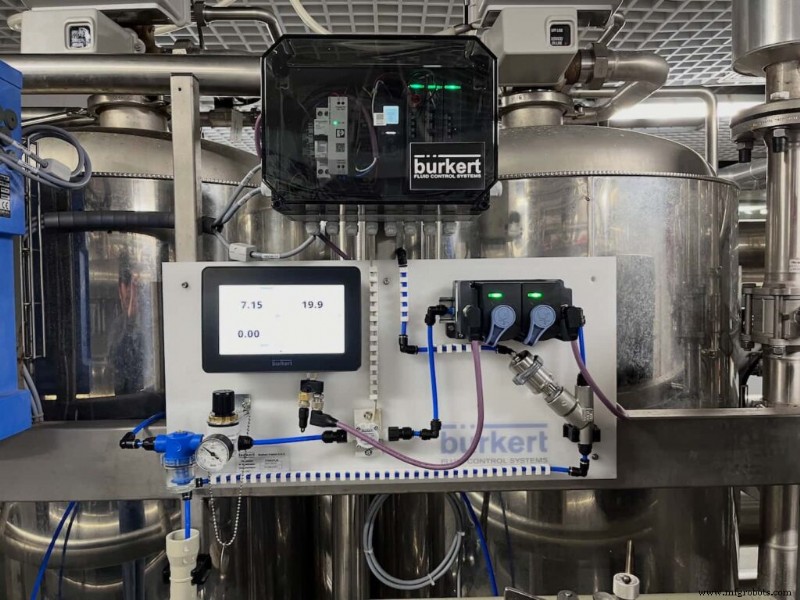
Bürkert’s MS02 Chlorine Cube sensor introduces a paradigm shift. Originally developed for demanding pharmaceutical and drinking‑water applications, the MS02’s on‑chip amperometric design—protected by an immobilised membrane—eliminates the need for electrolyte buffers.
As a result, the sensor achieves a T90 response time of roughly 30 seconds—dramatically faster than conventional technologies. This speed translates into earlier alarms, quicker intervention, and reduced risk to patients.
Crucially, the MS02 can detect zero chlorine, making it ideal for monitoring the outlet of carbon filters. Its stable floating zero point eliminates polarisation effects and removes the need for artificial chlorine dosing, simplifying system design and validation. With no reagents and minimal maintenance, users report continuous operation for over two years without recalibration.
Bürkert’s Broader Role in Dialysis Technology
Chlorine monitoring is just one facet of the dialysis process. Bürkert partners with dialysis machine manufacturers worldwide, supporting projects from concept development to full‑scale production through its global Systemhaus network.
A notable collaboration involved a leading manufacturer’s latest dialysis machine. Bürkert engineered a compact, integrated fluidic assembly that combines valves, sensors, and pumps, streamlining setup, reducing error risk, and enhancing workflow efficiency for clinical staff.
All components are engineered to meet stringent medical standards for hygiene, durability, biocompatibility, and quiet operation—critical attributes for home and nocturnal dialysis environments.
Recognition for Innovation
The MS02 Chlorine Cube sensor recently earned the “Highly Commended Sensor Product of the Year” award from a leading industry publication, highlighting its impact in high‑criticality applications such as healthcare and water treatment.
Safeguarding Patients Through Better Sensing
As the global prevalence of chronic kidney disease rises, the pressure on dialysis infrastructure will only grow. Ensuring that every litre of water used in treatment is free from harmful chlorine is non‑negotiable.
By combining proven carbon filtration with fast, accurate, low‑maintenance chlorine sensing, dialysis providers can markedly reduce risk while boosting operational confidence. Bürkert’s MS02 sensor—and its broader expertise in fluid control and medical system integration—demonstrates how cutting‑edge engineering can directly translate into safer outcomes for patients and greater assurance for clinicians and operators alike.
For UK healthcare providers, investing in advanced chlorine monitoring technology is more than compliance; it is a critical step toward delivering safe, reliable, and future‑ready dialysis treatment.
Bürkert Fluid Control Systems
Greg Wainhouse, Regional Business Development Manager – Industrial Water, North Europe
Tel.: +44 1285 64 87 20
sales.uk@burkert.com
www.burkert.co.uk
Industrial equipment
- Mindsets of Sellers and Buyers in the Second‑Hand Industrial Machinery Market
- Choosing the Ideal Lift Table: A Complete Buyer’s Guide
- Understanding Industrial Clutches: Definition, Function, and Applications
- Understanding Concrete Columns: Design, Function, and Construction
- Celebrating 102 Years of Innovation at Nolte Precise Manufacturing
- Durable Tooling Cuts Cycle Times for Challenging Turn‑Peeling Operations
- Understanding Concentrated Loads on Beams: Definition & Impact
- Atlas Copco Showcases Innovative Air Compressors at 2017 SEMA Show
- Siemens & Ingersoll Strengthen Digital Enterprise Partnership for Aerospace Innovation
- Compactors in Construction: Types, Functions, and Their Crucial Role in Foundation Stability