



Automated Warehouse Storage Systems: Types, Benefits, and Drawbacks
Why read this: Automated storage systems can greatly optimize a warehouse, but they demand a lot of the existing surroundings. This article highlights the pros and cons, the different systems – and what to look for before investing.
For many companies, automation is about optimizing production processes. However, this might make more demands on storage and warehouse capacity.
Optimizing the warehouse can be a good way of improving the factory flow, but it requires extensive preparation.
What is an automated storage system?
An automated storage system is a storage solution that can place and retrieve parts or products automatically.
This is typically based around storage in bins, on shelves or pallets. These move around automatically in a system with fixed storage locations. The overall objective of the system is to reduce the manpower needed to store and retrieve parts.
Automated storage systems also have the potential to increase the speed and accuracy of these processes and optimize the storage usage.
There are 5 main types of automated storage systems
There are several different types of automated storage and retrieval systems (AS/RS). The five main types are:
- Unit load AS/RS is a system used for large and heavy loads from 500 kg and up. The parts are located at pallets on aisle racks within the storage. It is paired with a crane to handle the store and retrieval processes.
- Mini load AS/RS is similar to the unit load AS/RS but scaled down in terms of weight and size of parts that can be handled. Typically, parts are stored in boxes or trays in this system.
- Shuttle based AS/RS manages the storage via shuttles on tracks running within storage racks to store and retrieve racks and deliver them to a workstation.
- Carousel based AS/RS has a constant rotation of the stored products in bins or trays following a track. This can be either vertical or horizontal.
- Vertical Lift Modules are closed systems with a dedicated space for inserting and retrieving parts. This is done on either trays or shelves that are stored in vertical columns.
Before one chooses the specific type of system to implemented, there are some general points regarding automated storage systems worth considering.
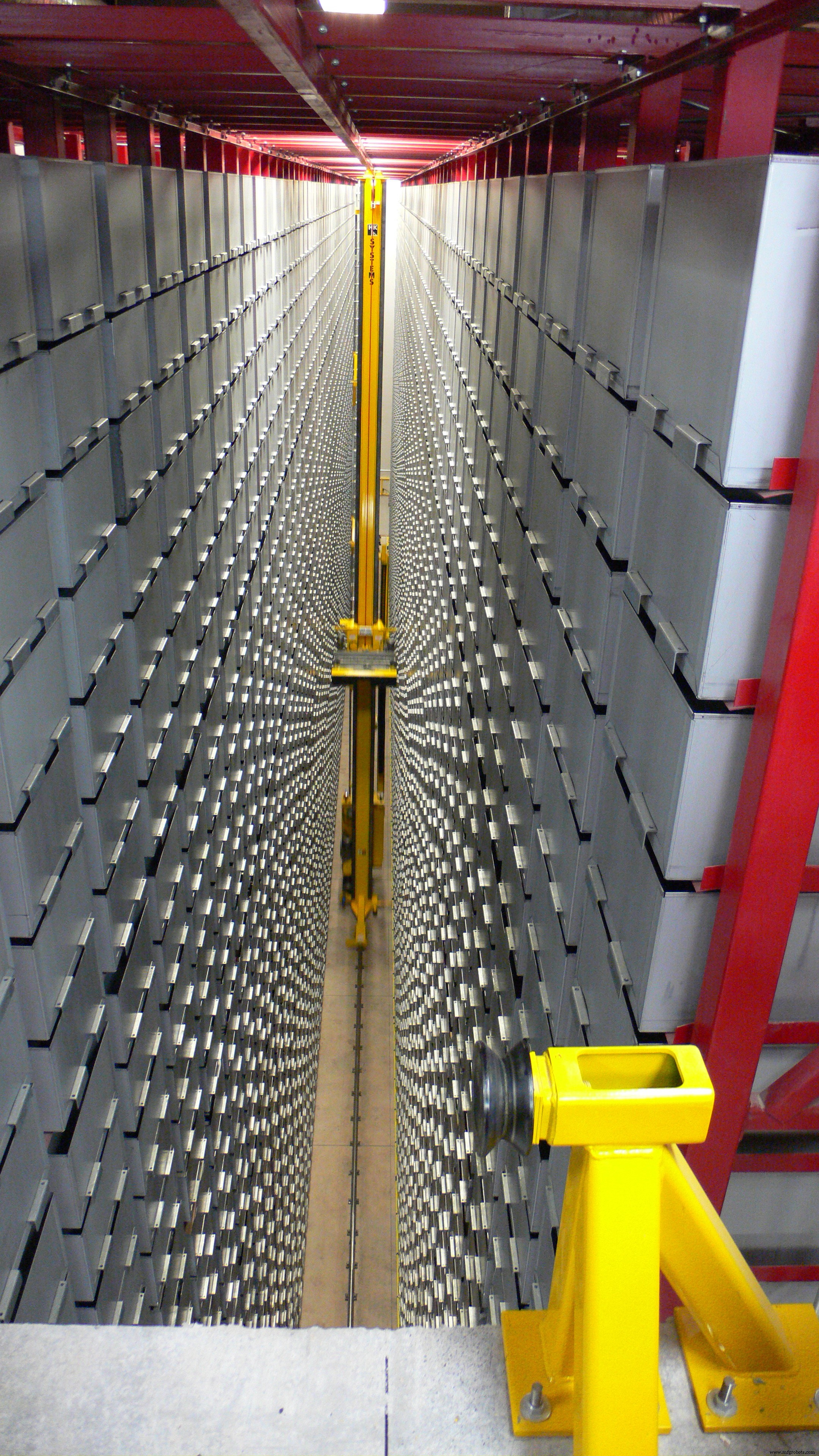
Pros and cons of automated storage systems
One of the main benefits of these systems is the reduction of floor space needed for storage as almost all types evolve around building storage in height and with more narrow corridors for cranes/AGV trucks.
However, this can challenge the structure of the building. Can the floor support the total weight of many stacked racks? Does the width of the corridors need to be changed?
Ergonomics for warehouse operators can be improved when parts are delivered to a fixed location. It makes it possible to set up a workstation based on the operator’s needs and physical capabilities, resulting in a better work environment.
An automated storage system can also help in monitoring the stored parts. This is typically done from a Warehouse Management System (WMS) connected to the company’s ERP system and is updated when something is either stored or retrieved.
This can improve the overview for planners and purchasers to optimize production planning, purchasing and minimum stock – but integration to the ERP system can be costly and time consuming.
Things to consider before investing in automated storage systems
Automatic storage systems require a certain level of standardization. To some degree, containers, bins, and boxes transporting the goods must be made uniform. Reducing the types of containers means that the technology handling them can be simpler as well – and therefore cheaper and less prone to failure.
This standardization requires dialog with component suppliers to incorporate it into their deliveries. It might be difficult for some suppliers to deliver in standard pallets or boxes.
It is also important to consider the possibility to expand the capacity of the system if demand increases. This can be done by integrating more machines and storage space into the system. However, it is a time and money consuming process to rebuild or expand.
It also requires a thorough survey and planning of the new logistics concept for your production. E.g. space requirements, standardization of transport bins/pallets, integration to ERP systems etc.
Therefore, maybe the most important thing is to evaluate whether the warehouse and the rest of factory is ready for the challenge.
Industrial robot
- Transform Your Warehouse: How AI-Driven Depalletizing Systems Boost Productivity and Employee Safety
- Automated Adhesive Dispensing Systems: Types, Applications, and Efficiency Gains
- Explore 8 Welding Helmets: Pros, Cons & the Best Fit for You
- Comprehensive Guide to Wiring Systems and Electrical Connection Methods
- Explore 6 Proven Warehouse Storage System Solutions for Optimal Efficiency
- 5 Key Advantages of a Warehouse Execution System for Modern Supply Chains
- Choosing the Right CMMS: Web-Based vs On-Premise – Pros, Cons, and Decision Guide
- Exploring Fire Suppression Systems: Types, Functions, and Applications
- Compare 8 Top Welding Helmets: Pros, Cons, and Expert Tips
- Exploring Three Core Types of Robotic Systems in Modern Manufacturing