



7 Expert Resources to Master Inertia and Inertia Mismatch for Optimal Motor Sizing
When selecting the right motor, understanding load and motor inertia—and how they interact— is essential for reliable performance.
If couplings, shafts and belts were perfectly rigid, torque and speed alone would dictate motor selection. In reality, every component has compliance, which creates mechanical resonances that can compromise speed, accuracy and lifespan.
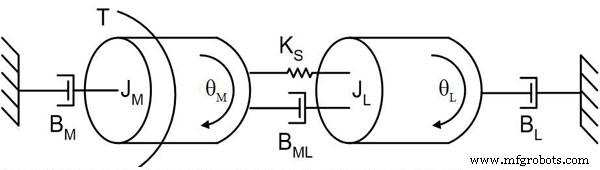
In a compliant system, resonant behavior depends on rotor inertia (JM), load inertia (JL), coupling stiffness (KS), applied torque (T) and viscous damping (BML, BM, BL). Courtesy of Kevin Craig, Hofstra University.
Every compliant element introduces vibration at resonant frequencies when the motor drives the load. Accurate motor sizing therefore hinges on a solid grasp of inertia concepts.
Inertia is a body's resistance to changes in speed. Load inertia, or moment of inertia, is measured relative to the rotational axis. The overall moment of inertia in a servo system is the sum of motor and load inertia. The inertia ratio—load inertia divided by motor inertia—quantifies how well the motor can drive the load.
Motor manufacturers publish permissible load inertia limits; exceeding these can lead to stalling, excess vibration and reduced performance. There is no universal “ideal” ratio—each application requires its own calculation.
High load-to-motor inertia ratios shrink bandwidth, force the motor to work harder, and lengthen settling times, all of which degrade performance. Gearboxes, by inverting the square of the gear ratio, can effectively lower the load inertia and enable higher‑speed, smaller‑motor solutions. Alternatively, selecting a motor with higher inertia may be appropriate for some systems.
Modern servos incorporate advanced drive algorithms that mitigate resonance, allowing designers to employ higher inertia ratios safely.
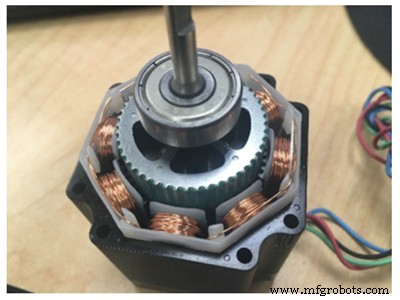
Rotor inertia can be tuned by altering materials, dimensions or design, such as the ‘car‑wheel’ concept shown here. Credit: A3.
Below are seven highly regarded resources that deepen your understanding of inertia, inertia mismatch, and motor sizing best practices:
- Understanding the Mysteries of Inertia Mismatch: A comprehensive A3 archive article detailing equations and practical solutions for instabilities caused by inertia and coupling stiffness.
- Servo Motor Sizing Basics – Yaskawa America: Free e‑learning modules covering peak torque, RMS torque, inertia ratio and speed considerations.
- Robot Academy Inertia Videos – Queensland University of Technology: A collection of videos that explain inertia in motion‑control and robotics scenarios.
- Motor Sizing Basics: Load Inertia – Oriental Motor: A concise guide from a leading motor manufacturer that clarifies load inertia fundamentals.
- Online Inertia Ratio Calculator – Destaco: An interactive tool that simplifies the calculation of inertia ratios for your specific application.
- Understanding Inertia Ratio and Its Effect on Machine Performance – Mitsubishi Electric: A whitepaper that explains inertia ratio basics and warns against simplistic sizing rules.
- Solutions to Reduce Stepper Motor Resonance – A3 Archives: Insightful strategies for tuning motor and load inertia to mitigate stepper resonance.
Industrial robot
- Top 5 Must‑Have Resources for IIoT System Engineers & Architects (2017)
- Mastering Weight Updates and Backpropagation in Multilayer Perceptrons
- Lean & Six Sigma: A Practical Guide for Manufacturing Excellence
- Additive Manufacturing in Aerospace: How 3D Printing Transforms Aircraft Design
- Expert Guide: Servo Motor Repair & Troubleshooting Tips
- 48 Essential Inventory & Asset Management Resources for Schools & Educators
- Hybrid Manufacturing: Key Benefits, Challenges, and Industry Impact
- Shock-Resisting Tool Steels: Mastering Punch and Die Performance
- Engine Starter Motor: How It Works & Why It Matters
- Non-Renewable Energy Resources: Definition, Types, and Impact