



Deburring Robots: Efficiently Removing Welding Lines for Stronger Products
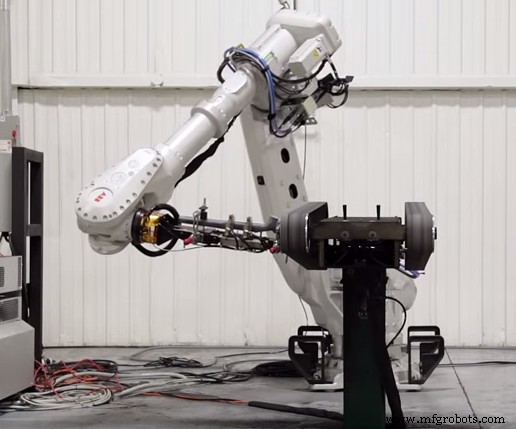
A welding line is the line created when two flow fronts meet. The fronts don’t weld or knit themselves together properly, which causes locally weak areas in the product.
A welding line occurs when the mold or material temperatures are set too low, so that the materials are too cold when they meet to bond perfectly. Another way welding lines form is when oxide forms on the corner of the weld preparation. If the welding arc can’t reach the area to clean the oxide, the welding line appears.
Prevention is best; if welding lines can be prevented, then they don’t need to be removed. However, if a welding line is causing a weak area, a deburring robot can come to the rescue!
If a deburring robot puts a chamfer on the product, the welding line should disappear. This is a simple and standard process for a deburring robot.
RobotWorx provides a variety of deburring robots that can help diminish welding lines. Contact RobotWorx today at 877-762-6881 for more information.
Industrial robot
- Finite-Length Transmission Lines: Impedance, Reflections, and Termination
- Maximize ROI: Proven Strategies to Extend Your Welding Robot’s Lifespan
- Top Italian Welding Machine Manufacturers – Quality, Innovation, Reliability
- Assembly Line Robots Explained: Boost Efficiency, Precision & Quality
- How Welding Robots Revolutionize Automotive Parts Production
- Unlocking Welding Automation: Boost Quality, Reduce Costs, and Accelerate Production
- From Manual to Modern: The Evolution of KUKA Welding Robots
- Motoman Robotics: Advanced Welding Robots Powering U.S. Defense Projects
- Precision Aluminum Welding with Fanuc Robots for Automotive Excellence
- How Resistance Welding Robots Outperform Riveting in Automotive Manufacturing