



Positioner, Turntable, or Manipulator? 2026 Expert Guide to Welding Automation
By the EVST Editorial Team · Last updated: June 11, 2026
Welding positioners, turntables, and manipulators all move a workpiece or torch to streamline seam welding, yet each addresses a distinct limitation. A positioner reorients the part so every seam sits in the optimal flat position. A turntable indexes between loading and welding stations, allowing loading to occur while the robot welds. A manipulator carries the welding head over large or fixed parts, extending reach beyond the capacity of a rotating fixture. Selecting the right equipment hinges on whether your primary constraint is part orientation, cycle overlap, or torch reach.
The Three Machines, Defined
Confusion often arises because a single cell can house all three. Clarifying each machine’s core role simplifies the decision.
Welding Positioner
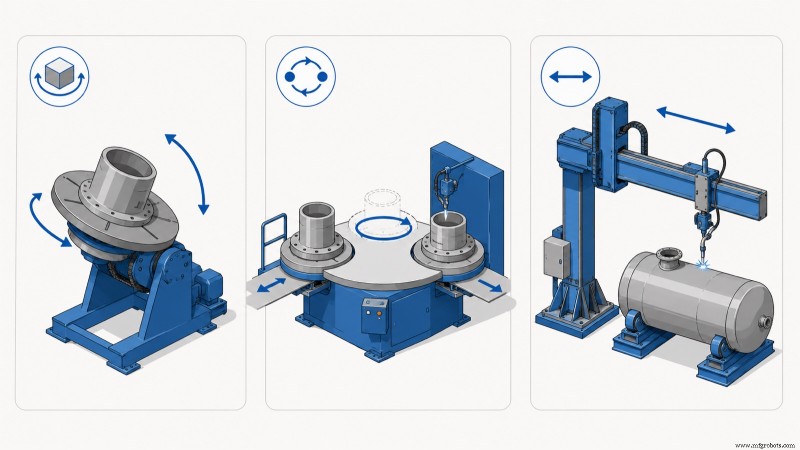
A positioner grips the workpiece and rotates, tilts, or performs both motions to bring each seam into a flat, horizontal position where weld quality and deposition rates are maximized. When welders struggle with out‑of‑position seams, a positioner delivers the biggest speed and quality improvement—up to 30% faster travel per AWS D1.1 guidelines.
Welding Turntable (Indexing Table)
Typically a two‑station rotary index table, the turntable alternates parts between a load/unload station and a welding station. While the robot or welder is engaged, an operator can load the next part or unload the finished one. This overlap raises station utilization, often boosting robot arc‑on time from ~50% to >80% of the cycle.
Welding Manipulator
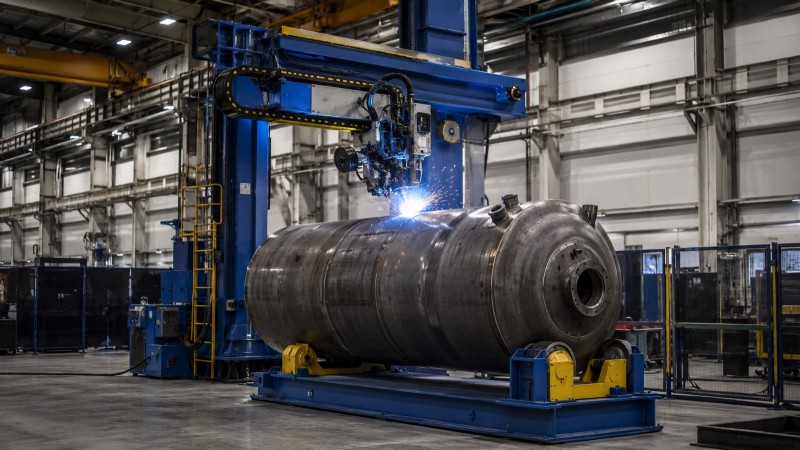
Also known as a column‑and‑boom, the manipulator moves the torch rather than the part. A vertical column supports a horizontal boom that carries the torch (and sometimes a wire feeder or flux system) over large vessels, tanks, or long fabrications that cannot rotate freely. It is usually paired with a single‑axis positioner to rotate the vessel beneath the boom.
| Machine | What Moves | Core Job | When It Wins |
|---|---|---|---|
| Positioner | Part (rotate/tilt) | Bring seams to flat position | Seams out of position on a movable part |
| Turntable / Index Table | Part (index between stations) | Overlap loading with welding | Load/unload time limits throughput |
| Manipulator (column & boom) | Torch/head | Reach seams on large fixed work | The part is too large to orient freely |
How to Choose: Match the Machine to the Constraint
The clearest approach is to identify the bottleneck in your current process and then select the equipment that eliminates it.
If the Constraint is Weld Position
When welders operate overhead or at steep angles, or a robot cannot maintain a proper work angle, the limitation is orientation. A positioner resolves this by re‑orienting the part to flat, which AWS D1.1 confirms supports higher current and travel speed, yielding significant quality and speed gains. Two‑axis positioners handle multi‑plane seams; single‑axis units suit cylindrical geometry.
If the Constraint is Loading Time
When the robot or welder sits idle waiting for parts, the bottleneck is cycle overlap. A two‑station turntable moves the loading off the critical path, often improving robot utilization by 30–40% and providing a low‑cost throughput boost.
If the Constraint is Part Size
For large vessels, tanks, or long structures that cannot rotate freely, the limitation is reach. A manipulator, typically paired with a single‑axis positioner, lets the torch travel along the seam while the part rotates under the boom—standard in pressure‑vessel and pipe‑spool fabrication.
They Often Work Together
In practice, a welding cell rarely asks “which one?”; it asks “which combination?” A heavy‑fabrication cell might combine a single‑axis positioner to rotate the vessel with a column‑and‑boom manipulator to carry the head along the seam. A robotic job‑shop cell could pair a two‑station turntable for load overlap with two‑axis positioners on each face for seam orientation, allowing one robot to weld one part while an operator reloads the other. Naming each machine by its function—orientation, overlap, or reach—keeps layout decisions clear even when all three coexist.
In automated cells, all three systems become coordinated motion axes controlled by the robot PLC. Specifications and quotations for the robot, power source, and positioner are presented together in EVST’s welding robot cell selection guide.
Cost and Complexity, Briefly
Roughly, a single‑axis positioner is the simplest and lowest‑cost option; a two‑station turntable adds a second fixture set and indexing mechanism; a column‑and‑boom manipulator is typically the most capital‑intensive due to its structure and reach. However, the true comparison is cost per good weld at your throughput target. A turntable that doubles robot utilization can recoup its price quickly, whereas an oversized manipulator purchased for a part welded only twice a year may not justify the investment. For a detailed ROI analysis on positioners, see EVST’s welding positioner cost and ROI guide.
EVST’s Workpiece‑Handling Range
EVST, headquartered in Chengdu with manufacturing in Wenling, offers welding positioners across single, two, and three‑axis classes as part of complete robotic welding cells, alongside QJAR welding robots and power‑source integration. Positioners can be combined with indexing stations and head‑carrying structures so that part orientation, load overlap, and torch reach are engineered together for a given part family rather than purchased as separate machines.
EVST’s robotic and welding‑automation line holds IATF 16949 automotive‑grade quality certification, with CE, SGS, and TUV third‑party certifications. Because the right solution is usually a combination, EVST sizes handling equipment against the worst‑case part and throughput target together, rather than selling a single machine in isolation.
Frequently Asked Questions
What is the difference between a welding positioner and a turntable?
A welding positioner rotates and tilts the part to bring each seam to flat, solving an orientation problem. A turntable, or index table, swaps parts between load and weld stations, solving a cycle‑overlap problem. They are often combined; a turntable can carry positioners on each face.
What is a welding manipulator used for?
A welding manipulator moves the torch rather than the part. It’s ideal for large vessels, tanks, and long fabrications that cannot rotate freely. It is usually paired with a single‑axis positioner that rotates the part under the boom.
Do I need a positioner or a manipulator?
Choose by part size. If the part can be rotated and tilted to bring seams to flat, a positioner suffices and is simpler. If the part is too large to orient freely and the torch must travel to the seam, a manipulator—typically with a single‑axis positioner—is required. Many heavy‑fabrication cells use both.
Can one cell use a positioner, a turntable, and a manipulator together?
Yes, and many do. Each solves a different constraint—orientation, load overlap, or reach—so a cell often combines them. In automated cells they are commissioned as coordinated motion axes under the robot controller.
Which option gives the biggest throughput improvement?
It depends on the bottleneck. If welders work out of position, a positioner gives the biggest quality‑and‑speed gain. If the robot waits for loading, a two‑station turntable gives the biggest utilization gain. If the part is too large to orient, a manipulator is the enabling machine. Identify the constraint first, then pick the machine that removes it.
Where to Go Next
For engineering details on positioner classes, read the Welding Positioner Guide. To match an EVST positioner to your part and receive a quote, see the Positioner Selection page. For the complete robotic welding cell, consult our Welding Robot Guide and the Cell Selection Guide. For procurement questions, contact EVST sales via the contact page.
About the author: The EVST Editorial Team writes about industrial robotics and intelligent manufacturing for engineers and operations leaders evaluating automation projects. EVST (EVS TECH CO., LTD), founded in Chengdu in 2018, has delivered 600+ automation projects and ships to 100+ countries, with IATF 16949 automotive‑grade certification and CE/SGS/TUV third‑party certifications across the QJAR, collaborative robot, SCARA, and delta product families.
Industrial robot
- Enhancing Safety in Robotic Workcells with Light Curtains and Advanced Protective Devices
- Emerson Launches Plantweb Optics Data Lake to Simplify Manufacturing Data
- Why Laser Welding Is the Gold Standard for Precision and Strength
- Robots vs CNC Machines: Who Leads in Modern Machining?
- Accuracy vs Repeatability vs Resolution: Understanding Key Metrics in Industrial Robotics
- 5 Proven Ways Robotics Strengthens Manufacturing During Crises
- Blue e+ IT: Safeguarding Your Industrial IT Infrastructure
- Elevate Metal & Machining Productivity with Universal Robots' Collaborative Arms
- Real‑World Automation Success Stories: Boosting Efficiency and Quality
- Exponential Growth of Industrial Robotics: From Painting to Automation