



Real‑World Automation Success Stories: Boosting Efficiency and Quality
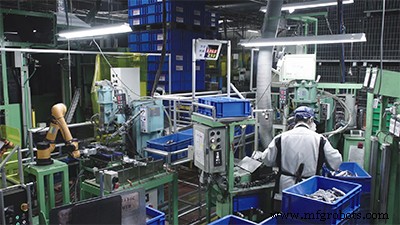
One key advantage of collaborative robots is that, after a thorough risk assessment, they can operate without physical barriers and work safely alongside human colleagues—demonstrated in a recent deployment at Yokoyama Kogyo in Japan. Credit: OnRobot
Manufacturing plants and warehouses worldwide rely on technologies from A3 members to boost productivity, stay competitive, and tackle industry‑specific challenges. This year, as ever, numerous real‑world applications showcase these benefits.
Cobot & Gripper Deliver Cost Savings, Improved Quality
Manufacturers worldwide are grappling with labor shortages, supply‑chain disruptions, and rising costs, making automation a critical lever for sustainability. Kristian Hulgard, General Manager Americas at OnRobot, explains how OnRobot’s grippers for collaborative robots and lightweight industrial robot arms are designed to be deployable with a minimum of fuss, which allows companies to address their automation needs quickly and easily and speeds time to ROI.
Yokoyama Kogyo, a Toyota City‑based manufacturer of parts for the auto and construction sectors, faced a shortage of skilled labor for machine‑tending tasks. The firm had previously relied on manual loading and unloading of parts into metal stamping machinery—a physically demanding process that limited throughput. By deploying an AUBO collaborative robot paired with an RG2 gripper from OnRobot, the company automated the lifting operation, achieving a 35% reduction in labor costs, improving product quality, and freeing staff to focus on higher‑value roles.
Boosting Daily Output by 300%
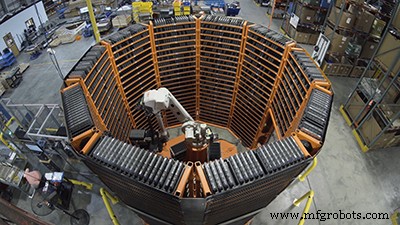
A linear slide on the robot arm ensures it can reach every position on the shelves, and the end‑of‑arm tooling incorporates a gripper from SCHUNK Inc. and additional sensors to ensure handling is gentle and collision‑free. Credit: ABB
Automotive battery‑pack remanufacturer Dorman Products Inc. faced challenges in manually reassembling battery packs for Toyota Prius hybrid vehicles at its Sanford, NC facility. Operators had to identify 28 different modules that, when combined correctly, produce an optimal replacement battery—a process that could involve up to 100 attempts.
Collaborating with an integrator, Dorman Products implemented a solution designed in ABB’s RobotStudio simulation software. The system features 10 stacks of shelving that hold up to 5,000 modules arranged in a decagon around a central ABB IRB 4600 six‑axis robot. The robot identifies likely matches across each 28‑module pack and can store or retrieve a module every eight seconds, cutting build time by 66% and boosting the plant’s daily output of finished battery packs by 300%.
“The circular robotic storage tower has dramatically improved our remanufactured hybrid battery pack business,” says Michael Menta, Dorman’s vice president of engineering. “We went from an exceedingly drawn‑out manual process, endlessly pulling modules from bins to find precise matches, to an automated system that is much easier on our staff.”
AMRs Drive Productivity, Enhance Worker Safety
Lenze Drive Systems (LDS) sought to improve productivity and ergonomics around product transport in its Ruitz, France facility. The manual process involved operators carrying around 100 packages per day, a task well suited for automation with autonomous mobile robots (AMRs).
LDS integrated a MiR200 from Mobile Industrial Robots (MiR) with its existing machinery, enabling fully autonomous transport of finished products between packing and sorting stations. The robot travels approximately 3.1 miles (5 km) daily, improving productivity by 10–15% and eliminating unnecessary travel for operators.
“As customers across myriad industries have tested AMRs for various material‑transportation needs, they’ve started to ask for solutions that can handle even greater payloads in more challenging environments,” says Ed Mullen, VP Sales Americas at MiR. “We’re listening to these demands, designing higher‑payload AMRs that are more reliable, flexible, and scalable, allowing companies to transition from a single robot to full fleets that can handle heavier weights in almost any setting.”
Inspection At The Speed of Production
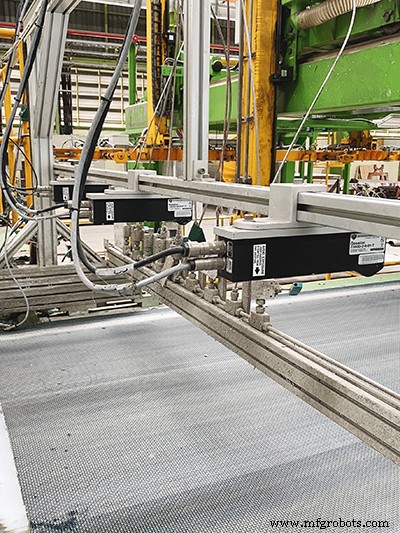
One of Thailand’s leading cement manufacturers produces fibre cement sheets that move at line speeds up to 130 m (426.5 in) per minute across seven production lines. Two operators per shift performed visual inspections—a costly and inefficient task.
The company installed six networked Gocator 3D laser line‑profile sensors from LMI Technologies on each line: two sensors on top and four on the bottom. The multi‑sensor network delivers consistent, high‑precision inspection results, enabling the firm to reduce the number of operators required by two per shift.
“As demand for cost‑effective, high‑precision machine‑vision technologies rises, LMI is expanding its 3D sensor solutions into new industries such as fibre cement sheet inspection,” says LMI. “Our web‑based 3D inspection platform allows companies to create multi‑sensor networks that scan entire sheets, generate accurate heightmap data, and apply measurements with on‑sensor tools—all without PCs or controllers.”
Industrial robot
- How Automation Drives Lean Manufacturing Success
- Wittmann Battenfeld Launches the WX153: Advanced Robot Line for High‑Force Injection Molding Automation
- Unlocking Efficiency: The Proven Benefits of Warehouse Automation
- Unlocking ERP Automation: Benefits, Trends & Business Impact
- Unlocking Enterprise Success: How an Automation Operating Model Drives Growth – Part 1
- Top 3 Advantages of Interoperable Automation & Controls for Industrial Efficiency
- All‑In‑One Panels vs. PACs: Choosing the Right Automation Solution for Your Plant
- 10 Key Advantages of Adopting Industrial Automation Systems
- Why Sumitomo Inline Drives Boost Efficiency and Reliability
- Unlocking Welding Automation: Boost Quality, Reduce Costs, and Accelerate Production