



Hybrid Cloud Strategy: Proven Steps to Build a Flexible, Secure IT Environment
Home » Blog » Cloud Computing » Hybrid Cloud Strategy: Proven Steps to Build a Flexible, Secure IT Environment

Hybrid cloud blends private data centers with public cloud services to create an adaptable, scalable IT foundation. By keeping sensitive workloads on-premises while leveraging the agility and cost‑savings of the public cloud, organizations can meet evolving business demands without compromising security.
A well‑crafted hybrid cloud strategy guides decisions about where applications and data should reside, how systems interconnect, and how to manage security, performance, and costs across both realms.
In this article we outline the essential steps and best practices for building an effective hybrid cloud strategy.
What Is a Hybrid Cloud Strategy?
A hybrid cloud strategy is a comprehensive plan that unites private infrastructure and public cloud services into a single, cohesive environment. It defines how applications, data, networking, security, and workloads are distributed based on business, performance, security, and compliance requirements. The strategy also specifies how these systems communicate, how resources are managed, and how operations remain consistent across the hybrid landscape.
Successfully implementing a hybrid cloud strategy requires overcoming technical, operational, and cultural hurdles. For deeper insight, read our article on hybrid cloud challenges.
Key Components of a Hybrid Cloud Strategy
Below are the core elements that enable private and public clouds to work together seamlessly:
- Private cloud infrastructure. Hosts sensitive applications and data that demand heightened control, security, or regulatory compliance.
- Public cloud services. Offers scalable compute, storage, networking, and managed services for flexible, on‑demand workloads.
- Networking and connectivity. Secure, high‑throughput links that allow seamless data and application flow between environments.
- Workload placement. Decision framework for allocating workloads based on performance, cost, security, latency, and compliance.
- Security and identity management. Policies, access controls, encryption, and IAM systems that protect users, applications, and data across all environments.
- Data integration and management. Tools that synchronize, transfer, back up, and govern data between clouds.
- Centralized management and automation. Monitoring, orchestration, and automation platforms that simplify scaling, deployment, and maintenance.
- Disaster recovery and business continuity. Backup and recovery mechanisms that ensure uptime and rapid restoration after failures.
When combined, these components create a hybrid cloud environment that is flexible, secure, scalable, and easier to manage across diverse infrastructures.
Types of Hybrid Cloud Implementations
Organizations can tailor their hybrid cloud to match specific goals—whether that be scalability, compliance, disaster recovery, or application modernization. Below are common implementation models:
Traditional Hybrid Cloud
This model merges an on‑premises private environment with one or more public cloud platforms. Sensitive workloads stay in the private realm while the public cloud supports scalable resources, backups, or less critical applications.
Multi‑Cloud Hybrid Environment
By combining private infrastructure with multiple public cloud providers, organizations avoid vendor lock‑in, improve redundancy, and optimize pricing. Specialized services can be chosen from each provider, but consistent security policies and centralized orchestration become essential.
Cloud Bursting Hybrid Cloud
Workloads run locally under normal conditions but burst into the public cloud during peak demand. This pattern is ideal for seasonal spikes, large‑scale analytics, or temporary workloads, allowing capacity expansion without permanent infrastructure investment.
Disaster Recovery Hybrid Cloud
Here, the public cloud serves as a backup and recovery site. Critical data and applications are replicated to the cloud, enabling rapid restoration after outages, hardware failures, or cyber incidents.
Edge‑Integrated Hybrid Cloud
This model pairs centralized cloud resources with edge locations closer to users or devices. Latency‑sensitive workloads run at the edge while still connecting to the central cloud for storage, analytics, and governance—an ideal fit for IoT, AI, and real‑time processing.
Application Modernization Hybrid Cloud
Legacy systems remain on private infrastructure while new services are containerized or run on Kubernetes, enabling gradual migration to cloud‑native architectures without a wholesale rewrite.
Concerned about costs? Explore our guide on hybrid cloud pricing expectations.
Benefits of a Hybrid Cloud Strategy
A hybrid cloud approach balances flexibility, performance, security, and cost efficiency. Key advantages include:
- Greater flexibility. Run workloads in the environment that best meets performance, security, and operational needs.
- Improved scalability. Public cloud resources allow rapid expansion during demand spikes.
- Enhanced security and compliance. Sensitive data remains on private infrastructure while less regulated workloads move to the cloud.
- Cost optimization. Pay only for what you use in the cloud, reducing the need for constant private infrastructure expansion.
- Higher reliability and availability. Distributed workloads lower downtime risk and improve business continuity.
- Accelerated application deployment. Automation and on‑demand infrastructure speed rollout and updates.
- Support for legacy and modern applications. Maintain older systems while gradually adopting cloud‑native services.
- Improved disaster recovery. Cloud‑based backup and replication expedite recovery after disruptions.
- Reduced vendor lock‑in. Greater control over data placement across multiple providers.
- Optimized performance for distributed workloads. Run services closer to end users to lower latency.
Overall, a hybrid cloud strategy empowers organizations to manage, secure, and scale workloads across diverse environments with confidence.
How to Build a Hybrid Cloud Strategy
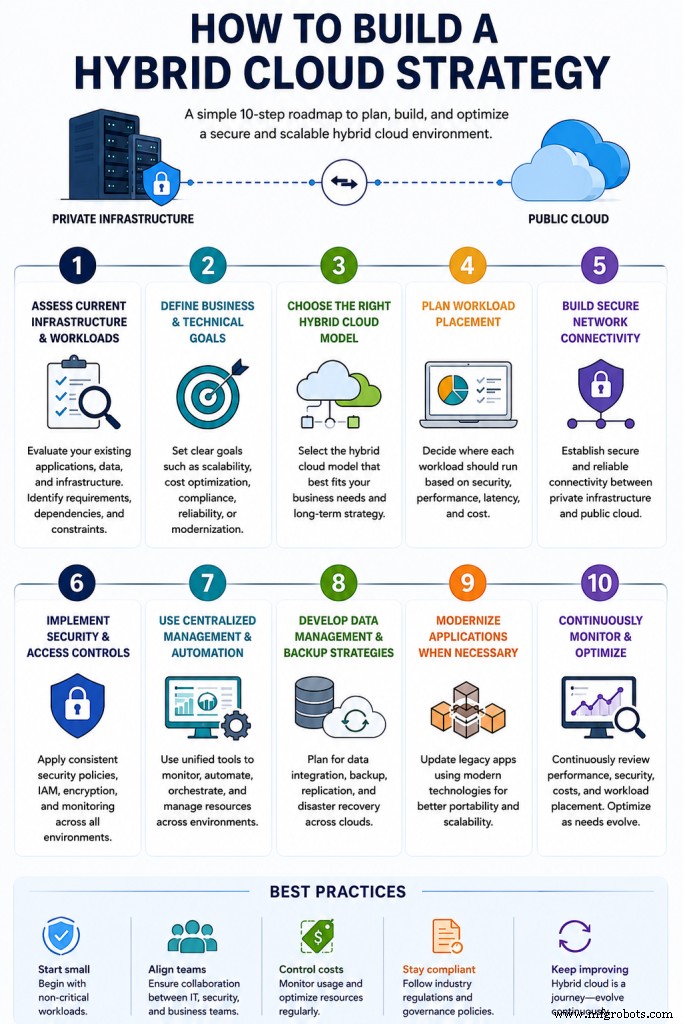
Developing a hybrid cloud roadmap requires thoughtful planning. Below is a ten‑step framework that covers assessment, goal definition, model selection, and continuous optimization.
Step 1: Assess Current Infrastructure and Workloads
Start by inventorying applications, servers, storage, networking, and existing workloads. Identify which workloads demand high security, low latency, regulatory compliance, or high scalability. This assessment informs which workloads should stay on-premises versus those that can move to the public cloud.
Step 2: Define Business and Technical Objectives
Clear goals steer the entire strategy. Typical objectives include:
- Scalability and elasticity
- Cost reduction
- Remote‑work support
- Application modernization
- Compliance adherence
Measurable targets also enable performance evaluation over time.
Step 3: Select the Appropriate Hybrid Cloud Model
Choose a model—traditional, multi‑cloud, edge‑integrated, disaster recovery, or modernization—that aligns with your workload mix, risk appetite, and growth plans.
Step 4: Plan Workload Placement
Allocate workloads based on performance, security, latency, and cost. Strategies include:
- Running latency‑sensitive services in the edge or private cloud
- Keeping regulated data on-premises
- Deploying scalable web or analytics workloads in the public cloud
- Separating production, staging, and development environments
- Optimizing bandwidth and data transfer between sites
Step 5: Build Secure Network Connectivity
Implement VPNs, dedicated interconnects, network segmentation, firewalls, and encryption to ensure reliable, secure communication across environments.
Step 6: Enforce Robust Security and Access Controls
Layered defenses—including IAM, MFA, RBAC, encryption, network segmentation, and continuous monitoring—protect infrastructure, workloads, and data.
Step 7: Leverage Centralized Management and Automation
Adopt platforms such as Kubernetes, Terraform, Ansible, or VMware vRealize Automation to orchestrate, scale, patch, and back up resources across the hybrid stack, reducing manual effort and boosting consistency.
Step 8: Develop Data Management and Backup Strategies
Implement clear policies for classification, synchronization, backup, disaster recovery, replication, encryption, and versioning to safeguard critical information and support rapid recovery.
Step 9: Modernize Applications Where Needed
Convert legacy applications to containers, microservices, or API‑driven services to enhance portability and performance in hybrid environments.
Step 10: Continuously Monitor and Optimize
Ongoing oversight ensures the environment adapts to changing demands. Key activities include:
- Performance and utilization monitoring
- Cost analysis and optimization
- Security threat detection
- Network latency assessment
- Automated scaling
- Centralized logging and reporting
- Capacity planning and forecasting
- Compliance audits
- Patch management
- Incident response automation
Regular review keeps the hybrid cloud aligned with business objectives and operational realities.
PNAP’s hybrid cloud services provide secure connectivity, scalable infrastructure, and intelligent workload placement to enhance performance, reliability, and cost efficiency across private and public clouds.
Challenges of Building a Hybrid Cloud Strategy
While the benefits are compelling, hybrid cloud adoption introduces several challenges:
- Infrastructure complexity. Managing disparate environments can complicate deployment and monitoring.
- Security consistency. Enforcing uniform policies across platforms is demanding.
- Data synchronization. Maintaining consistency across clouds can be difficult at scale.
- Network latency and connectivity. Poor links degrade performance and reliability.
- Compliance constraints. Meeting regulatory requirements across jurisdictions adds overhead.
- Operational cost spikes. Unplanned usage or duplicate resources inflate expenses.
- Legacy application constraints. Some older systems resist migration or require redesign.
- Visibility gaps. Fragmented tools hinder holistic monitoring.
- Vendor integration. Differing APIs and services increase integration effort.
- Skill shortages. Specialized expertise in networking, automation, and security is essential.
Strategic planning, automation, and centralized management tools can mitigate these issues, enabling stable, secure, and efficient hybrid operations.
Building a Successful Hybrid Cloud Strategy
By thoughtfully orchestrating workload placement, security, networking, management, and automation, organizations can create a hybrid cloud environment that delivers performance, reliability, and future‑proof growth. While complexity is inherent, the right tools, policies, and long‑term vision enable secure, efficient infrastructure that evolves with business needs.
Cloud Computing
- Explore 5 Cloud Deployment Models – Choose the Right One for Your Business
- Mastering Azure Cloud: Essential Skills & Career Path
- Mastering Multicloud: A Strategic Guide to Avoid Lock‑In and Boost Resilience
- Data Repatriation Explained: Why Moving Cloud Data On‑Premises Matters
- How PaaS Shapes Application Performance Monitoring (APM) – Key Considerations
- Top 5 Google Cloud Certifications & Courses for Professionals in India
- Understanding the Fourier Transform: Fundamentals, Applications, and Signal Decomposition
- Top 10 Free Cloud Computing Courses to Boost Your Career in 2020
- Cloud vs. Virtualization: Key Differences & Business Impact
- Expert Guide to Seamless Cloud Migration: Strategies, Benefits, and Tools