



Understanding the Fourier Transform: Fundamentals, Applications, and Signal Decomposition
This article provides a clear, expert overview of the Fourier Transform—a cornerstone technique for analyzing signals in engineering and science.
Named after French mathematician Joseph Fourier, the Fourier Transform is a mathematical procedure that uncovers the frequency content of a function. For electrical engineers, it is most commonly applied to time‑domain signals—waveforms that describe voltage, current, or other measurable quantities over time.
Sinusoidal Decomposition
While oscilloscope traces of voltage or current versus time are intuitive, they are not the only useful representation. In many design contexts—especially RF and communications—engineers need to understand the periodic behavior of signals in terms of pure sinusoids, because sinusoids are the unique mathematical expressions of “pure” frequency.
The Fourier Transform reveals a signal’s elemental periodicity by decomposing it into constituent sinusoidal frequencies, along with their magnitudes and phases. This decomposition is key: it lets us treat a complex waveform as a superposition of simple sinusoids.
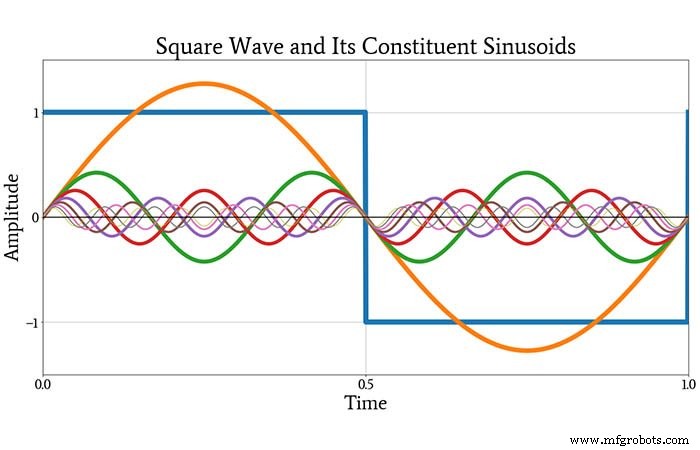
For example, an AC‑coupled square wave of period T and amplitude A can be expressed as an infinite series of odd harmonics:
\[f_{square}(t)=\frac{4A}{\pi}\sum_{k\in\{1,3,5,...\}}\frac{1}{k}\sin\left(\frac{2\pi kt}{T}\right)\]
Rewriting in terms of the fundamental frequency f yields a more intuitive form:
\[f_{square}(t)=\frac{4A}{\pi}\Bigl(\sin(2\pi ft)+\tfrac{1}{3}\sin(6\pi ft)+\tfrac{1}{5}\sin(10\pi ft)+\dots\Bigr)\]
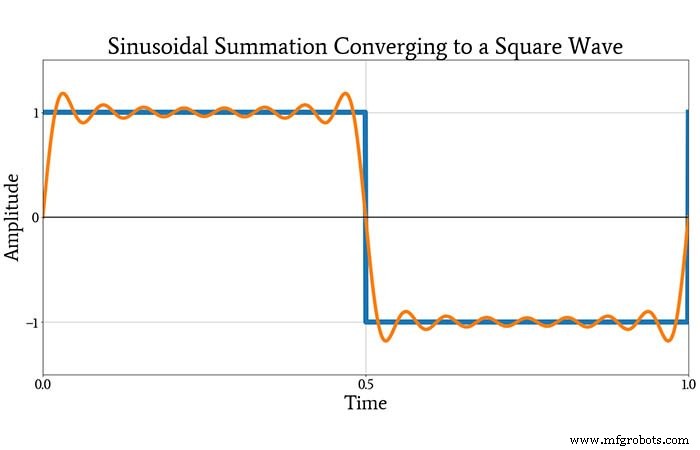
The accompanying plots illustrate the square wave (blue) and the first eight sinusoids, followed by a reconstruction plot that confirms the series reproduces the original waveform.
Time‑Domain and Frequency‑Domain Functions
When computing a Fourier Transform, we start with a time‑domain function f(t) and obtain a frequency‑domain function F(\omega), where \omega is angular frequency. Evaluating F(\omega) at a specific frequency (e.g., 100 rad/s) yields the magnitude and phase of the sinusoid that appears in f(t) at that frequency.
The transform is inherently complex‑valued, so magnitude and phase are extracted via additional calculations. In practice, engineers use the magnitude of the complex coefficients (\sqrt{a^2+b^2}) to analyze frequency content, especially when working with the discrete Fourier transform (DFT) on sampled data.
Visualizing the Fourier Transform
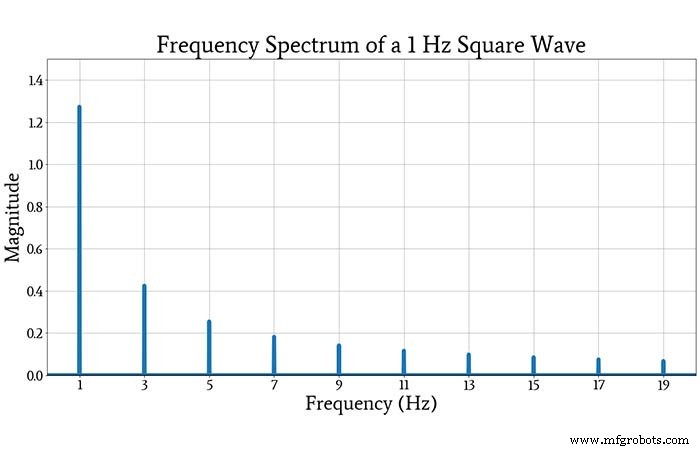
Frequency spectra—plots of magnitude versus frequency—are ubiquitous in datasheets, test reports, and textbooks. The following spectrum demonstrates the harmonics of an AC‑coupled square wave with amplitude 1 V and fundamental frequency 1 Hz.
Computing the Fourier Transform
While most engineers rely on software tools to perform Fourier analysis, understanding the underlying mathematics is valuable. The continuous‑time Fourier Transform of a signal f(t) is defined as:
\[F(\omega) = \int_{-\infty}^{\infty} f(t) e^{-j\omega t}\,dt\]
For discrete‑time signals, the DFT replaces the integral with a finite sum, yielding complex coefficients that directly represent the frequency spectrum.
Conclusion
This article has outlined the core principles of the Fourier Transform, from sinusoidal decomposition to practical spectrum visualization. The transform is the foundation of modern signal processing and a gateway to advanced topics such as filter design, modulation, and spectral estimation.
Further Reading
- An Introduction to the Discrete Fourier Transform
- An Introduction to the Fast Fourier Transform
- How to Perform Frequency-Domain Analysis with Scilab
- Learning to Live in the Frequency Domain
- Linear Filtering Based on the Discrete Fourier Transform
Cloud Computing
- Re‑Platforming in the Cloud: What It Is & How It Drives Efficient Migration
- Edge AI: Accelerating On-Device Intelligence and Transforming Consumer and Enterprise Markets
- Harnessing Data in the Internet of Reliability: Strategies for Effective Management
- What Is the Circular Economy? Insights from Leading Plastics Companies
- DC vs. AC Motors: Key Differences and Choosing the Right One for Your Application
- The Modern Manufacturing Process: Key Techniques and Innovations
- The Construction Industry Explained: Scope, Roles, and Global Impact
- Understanding the Printing Industry: Key Roles and Services
- The Fabrication Industry Explained: Processes, Materials, and Impact
- Understanding the Security Industry: Products, Services, and Global Impact