



Processors Power the Next Generation of Medical Devices
Medical devices—from ultrasound systems and implantables to home glucose meters and fitness trackers—rely on microprocessors (MPUs) and microcontrollers (MCUs) that excel in execution speed, reliability, security, power efficiency, and connectivity. Many of these performance gains translate across a broad spectrum of applications.
Growing Demand for Ultra‑Low‑Power and Secure Chips
The aging population and heightened health awareness are accelerating the adoption of wearable and connected medical electronics. This surge forces chip designers to embed cybersecurity at the silicon level. Ultra‑low power is critical for real‑time sensing (temperature, acceleration, speed) and for devices that must run on a single battery for years.
A MarketsandMarkets report highlights the need for microcontrollers that combine low power with integrated analog peripherals. Such chips deliver higher reliability, lower noise, reduced latency, and cost savings—key advantages for glucose meters, heart‑rate monitors, and implantable devices.
Renesas Synergy S1JA: A Low‑Power, High‑Performance Solution
The Synergy S1 MCU series exemplifies this trend. The S1JA group offers a 48‑MHz Arm Cortex‑M23 core, programmable analog blocks, and robust security functions, simplifying design and reducing bill of materials (BOM). These MCUs fit cost‑sensitive, low‑power IIoT and medical monitoring applications—including flow meters, multi‑sensor systems, and single‑phase electricity meters.
- Flash: 256‑KB
- SRAM: 32‑KB
- Operating voltage: 1.6 V – 5.5 V
- Integrated sensor‑biasing unit and configurable analog fabric
The on‑chip analog suite includes a 16‑bit ADC, 24‑bit sigma‑delta ADC, 12‑bit DAC, rail‑to‑rail low‑offset op‑amps, and high‑speed comparators. Designers can replace multiple external analog components with these internal blocks.
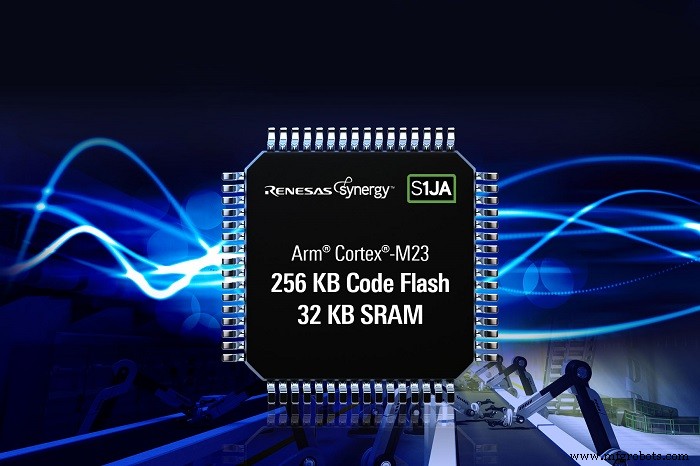 Renesas’ S1JA MCUs enable advanced analog configurations, from basic functions to more complex analog blocks. (Image: Renesas Electronics)
The S1JA MCUs achieve ultra‑low power: a 500 nA standby mode supports 20‑year battery life for devices that spend most of their time sleeping.
Security is built in with an AES cryptography accelerator, true random number generator (TRNG), and memory protection units—foundational blocks for secure cloud connectivity.
The Renesas Synergy Software Package (SSP) supplies HAL drivers, application frameworks, and RTOS support. It also offers six modules that streamline interconnection of internal analog blocks. Designers may use e² Studio or IAR Embedded Workbench to tailor their solutions.
Reference Designs for Wearable Health Monitors
Renesas’ reference solution demonstrates the S1JA’s versatility. It powers a wearable galvanic skin response (GSR) and handheld body composition meter (BCM). GSR measures DC conductance, while BCM captures high‑precision AC impedance—both requiring accurate ADC resolution, fast sampling, and skin‑temperature compensation.
Key components: Renesas S1JA MCU, RL78/G1D Bluetooth‑LE MCU (4.3 mA transmit, 3.5 mA receive), and ISL9203A Li‑ion charger (operates from 2.4 V).
Samsung’s Exynos i T100: Multi‑Protocol, Secure Wearables
Samsung’s Exynos i T100 integrates an Arm Cortex‑M4F (up to 100 MHz) with 1.2 MB flash, 192 KB SRAM, and 24 KB RAM. It supports Bluetooth 5 LE, Zigbee 3.0, and Thread, and can run two protocols concurrently. The dedicated security subsystem (SSS) and physical unclonable function (PUF) provide strong protection against hacking.
Operating temperature: –40 °C – 125 °C. Samsung offers a reference board with an Arduino‑compatible Shields interface, plus OS and API support for rapid application development.
STMicroelectronics’ STM32MP1: Linux on a Low‑Power Chip
The STM32MP1 multi‑core processor marries an Arm Cortex‑A7 with a Cortex‑M4, delivering Linux‑level performance while preserving real‑time capabilities. Power savings are significant: idle Cortex‑A7 execution can be stopped, allowing the Cortex‑M4 to handle most tasks and cut power by ~25%. Standby mode further reduces consumption by up to 2.5 k times.
The chip includes a 3D GPU for HMI, supports external DDR SDRAM and flash, and offers a broad set of peripherals that can be allocated to either core. Evaluation boards (STM32MP157A‑EV1, STM32MP157C‑EV1) and discovery kits (STM32MP157A‑DK1, STM32MP157C‑DK2) are available, along with three developer packages (Starter, Developer, Distribution) to suit varying project needs.
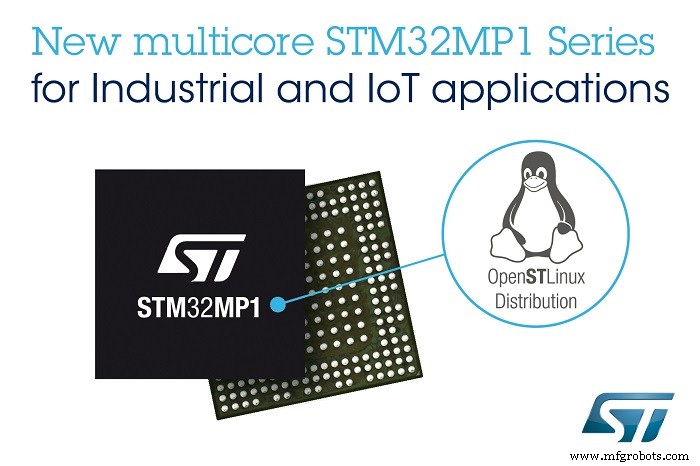 STMicroelectronics’ STM32MP1 delivers enhanced performance, resources, and open‑source software. (Image: STMicroelectronics)
Big Data Meets Medical Imaging
Large‑scale data handling is a critical challenge across medical imaging, connected devices, and automation. Greater data volumes demand stronger security, higher interoperability, faster processing, and consistent communication.
Texas Instruments’ BAW‑Based Solutions
TI’s bulk acoustic wave (BAW) technology powers the SimpleLink CC2652RB wireless MCU and the LMK05318 network synchronizer clock—devices designed for high‑throughput medical equipment. BAW resonators offer high frequency in a compact form, improved mechanical resilience, and precise timing for wired and wireless signals.
The CC2652RB is the first crystal‑less MCU, integrating a BAW resonator and a 48‑MHz Arm Cortex‑M4F CPU. It delivers exceptional battery life (sub‑µA sleep current, up to 80 KB parity‑protected RAM) and supports Zigbee, Thread, Bluetooth LE, and proprietary 2.4‑GHz protocols. The device operates from –40 °C to 85 °C and is available on a TI LaunchPad development kit.
Intel’s Xeon Scalable Processors in AI‑Driven Imaging
Artificial intelligence is rapidly transforming medical imaging, yet many solutions still rely on GPUs for deep learning. Intel’s Xeon Scalable processors now handle complex, memory‑intensive workloads typically reserved for GPUs.
In collaboration with Philips, Intel demonstrated that Xeon Scalable servers can perform deep‑learning inference on x‑ray and CT scans without dedicated accelerators. Using the Intel Distribution of OpenVINO and software optimizations, Philips achieved a 188× speedup for bone‑age prediction from x‑rays and a 37× speedup for lung segmentation from CT scans.
These results confirm that high‑performance CPUs can meet demanding AI workloads in healthcare, potentially reducing hardware complexity and cost.
Embedded
- Mastering Product Design: Proven Strategies to Overcome Common Challenges
- Reliable Power‑On Solutions for Battery‑Operated Medical Devices
- Tracking Advancements in Medical Device Technology
- OmniVision OH02A1S: One Sensor, Dual Imaging – Shrinking Endoscope Footprint
- Overcoming Design Challenges in Precision DC Energy Metering
- Navigating Challenges and Seizing Opportunities in Medical Device Manufacturing
- Protecting IoMT: Best Practices for Securing Internet-Connected Medical Devices
- Overcoming New Product Development Challenges: Strategies for Success
- Top 4 Digital Transformation Challenges for Medical Device OEMs
- Essential Factors for Successful Medical Device Manufacturing