



Private 5G Networks: Transforming Industrial Automation

Since the mid‑1995, industrial communication technologies have increasingly converged with mainstream IT solutions. Ethernet, WLAN and industrial PCs have been adapted for factory automation, as Alexander Bufalino, VP Marketing at Quectel Wireless Solutions Co., Ltd., points out.
Economies of scale drive this shift: standard IT hardware—chips, devices and components—offers cost‑effective deployment, while a vast research community backs these technologies with robust engineering performance that single‑industry solutions cannot match.
Mobile communication has evolved from voice to high‑speed data, now delivering truly global connectivity that can be accessed from virtually anywhere. Industrial automation (IA) has explored cellular tech (2G, Edge, 3G, LTE) for the past decade, finding success in non‑critical monitoring and remote maintenance.
Earlier generations were tailored to public smartphone use, and their high latency, limited determinism and opaque diagnostics posed challenges for mission‑critical IA applications.
5G: Designed for Industrial Use
With 5G, the focus shifts to the stringent latency, determinism and reliability demanded by industrial automation. 5G is built in successive releases defined by the 3GPP (the 3rd Generation Partnership Project – www.3gpp.org). Release 15 introduced the new radio (NR) and enabled enhanced mobile broadband (eMBB). Releases 16, 17 and 18 are in development.
Private 5G Networks
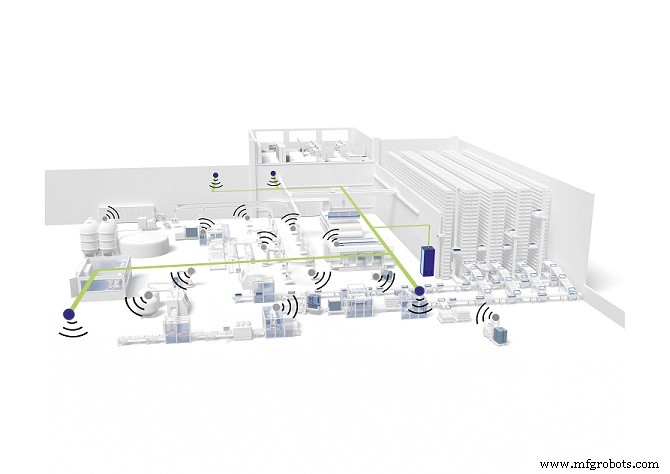
Private, or non‑public, 5G networks are enterprise‑dedicated infrastructures that meet specific performance, reliability and security needs. They can be fully isolated or integrated into operator networks, and spectrum regulators—e.g., in Germany—allocate separate bands for local private use.
In a groundbreaking collaboration, Quectel, Phoenix Contact and Ericsson launched the first industrial‑grade 5G router for private networks, enabling commercial‑grade performance and Industry 4.0 applications.
The trio conducted extensive interoperability testing at Ericsson labs to validate the router’s reliability and co‑developed solutions for standalone private 5G deployments.
Quectel, a global supplier of cellular and GNSS modules, offers a broad portfolio: 5G, LTE‑L, NB‑IoT, UMTS/HSPA+, GSM/GPRS and GNSS. Its RG500Q/RG510Q and RM500Q/RM510Q modules—introduced at MWC 2019—support 5G Release 15 in NSA and SA modes, with sub‑6 GHz and mmWave capabilities.
Ericsson, a leading network supplier, drives 5G development and partners with CSPs to unlock Industry 4.0 potential. It offers tailored private‑network solutions such as the Ericsson Private Networks Solution and the compact Industry Connect.
Phoenix Contact, with over 20 years of experience in wireless data transmission, supplies WLAN, Bluetooth and mobile routers. Its latest 5G router integrates industrial applications into a private 5G backbone, prioritising resource usage and behaviour.
Why 5G Outperforms Legacy Wireless
Unlike legacy non‑3GPP wireless that operates on shared, license‑free bands, private 5G networks allow spectrum allocation to be custom‑designed for enterprise needs, eliminating performance loss in crowded spectrum.
Consequently, 5G can become the backbone of industrial automation, supporting sensors, mobile tools, driverless transport and high‑resolution video—all wireless, high‑performance, scalable and prioritised.
The author is Alexander Bufalino, VP Marketing, Quectel Wireless Solutions Co., Ltd.
Internet of Things Technology
- Industrial Automation: How Smart Control Systems Transform Manufacturing
- Introducing A3: New AI Community, Tools, and Guides for Automation Leaders
- Why Industrial Wireless Matters: Key Benefits and Implementation Challenges
- Emerging Wireless Technologies of 2015: A Guide for M2M & IoT
- Mastering Wireless Communication Range: How Power, Data Rate, and Interference Shape Connectivity
- Omron Unveils Next-Gen Industrial Robot Equipped with Embedded AI for Predictive Maintenance
- ATI Industrial Automation Launches QC-7 Robotic Tool Changer for Efficient Tool Storage & Switching
- Understanding Industrial Automation: Enhancing Efficiency & Quality in Manufacturing
- Automation Types: Boosting Productivity, Quality, and Safety Across Industries
- How Industrial Automation Boosts Productivity and Quality in Modern Manufacturing