



AT&T Foundry: Accelerating Innovation Through Pragmatic Prototyping
Hidden within a three‑storied office building in the Dallas suburb of Plano, Texas is the AT&T Foundry, a startup lab brimming with prototypes and equipment.
Visitors find the Foundry well‑equipped, with an ABB robot that efficiently packages items into boxes—an early demo in the first‑floor showroom—before the goods travel along an IoT‑enabled assembly line to a trailer.
Not far away is a replica of a retail environment, replete with large bags of potato chips. If you walk up and remove three bags, a counter display retells how many are left on the shelf. "If you are the brand owner responsible for replenishment, there is quite a bit of value in more accurately mapping where you are going," Lee said.
IoT World is the leading event that transforms industrial IoT from concept to deployment, boosting business performance. Secure your spot today.
Also in the AT&T Foundry is a replica of a semi‑truck cab complete with a high‑resolution, video‑game display, pedals, speakers and authentic‑looking dashboard controls that helped an AT&T customer develop a tracking system.
Nearby, a connected Red Bull cooler monitors door openings and can detect when a can is removed. It reports potential maintenance issues to service teams and uses a Wi‑Fi sniffer to determine its location, alerting if it has been moved from its designated retail spot—such as into a college dorm. The device also evaluates whether it occupies an optimal position in the store. "Red Bull pays the retailer a monthly fee for premium placement—typically near the cash register," Lee explained. "We install a motion sensor that counts foot traffic; if the expected 1,000 daily passersby drop to 20, the cooler is not in the right spot."
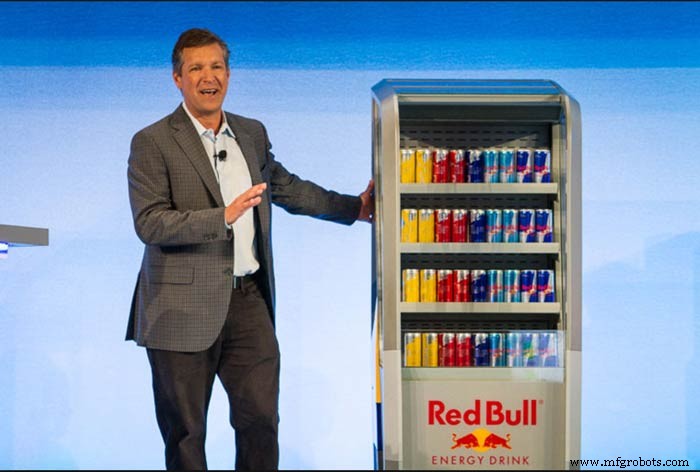
The Red Bull cooler displayed at the 2016 AT&T Summit.
The second floor hosts a workshop that demonstrates AT&T’s agile prototyping methodology. Employees embrace a "less is more" mindset: "We focus on solving the problem with the simplest, most cost‑effective technology," Lee says. "Additional features can be added later, but a solution that cannot meet the core need at minimal deployment cost is unlikely to reach production."
AT&T established its foundry network to accelerate the delivery of IoT solutions that meet specific business challenges. Beyond Plano, the company operates three additional U.S. sites, one in Mexico, and another in Israel. With a history of connected‑device innovation since 2011, the Plano Foundry helps clients sidestep costly detours," Lee notes.
The second‑floor facility also houses production equipment that speeds up prototyping. Instead of outsourcing PCB fabrication, the Plano Foundry can fabricate boards in-house in minutes. A precision pick‑and‑place system assembles tiny components, while a water‑jet cutter cuts steel up to 10 inches thick. 3‑D printers create custom housings and plastic parts, and the center produces limited‑run injection‑molded components. Woodworking tooling proved useful when a client needed trackers embedded in 2‑by‑4s used on shipping pallets.
Given AT&T’s telecommunications heritage, the Foundry also features equipment that simulates cellular (including Wi‑Fi and GPS) signals. "We can reproduce the full spectrum—from narrowband to 2G—and all global frequency bands," Lee explains. "This allows a device to be tested across every intended market during a single trial."
A notable example of the Foundry’s pragmatic approach is a portable‑toilet prototype. A construction‑equipment customer struggled with worker attrition, citing dirty portable toilets and lack of cold bottled water as primary concerns.
The Foundry devised solutions for both issues. Since the company rented the toilets, measuring usage was challenging. "We needed a way to detect poor usage," Lee said. "We turned to a motion sensor—essentially using the human as the sensor."
An LTE‑M battery‑powered sensor records door‑opening speed and streams data to the cloud. A sudden slam signals a need for cleaning. "If we observe the door opening and closing without a person inside, that pattern indicates a problem," Lee notes.
Additional tilt sensors detect tipping; an alert is triggered immediately when the unit is overturned.
A GPS module assists maintenance crews in locating units requiring service.
The team also incorporated sensors in coolers to monitor ice and water levels; a temperature rise indicates melting.
The Foundry’s diverse projects rely on common enablers, yet Lee emphasizes that the goal is practical customer solutions, not merely experimental prototypes. "We’re a foundry because we build things," Lee says. "Most projects arise from technology we develop or apply to solve real customer problems. Some—like Red Bull’s cooler tracker—transition to mass production, while others remain tailored solutions."
Internet of Things Technology
- How 5G Fuels IoT: Current State, Opportunities, and Key Challenges
- GaN Power Amplifiers: Driving Sub‑6 GHz 5G Massive MIMO Beyond LDMOS
- 3D Printing & Prototyping at Mar‑Bal: Accelerating Composite Innovation
- Worthington Industries: Zero Injuries, Zero Harm – The Delta Plant’s Safety Excellence
- From Dual Grids to Smart Systems: Japan’s Journey Toward a Unified, Resilient Power Future
- Digital Twins in Manufacturing: Benefits, Challenges, and the Road Ahead
- Gartner Forecasts AI’s Next Chapter: Opportunities, Risks, and Adoption Hurdles
- Fast Prototyping with 3D Printing: Revolutionizing Foundry Processes
- How Rapid Prototyping & 3D Printing Accelerate Manufacturing Success
- Unleashing Efficiency: The Motoman UP130 Robot’s Power and Precision