



IoT Spending 2020: Mixed Outcomes Amid Budget Constraints and Pandemic Shifts
Key takeaways from this article include the following:
- Many IoT implementers report budget as a hurdle, but the overall spending landscape is more nuanced.
- Budget constraints also impede IoT‑based analytics projects.
- Low maturity in analytics and data science often underlies these challenges.
Budget constraints have long been a chief barrier to IoT adoption, alongside staffing and security concerns.
While 52% of respondents to the 2020 IoT Adoption Survey cited budget hurdles or high technology costs, other data suggest a more complex picture.
Headwinds and Tailwinds
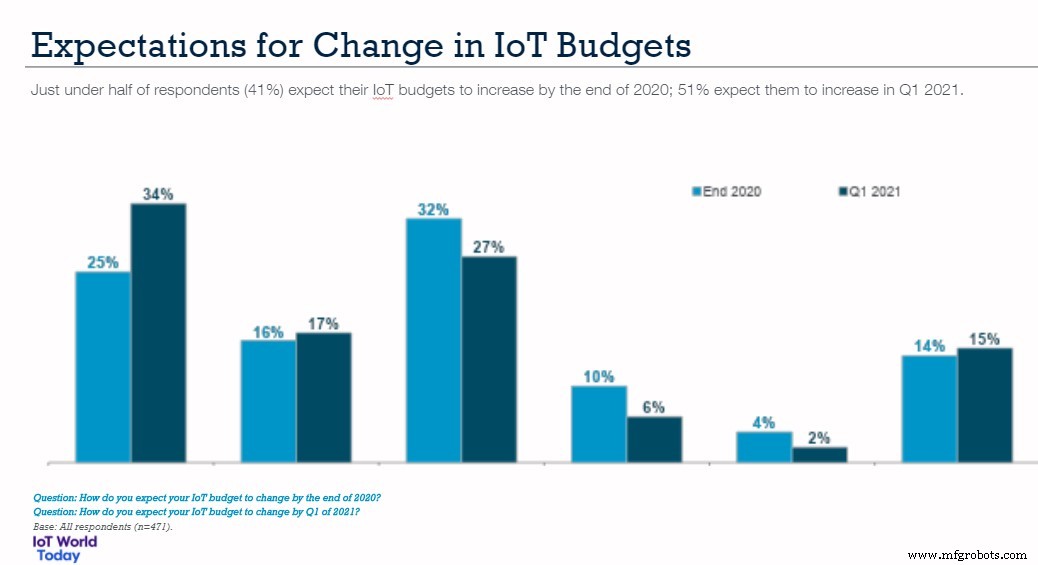
One silver lining of the COVID‑19 crisis is IoT vendors’ willingness to offer discounts or added features at the same price. Fifty‑nine percent of respondents reported receiving such perks. Most implementers are optimistic about budget allocations for IoT in 2020 and 2021: 41% expect increases this year and 51% next year, while only 14% and 8% foresee declines.
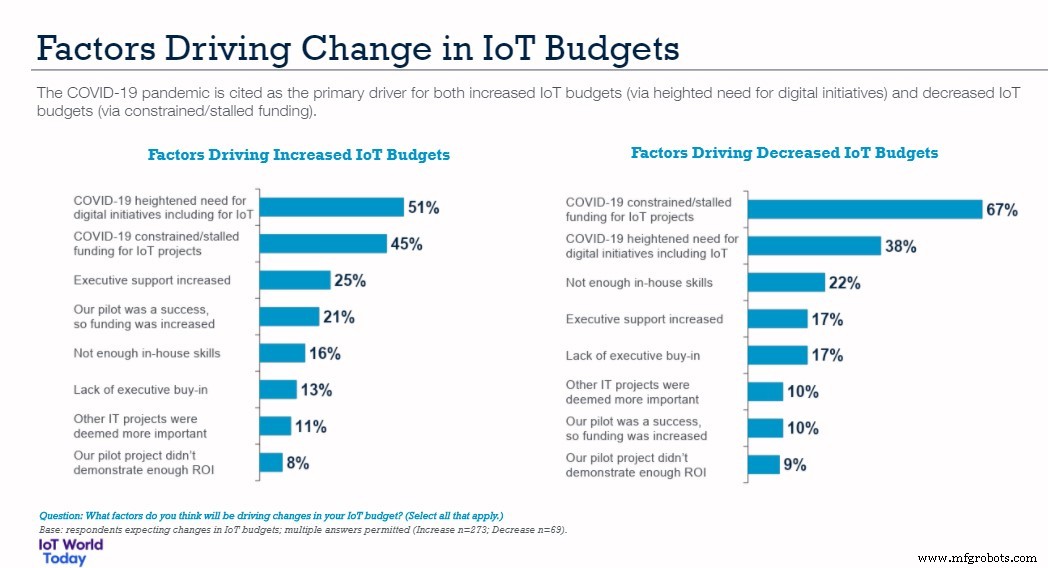
Conversely, two‑thirds of respondents noted that the pandemic constrained or stalled funding for IoT projects, even as COVID‑19 drove overall budget increases. For those with budget changes, 50% said the pandemic heightened the need for digital initiatives, including IoT.
Chander Damodaran, chief architect at Brillio, observed a surge in IoT interest during the pandemic, especially in consumer packaged goods, logistics, utilities, healthcare, and technology sectors. Spending increases were most pronounced in these industries.
Hard‑hit sectors such as hospitality, travel, and oil‑and‑gas saw less investment. Alex West, senior principal analyst at Omdia, noted that many oil‑and‑gas companies prefer technology‑as‑a‑service models, outsourcing control systems to vendors rather than paying upfront.
Budget constraints also deter analytics deployment, selected by 42% of respondents. However, this does not necessarily reflect high costs; it often signals the immaturity of analytics and AI initiatives. Chris Kocher, co‑founder of Grey Heron, emphasized that data streams and analytics are the most valuable components of IoT projects, yet organizations frequently overlook analytics budgeting until after device deployment.
Despite this, 61% of respondents plan to increase IoT analytics spending in the next 24 months. Cloud‑based machine learning and AI resources have made launching AI projects more accessible, with 65% of respondents performing analytics in the cloud.
The cost of hiring full‑time data science or IT talent remains a significant hurdle. Nearly 40% of respondents lack in‑house capabilities for IoT analytics, and 43% cite budget constraints as a slowdown factor.
As analytics and AI tools mature and prices decline, the ROI becomes clearer, encouraging broader adoption. Kocher noted that laggards will eventually catch up once toolsets become more affordable.
IoT Pilot Purgatory No More?
The issue of pilot purgatory—projects that fail to scale—has largely abated. Only 8% of respondents reported that pilot projects could not demonstrate enough ROI.
Historical data shows a decline in stalled PoC stages: 60% in 2017 (Cisco), 61% in 2018 (McKinsey), and roughly 30% in 2019 (Microsoft). Damodaran believes the paradigm has shifted toward integrated, scalable deployments.
Given the unique economic challenges of 2020, it may be premature to draw definitive conclusions about current IoT spending. Kocher added that COVID‑related priorities caused many initiatives to be shelved, killed, or repurposed, while projects improving operations in the pandemic were fast‑tracked.
The declining numbers likely reflect reduced risk tolerance and maturing technology. “Any technology, whether AI, IoT or otherwise, will see many failed PoCs early on,” Kocher said. “Once maturity sets in, expectations become clearer.”
Methodology
Between June and August 2020, IoT World Today surveyed 471 respondents about their IoT adoption plans and budgets. Fifty‑nine percent were from the U.S., 14% from Europe, 10% from Asia, and 17% from other regions. Company size distribution: 58% had fewer than 500 employees, 17% had 10,000 or more, 29% had 1,000–9,999, and 7% had 500–999 employees.
Internet of Things Technology
- 2020 IoT: The Top Challenges Facing Product Leaders
- Enhancing Insight into the Internet of Things: Leveraging Data Visualization and Graph Databases
- IoT Spending Shifts to Supply Chain and Inventory Management
- 2020 IoT Outlook: Steady Growth, Skill Gaps, and Security Challenges
- IoT World 2020 Rescheduled to August 10–13 at San Jose Convention Center
- Global IoT Spending to Hit $1.29 Trillion by 2020, Driven by Hardware Investment
- Which 2020 Tech Hype Is Unlikely to Deliver
- 2020: Continuous Intelligence Emerges as the Leading Trend
- IoT Careers 2020: Expanding Horizons & In-Demand Skills
- Industrial IoT Investment to Quadruple Post-Covid: $20B Over Five Years