



Sustaining IoT Growth: Securing Connectivity and Business Models for Cellular IoT
In 2011, Cisco released a white paper that would become the IoT bible: by 2020 the world would host 50 billion connected devices. It was bold, optimistic, and—by 2019—excessively so.
Since then, forecasts have been continually trimmed. Today the 2020 outlook ranges from 20 billion to 30 billion devices—roughly half of Cisco’s original projection. The market is still expanding, but several unresolved issues keep it from hitting the “trillions” threshold.
Security concerns and fragmentation across connectivity technologies remain the most cited hurdles. Devices built on disparate protocols—Wi‑Fi, Bluetooth LE, ZigBee, Z‑Wave, and Low‑Power Wide‑Area Networks (LPWANs)—present integration challenges. The lack of a unified security framework exacerbates the problem.
Viability of Cellular IoT
Connectivity options for IoT span short‑range radios, mesh networks, and LPWANs. LPWANs divide into licensed (LTE‑M, NB‑IoT, EC‑GSM) and unlicensed (SigFox, LoRa) spectrums. Proponents of cellular IoT argue that the use of licensed spectrum can reduce fragmentation and provide robust security, benefiting applications such as smart metering, automotive telematics, home automation, agriculture, and asset tracking.
However, cellular IoT introduces its own complexities, notably billing and provisioning for network operators. Every modem manufacturer must consider how device makers will monetize connectivity. The question remains: who will pay for the data plans that underpin these services?
Consider manufacturers of automobiles, refrigerators, shipping containers, and thermostats—all increasingly connected to deliver OTA updates, performance monitoring, and new revenue streams. The critical unknown is who bears the connectivity cost.
Consumers rarely think about connecting a new fridge to the Internet; the appliance maker typically shoulders that expense. Yet most appliance producers lack experience negotiating mobile data plans. Mobile operators, conversely, may need to craft appealing offers for these non‑traditional clients to spur IoT adoption.
Key issues include roaming policies for appliances that move between regions and whether operators will waive fees for nationwide distribution. Addressing these questions is essential for scaling IoT at a global level.
In short, sustainable IoT growth hinges on unified, secure connectivity solutions and clear business models that define who pays for what—and how the ecosystem benefits all parties.
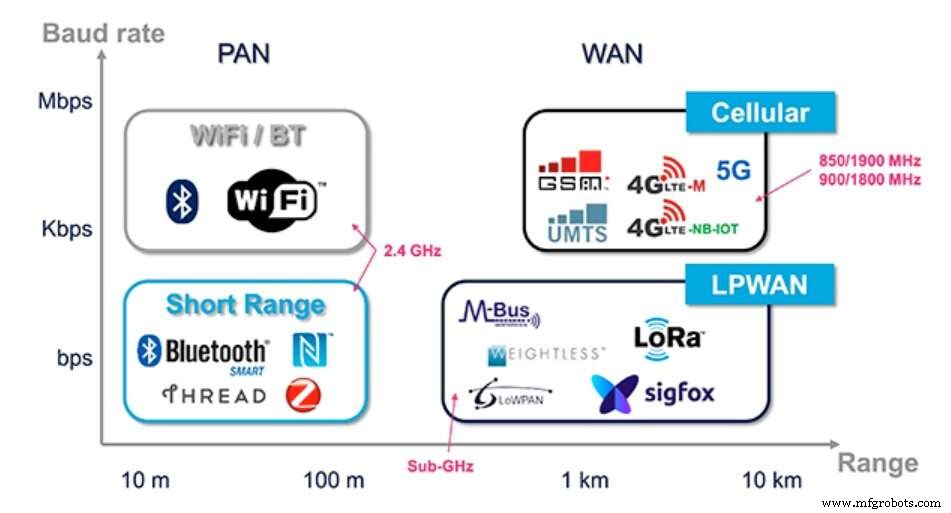
(Source: STMicroelectronics)
Internet of Things Technology
- Can Verizon’s M2M Solutions Drive the Next Generation of Cellular IoT?
- Cellular IoT: Weighing Cost, Battery Life, and Data Use
- Why Dedicated IoT Networks Make Sense: 3 Key Advantages
- Harnessing Cellular IoT and Bluetooth LE: A Synergistic Approach for Next‑Gen Connectivity
- Selecting the Optimal Cellular IoT Technology
- Cellular IoT: Comparing EC‑GSM‑IoT, NB‑IoT, and LTE‑M Performance
- Cellular IoT: Unlocking the Advantages of CIoT Connectivity
- Smart Garbage Can: A Cellular IoT Solution for Automated Waste Management
- Can the Rapid Growth of IoT Overwhelm Chipset Production?
- 6 Key Drivers Fueling Rapid IoT Adoption in Healthcare