



Mastering IoT Gateways: Seamlessly Connect Devices to the Cloud
IoT gateways act as middlemen connecting your devices to the cloud and managing everything from data security, connectivity protocols to edge computing.
The Internet of Things (IoT) ecosystem is booming as new products continue to get adopted worldwide. The technology offers incredible opportunities to optimize business processes, improve health and safety, and save time and money. However, integrating new and custom IoT solutions with the complex IoT landscape is a challenge. That is where IoT gateways play a fundamental role in connecting traditional and next-generation devices to the internet.
What are IoT gateways?
In simple words, IoT gateways are virtual platforms or physical devices that act as a wireless access portal, giving IoT devices access to the internet. They execute several functions, including protocol translation, device connectivity, data filtering, and security.
They integrate protocols for networking, manage storage and edge analytics on data, and facilitate secure flow between devices at the network’s edges to both cloud services above it all.
Use cases
In the past few years, IoT gateways have provided considerable support to a range of industry niches, fulfilling various business purposes, including:
- Telehealth to monitor patients in real-time
- Wearables for industrial and personal purposes
- Smart grids to reduce electricity costs and wastage
- Fleet management platforms to optimize supply chains
- Smart logistics platforms for inventory tracking and management
- IoT tracking and tracking devices on products to optimize warehouse operations
- AI-enabled industrial equipment and manufacturing lines to improve productivity
- Smart farming via drones, sensors, and robots to boost crop yield and reduce wastage
- Autonomous vehicles managed by IoT-enabled telematics solutions to offer convenience
An overview of the IoT gateway market
The soaring demand for individualized technologies paired with increasing adoption rates will positively impact growth within the IoT industry moving forward. Naturally, the structure around these networks is helping the IoT gateway market grow.
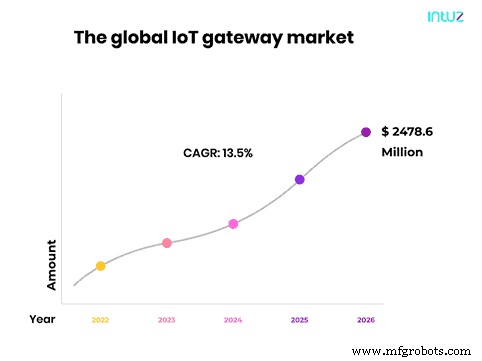
By 2026, the global IoT gateway market is expected to be valued at USD 2478.6 million, with a CAGR of 13.5%. By 2021-2026, edge deployments are anticipated to become an essential component in integrating IoT-connected devices and overcoming challenges associated with internet connectivity for these devices.
The demand for affordable gateways will grow as they provide access points between sensors or machines and other networks such as cloud computing platforms.
IoT gateways and security: the challenge
Hacking is a constant risk for any internet-connected device, but it can be reduced by establishing good cybersecurity practices at the IoT gateway. Since gateways are the first line of defense against hackers, they should be designed with solid cybersecurity.
IoT gateways sit between connected devices and the cloud; they reduce the number of internet connections, thus reducing the overall risk of hacking. However, this also makes them a target for malicious software to hack into, increasing vulnerabilities of the IoT ecosystems.
A simple IoT gateway only connects to the cloud using Wi-Fi, but depending upon usage, the system may work across a complex network. IoT gateways can support communication protocols such as Z-Wave, Zigbee, BACnet, and Bluetooth Low Energy (BLE).
They collect massive data from many devices and sensors. They process and send it along to cloud platforms. Some IoT gateways also allow autonomous management of their connected devices by retrieving information from the cloud.
The primary functions of an IoT gateway are:
- Data aggregation
- System diagnostics
- Data visualization and analytics
- Networking and hosting live data
- Short-term historical data analysis
- Device configuration management
- Authentication of role-based user access
- Caching, buffering, and streaming of data
- Management of network security features
- Pre-processing, cleansing, filtering, and optimization of data
- Device-to-Device (D2D) or Machine to Machine (M2M) communications
- Connection and communication with legacy or non-internet connected devices
Enterprise IoT gateway vendors
While it is comparatively early in the IoT market development to draw sharp contrasts between application areas and product vendors, the top eight vendors of IoT gateways stand out:
1. Eurotech
The company provides IoT solutions to accelerate business analytics, application development, and deployment. Based on open-source standards in the field of Internet-connected devices under the brand name Everyware IoT.
2. ADLINK
ADLINK’s IoT gateways feature secure and scalable computing for seamless edge-to-cloud connection. The company offers a range of gateway platforms that support Fieldbus, Wi-Fi, or LTE connectivity interfaces. It enables data aggregation from the edge through the cloud.
3. DELL Edge Gateways
The Dell Edge Gateway is a powerful gateway that aggregates and analyzes all of your IoT data to provide deeper insights.
It prioritizes the most critical pieces of information for you by filtering data. It enables optimal performance and backs up to the cloud or control center. The efficiency of the IoT system increases as less time is spent uploading bandwidth-consuming raw data.
4. HPE Edgeline
The HPE Edgeline system integrates key open standards-based operational technology for data acquisition and control cellular technologies directly into the enterprise IT system responsible for running analytics. This convergence of capabilities reduces latency between acquiring, analyzing, and acting on data, saving space, weight, and power (SWaP).
5. Cisco
The company’s IoT operations dashboard is controlling your connected assets. These easy to deploy tools offer insights for safer and efficient operations.
6. NXP and Freescale
The IoT Gateway Solution aims to ease developing an IoT network easier by providing pre-integrated, user-friendly guidance and support.
The solution includes the NXP Modular IoT Gateway (MIG), which is tested for ZigBee™ or Thread™ connectivity along with secure cloud communications through Wi-Fi, Ethernet, and cellular links that enable access to cloud services.
7. Meshify
Meshify sensors are long-range IoT devices that perform well even with a low power supply. They reduce financial losses by accurately detecting problems and alerting about conditions that may result in damage. With these high-tech gadgets on the job, you can constantly monitor your facilities for any irregularities or issues.
8. Huawei
The company offers switches optimized for outdoor use and enabled by IoT. They also provide heavy-duty industrial automation applications like machine surveillance and transportation.
The use of IoT gateways in industrial settings
The IoT gateway devices are the backbone of many successful applications in enterprises. Industry 4.0, healthcare, and automotive domains utilize IoT gateways to manage essential functions such as network compatibility and security protocols.
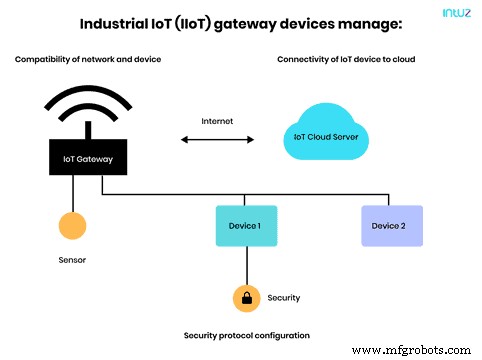
They also help IoT gadgets and their cloud services to connect seamlessly. Industrial IoT (IIoT) gateway devices manage:
- Compatibility of network and device
- Security protocol configuration
- Connectivity of IoT device to cloud
IoT gateways are essential for managing and securing IoT devices, but they also might help reduce the bandwidth consumption of your organization.
An IoT device that collects large amounts of data can be a problem. If the company has lots of devices and sends all this information to cloud storage, it will deplete their internet bandwidth as well as increase costs.
IoT gateways in the edge computing architecture
An IoT gateway is a critical component of edge computing. On the other hand, the latter takes some of the workload related to processing for smaller datasets, off the cloud, at an edge gateway or node in the network where smart objects are interconnected via local area networks (LAN).
Moreso, edge computing centralizes IoT devices at an edge level, filters the most critical information, initiates data visualization, and performs the complicated analysis.
For instance, if an organization has IoT-enabled security cameras, uploading security footage in real-time will consume much bandwidth and energy. Processing the video data on the edge device differentiates between unimportant and essential video streams.
Storing only relevant surveillance to the cloud saves both video storage space and bandwidth along with precious time.
Over to you
Connecting your devices securely to the cloud and gathering IoT-generated data can be a daunting task, but it does not have to be.
IoT gateways make connecting and managing connected devices easier than ever before with features such as remote management, network mapping, security options, and more. IoT gateways act as middlemen connecting your devices to the cloud and managing everything from data security, connectivity protocols to edge computing.
Internet of Things Technology
- Connecting 10 Million Devices: Bosch IoT Suite’s Landmark Growth
- Blockchain for the Internet of Things: Unlocking Secure, Decentralized Data Exchange
- Edge Cloud Computing: The Essential Backbone for IoT’s Rapid Growth
- How Narrowband Technologies Power the IoT Revolution
- IoT Security: Unpacking the Unique Threat Landscape for Connected Devices (Part 1)
- IoT Device Updates: Overcoming Distribution Challenges in Modern Workplaces
- Tracing the True Evolution of the Internet of Things
- 5 Key Challenges Facing the Internet of Things Today
- Three Powerful Ways Cloud Computing Enhances IoT Deployments
- Harnessing Cloud Power for IoT: Unlocking Seamless Connectivity & Data Insights