



Scaling IoT Asset Tracking: Proven Strategies for Enterprise Growth
The IoT‑supported asset tracking market is growing at an unprecedented pace. According to a Research and Markets report, by 2025 IoT‑based solutions will account for 95% of all enterprise and industrial deployments. In addition, IoT is finally enabling the monitoring of assets valued at or below $1,000.
These technologies make it easier than ever to scale tracking solutions, empowering businesses of all sizes to manage an ever‑expanding fleet of devices.
Achieving this requires a system architecture grounded in a solid scaling strategy—one that delivers measurable ROI while remaining reliable and cost‑effective.
The Basic Building Blocks
Before tackling scalability, let’s review the core components of an end‑to‑end asset‑tracking solution.
At Link Labs, it starts with a real‑time location system (RTLS). Our AirFinder indoor positioning platform integrates tags, sensors, local networks, and a user‑friendly interface to provide end‑to‑end visibility.
The secret lies in combining these components innovatively, empowering users to track valuable assets from anywhere, anytime.
With 21 technology patents to date, we collaborate closely with customers to build scalable solutions that reliably track parts, equipment, supplies, and people—while extending battery life and coverage distance.
We are recognized for our expertise in low‑power wide‑area networks (LPWAN) for IoT, RTLS, and GNSS, and we continuously expand into BLE mesh and sensor‑fusion technologies that blend ultrasound, motion, and other inputs.
Our intuitive UI—designed from the ground up—offers workflows, automated reports, smart asset groupings, configurable tables, and seamless indoor/outdoor mapping. For example, users can “peel the roof” of a building to zoom onto floor plans, then follow an asset across the road into a distribution center—all on a single map.
Beyond the core tech, we provide value‑added services: quick part ordering, rapid prototyping, ERP integration, field‑installation training, and monitoring tools that ensure continuous quality of service.
Three Proven Development Strategies for Scalability
Our experience has distilled three core strategies that underpin a scalable asset‑tracking solution.
1) Guiding Development Principles
Ease of Use Out of the Box
We prioritize solutions that meet identified use cases without creating complex infrastructure. The architecture is designed for seamless scaling as needs evolve.
Key features include plug‑and‑play devices, interoperability with third‑party systems, and data that remains manageable even as device counts reach hundreds of thousands—or even millions.
We also pioneer network‑layer technologies that adapt to assets moving through fragmented supply chains. For instance, we avoid Wi‑Fi‑dependent systems that break when a single network password changes.
Affordability and ROI
Cost is a guiding principle. We assess total cost of ownership over the entire lifecycle, not just initial installation.
By leveraging power‑ and data‑efficient technologies, we enable customers to realize internal economies of scale—boosting productivity, reducing asset replacement, and cutting costs.
Take AirFinder: a patented approach to smart, active RFID tags reduces power consumption, extending battery life, while shifting location processing to tags lowers network data throughput and IoT data costs. Combined, these savings cut ownership costs by 50–90%.
Affordable solutions also come with lifecycle maintenance and service delivery supported by our deep domain expertise—from hardware to firmware to connectivity.
2) Proven Development Process
We partner with customers as a collaborative extension of their team. Our consultative “magic wanding” starts with: “If you had a magic wand, what would the ideal report or alert look like?”
We never force solutions that would compromise user experience and are willing to refer clients to competitors if a better fit exists.
Once alignment is confirmed, we advance through a six‑step Stage‑Gate model—from discovery to launch—ensuring clear milestones and business‑critical decisions at each gate.
This process captures critical variables such as risk appetite, strategic importance, existing infrastructure integration, ROI expectations, and data‑management systems.
3) Valuable Partnerships
Scaling requires an ecosystem of innovative partners. We select abstraction points wisely, building our own layers where it adds value and leveraging others’ strengths for field‑to‑back‑office data flow.
Our go‑to‑market strategy relies on technology partners who bring patented components—like Wiliot’s battery‑free Bluetooth tags and Polte’s proprietary tech powering our AirFinder SuperTag.
Channel partners such as AT&T integrate and resell our location technology across hospitality, healthcare, and retail markets.
These alliances expand our skill set, enhance interoperability, and keep us ahead of industry trends—saving customers money by adopting consumer‑grade advances, such as smartphones for RFID tracking.
For more detail, Learn more about the AirFinder SuperTag with our free white paper >>.
Practical Examples
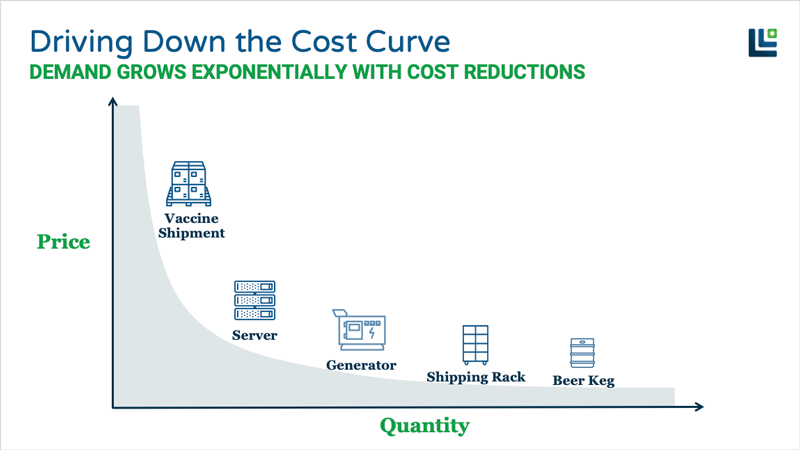
Historically, high costs limited IoT asset tracking to assets above $1,000. By demonstrating economies of scale, we now extend solutions to lower‑value assets—balancing cost and benefit.
Beer Kegs
Tracking beer kegs—from production to distribution—mitigates lost inventory, optimizes delivery routes, ensures temperature compliance, and maintains adequate stock levels.
Although individual kegs cost $50–$100, scaling the system across thousands of units reduces the per‑unit tracking cost, making the solution viable for breweries.
Panic Button Systems
Using AirFinder, we provide hotels with small, wearable panic buttons that transmit distress signals and precise location. The system also enables remote monitoring of leaks, noise pollution, and air quality.
Safety mandates, union agreements, and brand commitments drive adoption, and the solution scales across thousands of hotels, delivering measurable ROI and improved staff retention.
Conclusion
Scaling IoT‑based asset tracking is an art—and one that can be mastered with a solid strategy. By combining proven development principles, a rigorous process, and strategic partnerships, we deliver solutions that are easy, affordable, and generate lasting ROI.
Ready to find the right partner? Contact Link Labs for a free “magic wand” consultation and expert guidance.
Internet of Things Technology
- SuperTag: Advanced Asset Tracking & Monitoring for Modern Supply Chains
- Bluetooth LE vs. XLE: The Next Generation of Asset Tracking & Monitoring
- XLE: The Future of Bluetooth Low Energy Asset Tracking
- 2021 Asset Tracking Trends: Visibility, Condition Monitoring, and Cloud Integration
- Three Key Factors for Selecting the Right Asset Tracking Solution
- M2M Asset Tracking: Unlocking Efficiency, Security, and Peace of Mind
- How IoT is Revolutionizing Asset Management Solutions
- Choosing the Right Wireless Protocol for IoT Asset Tracking Solutions
- Asset Management Solutions: Building Robust Utility Infrastructure for Reliability and Cost Efficiency
- Top Benefits of Asset Tracking for Business Success