



Affordability & Scalability: The Cornerstones of Smart Home Success
Smart homes promise significant lifestyle and energy savings, yet upfront cost remains a major barrier. Homeowners must clearly see tangible benefits before committing. Vendors can lower entry thresholds by delivering affordable, plug‑and‑play solutions that scale effortlessly as needs evolve.
Figure 1. Pyroelectric sensing modules provide effective proximity detection and simplify design.
A truly responsive smart home relies on dense sensor networks that monitor ambient conditions, occupancy, and proximity. Infrared detection enables devices to wake only when needed, preserving power and enhancing user experience. Kemet’s SS series infrared sensors and plug‑and‑sense modules—illustrated in Figure 1—use proprietary materials to detect human presence through solid plastics or glass, allowing near‑invisible integration. These sensors reach up to two meters without a lens, five meters with a lens, and short‑range variants cover up to 20 cm.
The kitchen remains the heart of most households, making it a prime target for connected appliances. Smart refrigerators and cookers can further ease daily routines by monitoring food stock, temperature, and cooking progress remotely.
Despite its potential, the connected refrigerator market remains modest—approximately $2.5 B worldwide. Shipments are projected to reach two million units by 2026, suggesting consumers have yet to fully appreciate the value of remotely monitoring food stock, quality, or spoilage through internal cameras and sensors.
The market for connected cookers is roughly one‑tenth that of refrigerators, indicating lower perceived value. However, embedding AI could transform cooking by automatically identifying dishes and optimizing temperature profiles for ready‑to‑serve timing.
Beyond the kitchen, smart devices enhance home security. Electric door locks allow access privileges via a smartphone app, granting temporary entry without keys. While offering flexibility, they also raise concerns about hacking and user error. Affordable wireless cameras, on the other hand, provide clear deterrence—captured images are instantly uploaded to the cloud, making tampering impossible.
Smart meters already simplify meter reading and enable dynamic tariffing, supporting smarter consumption patterns. In the context of smart grids, they help maintain stability as the energy mix shifts toward renewables.
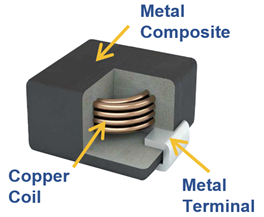
Figure 2. KEMET developed metal‑composite power inductors for small size and low energy loss. (https://ec.kemet.com/metcom/)
Kemet’s component materials ease smart‑meter deployment and reduce energy use. METCOM metal‑composite inductors offer low DC resistance and minimal high‑frequency loss, while polymer capacitors combine tantalum’s volumetric efficiency with low ESR and durability. Kemet’s HV supercapacitors power battery‑driven smart meters, such as gas or water meters that lack mains connections.
Smart homes for good
Smart technologies hold promise for improved care of the elderly and vulnerable, enhancing assisted living quality. Although humanoid helpers that do dishes and answer doors are still distant, affordable robotic assistants could enable seniors to live independently for longer by handling tasks that require strength or dexterity.
A more social connection with smart home tech can also help. As home digital assistants become routine, AI companions may alleviate isolation and support those between visits from carers or relatives.
Many people worldwide still lack reliable electricity for basic lighting. The UN estimates 1.3 B individuals rely on candles, wood fires, or kerosene lamps, risking eye health and air quality. Coupled with local solar micro‑generators, smart technologies can improve lighting efficiency, extending the reach of available energy.
Conclusion
A smart home should care for its occupants beyond what they can manage alone. While the concept remains unfamiliar to many, vendors can drive adoption by offering flexible, scalable solutions that demonstrate clear value. As the next generation of homeowners seeks energy efficiency, lower operating costs, and heightened comfort, the true potential of smart homes will unfold.
>> This article was originally published on our sister site, EE Times Europe.
Internet of Things Technology
- How Smart Home Technology Transforms Everyday Living
- How Smart Cities Drive Socio‑Economic Growth: Part One
- Why Some Smart‑Home Companies Disable Devices: The Business and Customer Implications
- UK Smart Meters: Why Consumer Trust Remains Low
- AI and Viztech: A New Era of Safer Online Content
- Smart Manufacturing Explained: Benefits & Impact for Modern Industry
- Enhancing Smart Home Connectivity: Building Truly Intelligent and Autonomous Devices
- Verizon & Honeywell Unite to Power Smart Energy Meters with LTE Connectivity
- Unlocking Industry 4.0: Why Your Workforce Is the Key to Success
- Industry 4.0 & IoT: The Driving Forces Behind Advanced Industrial Transformation