



How Robot Personal Assistants Are Becoming Everyday Reality
I recently attended MWC Shanghai, where robots dominated the floor—massive, cutting‑edge machines that companies showcased in hopes of securing a foothold in a rapidly expanding market. One standout was Tug, a mobile robot nurse that looks more like a wheeled box than a sci‑fi android. Yet it carries all the hallmarks of modern mobile robotics: precise navigation, obstacle avoidance, the ability to halt when someone steps in front of it, and even to request an elevator to change floors.
Designated to deliver medications and meals to patients, Tug is already active in 37 U.S. Veterans Affairs hospitals. Imagine the relief this brings to overworked nursing staff. Beyond healthcare, similar assistants are being deployed in elder‑care homes, educational settings, restaurants, and hotels. Following the success of smart speakers, the next wave of personal assistants is turning into tangible, everyday robots—Amazon, for instance, operates more than 100 000 robots in its warehouses and is poised to bring home‑robot solutions to consumers.
While the idea feels like science fiction, the reality is that home assistant robots are shipping today. The challenges, however, are substantial and resemble autonomous‑driving problems more than they differ. Key issues include navigation within dynamic indoor environments, real‑time obstacle avoidance, and the ability to adapt to temporary changes—think a sudden IV stand or a dropped package. Unlike cars, where clear lanes and traffic rules simplify navigation, indoor robots must continuously map and remap their surroundings. Moreover, a natural‑language interface isn’t a luxury; it’s essential for clear communication in settings where mis‑delivery can have serious consequences.
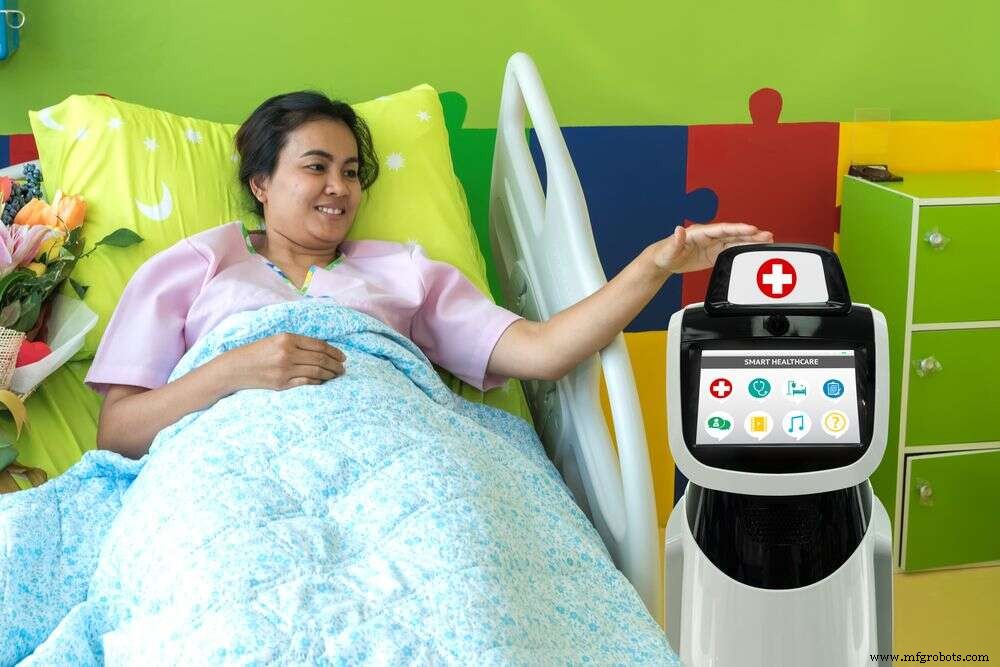
Robot health assistant (Source: CEVA/Shutterstock)
Gartner recently identified the top ten AI and sensing capabilities that will underpin future robot assistants:
- Computer vision: scene analysis and object recognition.
- Biometric recognition and authentication: ensuring only authorized users can issue commands.
- Conversational interface: speech recognition coupled with natural‑language processing.
- Acoustic scene analysis: detecting distinctive sounds such as a dog bark or a glass breaking.
- Location sensing: continuously determining position and proximity to people or objects.
- Autonomous movement: navigating to a target location without colliding with obstacles.
- Edge‑side AI: executing core functions locally rather than relying solely on the cloud.
Most developers start by prototyping on a multicore GPU platform, which offers a convenient and powerful solution for initial testing. However, as production volumes grow, the high cost, significant power draw, and lack of differentiation inherent to off‑the‑shelf GPUs become limiting factors. This is where custom ASIC or DSP solutions come into play, delivering the same intelligence at lower cost and energy consumption.
DSPs are well‑known for their performance‑per‑watt advantage over GPUs in machine‑learning workloads, thanks to efficient fixed‑point operations and flexible quantization. In volume‑sensitive edge applications, a dedicated DSP often outperforms a generic GPU in both cost and efficiency.
So, can a DSP match the capabilities of a GPU? For many core tasks, yes. Computer‑vision workloads—such as positioning, tracking, object recognition, and gesture detection—can be handled by embedded DSP platforms today. Autonomous navigation that supports local retraining, without the need to constantly query the cloud, also leverages the same recognition capabilities found on GPUs.
Voice recognition, authentication, and acoustic scene analysis can similarly be offloaded to an embedded solution. The pipeline—from microphone capture and direction finding to basic word spotting and even natural‑language understanding—can be processed locally for many applications. In scenarios that require only a limited vocabulary or the detection of non‑verbal cues, the entire process may run entirely on the edge, eliminating the need for cloud resources altogether. Emerging research suggests that even more sophisticated NLP tasks could be feasible on‑device in the near future.
Today’s ecosystem offers a growing suite of edge‑AI platforms that streamline front‑end voice processing, deep‑learning inference, and IoT integration. By leveraging these solutions, developers can accelerate the deployment of ubiquitous robot personal assistants.
 Moshe Sheier is Director of Strategic Marketing, CEVA, where he oversees corporate development and strategic partnerships for CEVA’s core target markets and future growth areas. Moshe is engaged with leading SW and IP companies to bring innovative DSP-based solutions to the market. In his spare time, Moshe rides mountain bikes and practices Aikido.
Internet of Things Technology
- Industrial Robots: Design, Manufacturing, and Future Trends
- Hand-Guided Collaborative Robots: Safety Standards Explained
- Robotic Healthcare Assistants: 5 Essential Insights
- Enhancing Robot Intelligence and Safety in Manufacturing
- Rapidly Deployable Collaborative Robots for Enhanced Productivity
- Collaborative Robots: Revolutionizing Human-Machine Interaction
- Modern Industrial Robots: Transforming Production & Quality
- Industrial Robots on the Rise: Advancing Automation Across Manufacturing
- Revolutionizing Automotive Production with Advanced Robot Vision
- Key Facts About Industrial Robots: From Unimate to Modern Applications