



Industrial Robots: Design, Manufacturing, and Future Trends
Background
Industrial robots are precision mechanical systems engineered to replicate human motions with unparalleled consistency. They are deployed when safety, strength, accuracy, or continuous operation surpass what a human can achieve. Most units are fixed, though mobile robots transport materials and supplies across the shop floor.
Unlike the humanoid figures seen in science fiction, contemporary robots perform basic tasks—picking, placing, welding, or painting—with a level of repeatability that humans find difficult to match. Human operators adjust posture and grip on the fly; a robot must be designed and programmed so that position, reach, weight, and grasp remain strictly controlled to avoid dropping or missing objects. Once a technician “teaches” the machine a motion, it can execute that motion thousands of times with an accuracy of a few thousandths of an inch, operating 24/7 without fatigue.
These capabilities have driven rapid adoption in manufacturing, particularly for repetitive painting, welding, and pick‑and‑place operations that lift and position products into assembly lines or packaging stations.
History
Robotics—a branch of automation—draws its name from the Czech word robota, meaning compulsory labor. The term first appeared in 1921 in Karel Čapek’s play R.U.R. (Rossum’s Universal Robots), which imagined humanoid machines that rebelled against their creators.
Practical robots emerged after computers became available. In the late 1960s, Stanford Research Institute built SHAKEY, a machine that could move and stack blocks using a camera and computer. In the mid‑1970s, General Motors, through MIT, commissioned Victor Scheinman’s PUMA (Programmable Universal Manipulator for Assembly), marking the first industrial robot to enter U.S. production lines. The Unimate, installed in a GM plant in Trenton, New Jersey in 1961, was the first pick‑and‑place robot to remove hot metal parts from a die‑casting machine.
Raw Materials
Robots are constructed from common industrial metals—steel, cast iron, and aluminum—for their strength and machinability. Mobile units often use rubber tires for quiet, reliable traction. Specialized robots for clean rooms, space, or high‑tech applications may incorporate titanium or carbon‑fiber composites for weight savings and corrosion resistance.
The mechanical structure houses hydraulic cylinders or pressurized air, with silicone, rubber, and braided stainless‑steel hoses routing fluid to control valves. Protective covers—flexible neoprene shields or collapsible bellows—shield exposed parts from paint spray, sparks, and other hazards. Electronics, including electric motors, linear drives, and the controller (“brain”), are sourced from automation suppliers and housed in steel cabinets near or on the robot.
The Manufacturing Process
Design
- Every robot starts with a design phase that incorporates job requirements, speed, environment, hazardous materials, reach, travel path, process variables, human interaction, controller capability, and potential failure modes. Most manufacturers begin with a standard platform and then customize it to meet application needs.
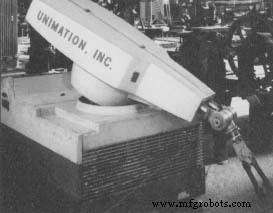 The first robot installed in American industry, Unimate, removed hot metal parts from a die‑casting machine at a GM plant in Trenton, New Jersey, in 1961. (From the Henry Ford Museum & Greenfield Village.)
Robots are only as effective as the people who design, program, and maintain them. In the 1980s, GM invested heavily in robotics but fell short on systems integration and workforce training, leading to costly failures and operational chaos.
Fabrication
- Once designed, the base, arms, column, and supports are fabricated. The base—often cast or welded—provides a heavy foundation to prevent tipping. Components that mate with the rest of the robot are machined to tight tolerances to ensure proper fit and function.
Assembly
Industrial robots can contain up to 2,000 individual parts. Assembly teams begin with the base and progressively attach motors, bearings, hydraulics, wiring, and controllers until the robot is ready for testing.
Mobile robots first receive traction motors, batteries, axles, wheels, and tires. Stationary units are temporarily bolted to the floor. Sub‑assemblies of columns and arms, equipped with drive motors, are then integrated onto the base. A ring gear drives the base’s turning motion, mating with a column gear. Thrust bearings support the weight, while a magnetic scale provides electronic position feedback to the controller.
Link
- The link acts as an elbow, connecting the arm to the base. Stabilizer supports and bearing mounts ensure controlled motion along a predetermined path. Each bearing is pre‑lubricated or fitted with a lubrication line, and the link houses a position sensor that sends data to the controller.
Arm
- The arm extends the robot’s reach and supports the wrist. It contains drive shafts operated by motors or hydraulic cylinders. Three motors—or a hybrid arrangement—connect to the drive shafts, and large bearings and a pivot pin allow the arm and link joint to bear the full load of the wrist.
Wrist
- The wrist is the core of the robot’s manipulation capability, replicating human wrist motion to orient tools—paint guns, welders, or grippers—in precise positions. Many wrists include load‑sensing electronics that detect obstructions or excessive loads, as well as additional position sensors and tool‑control electronics.
Wiring to the Controller
- After mechanical assembly, wiring and plumbing are completed. All motors, sensors, and electrical components receive power and data lines. Hydraulic and pneumatic hoses supply fluid pressure to cylinders, controlled from valves in the base. Wires and hoses typically route to a controller cabinet—mounted on the base for mobile units or a few feet away for stationary units via an umbilical cord. Protective guards or shields are added to cover arms and columns against sparks, paint spray, or other hazards.
Installation
Installation takes place at the customer’s facility. Stationary robots are bolted to the floor; mobile robots follow guide wires or, increasingly, laser‑based navigation systems. Fences are erected around mobile units to prevent accidental human contact. After installation, manufacturers provide operation and maintenance training to the client’s staff.
Quality Control
Testing comprises functional accuracy checks and a burn‑in period. During functional testing, a program commands the robot through a series of motions, recording data to identify and correct any discrepancies. The robot then runs continuously for several hours—burn‑in—to detect long‑term accuracy loss and to bring electronics and hydraulics up to operating temperature. Offset values are calibrated during this phase to compensate for temperature variations and ensure optimal performance.
The Future
Robotics remains one of the fastest‑growing segments of the industrial machine market. Rapid advances in computing and artificial intelligence enable newer models to learn and adapt autonomously. Japanese manufacturers lead in this innovation, integrating AI-driven control systems that allow robots to adjust their operations on the fly.
Improvements in camera technology and computer vision will expand robotics into healthcare, food service, and other domains where robots interact more closely with people, further broadening their impact beyond traditional manufacturing floors.
Manufacturing process
- Choosing the Best Industrial Paint Robots for Optimal Quality and Efficiency
- Why Industrial Robot Integration Is Stalled—and How to Accelerate It
- Maximize Robot Longevity: Expert Preventative Maintenance Strategies
- How Industrial Robots Revolutionize Automotive Manufacturing
- Revolutionizing Manufacturing: 21st Century Industrial Robotics
- Modern Industrial Robots: Transforming Production & Quality
- Key Specs for Choosing the Right Industrial Robot
- Unlocking Industrial Robot Potential: Efficiency, Precision, and Versatility
- Key Facts About Industrial Robots: From Unimate to Modern Applications
- Why Six-Axis Robots Boost Industrial Automation