



Revolutionizing Manufacturing: 21st Century Industrial Robotics
“Let us choose to let machines be machines, and let humans be humans. Let us choose to simply use our machines, and more importantly, to love one another.” Lee, Kai-Fu (AI Superpowers: China, Silicon Valley, and the New World Order)
Robots have been around for over 60 years. The world’s first industrial robot was brought to life in the United States in 1959 by Unimation, a venture company specializing in robot development. Their first product, the Unimate, was introduced in a General Motors Corporation die-casting factory in Trenton, New Jersey.
The automobile industry was the first one to adopt the Unimate. Each robot could do the job of ten experienced operators, including welders, working 24/7. Assembling each car required an average of 4,000 parts to be spot welded, so there were expectations that if they could automate this process, it would significantly increase productivity.
In 1968, Kawasaki manufactured the first industrial robot in Japan, based on the original Unimation design. The “Kawasaki-Unimate 2000” was completed in 1969. While many Japanese manufacturers already had machines in their factories specially designed for specific tasks, the Kawasaki Unimate could be programmed for many different operations, including the dangerous ones facing severe labor shortages.
While the first units had a price tag of ¥12,000,000 in 1970 (approx. ¥ 80 m. or $ 386,000 adjusted for inflation), Japanese car manufacturers realized that those robots could give them a significant market lead.
Later, Kawasaki modified the original design and introduced the “2630-type”, an upgraded Unimate with six degrees of freedom instead of the previous five, and a payload increased from 12 kg to 25 kg.
The Unimate was not a smart robot. It could only repeat the tasks it was programmed for. It had no connectivity, and programming had to be done manually. But it was the beginning of a revolution that will touch almost every manufacturing industry.
Today, robots are making more robots
The number of industrial robots has grown about 11% a year since 2014, to a total of 2.7 million industrial robots in use worldwide.
The International Federation of Robotics (IFR) recently published a report on industrial robot adoption. “Japan is the world´s predominant robot manufacturing country – where even robots assemble robots: 47% of the global robot production happens in Japan. […] Germany is by far the largest robot market in Europe with 38% of Europe’s industrial robots operating in factories here. Robot density in the German automotive industry is among the highest in the world.”
The world’s top 10 most automated countries are Singapore (1), South Korea (2), Japan (3), Germany (4), Sweden (5), Denmark (6), Hong Kong (7), Chinese Taipei (8), USA (9) and Belgium, and Luxembourg (10).
Initially designed for manufacturing, industrial robots are now taking on logistics
“The main difference between automation today and what we had 50 or 60 years ago is that we added software,” says Mick Mountz, who founded Kiva Systems in 2003. Amazon bought Kiva in 2012, and it became Amazon Robotics.
Kiva is responsible for developing Amazon’s warehouse robot, the ones that look like they could vacuum your floors when they get home from their day shift.
Kiva Systems developed a way to use robots to move the racks, or “pods,” on which the products are stored, instead of having them search out and move the individual products themselves. Storage pods can hold hundreds of different products, but each pod’s size and shape are the same.
The key to the robotic warehouse’s success is not the robot but the brains behind the system. The system is designed to optimize robot operation and workstation load. When a worker is not packing an order, he has time to restock shelves or conduct an inventory check of a pod brought in by a robot.
Today, almost all Amazon logistic centers operate with fleets of Kiva robots. The system has become the industry standard, with companies such as Alibaba in China using clones of the American pods for their operations.
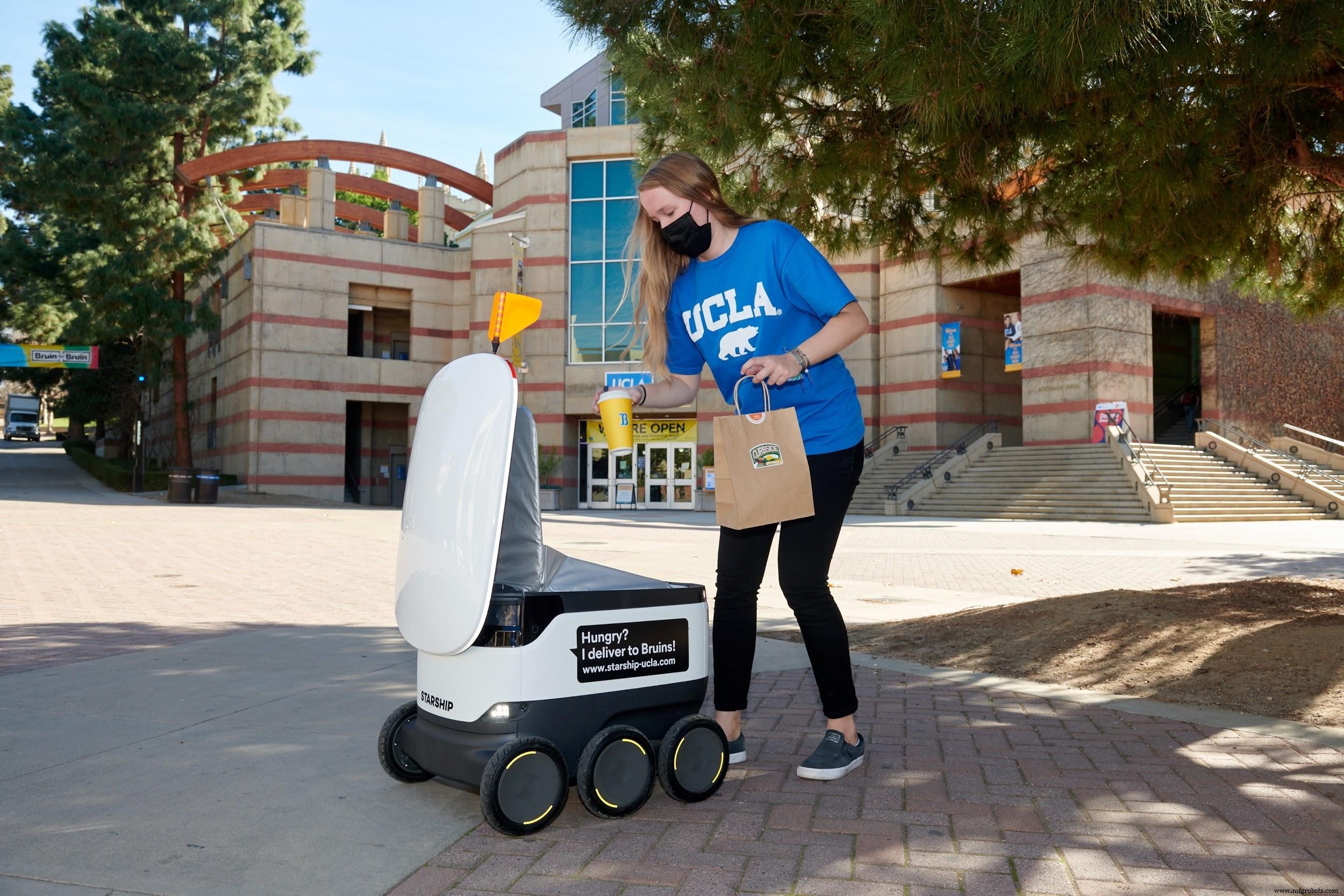
Also, in many cities and campuses, a new generation of robots are now in use for last-mile delivery. Starship, an Estonian startup with operations in Europe and the US, builds robots that can carry items within a 4-mile (6km) radius. The robot weighs around 40-45 pounds and can carry up to 22 pounds. It uses a sensor suite for navigation and situational awareness, a mixture of Computer Vision and GPS to pinpoint its exact location to the nearest inch.
An intelligent workforce, robots make redundant millions of jobs
Millions of jobs are predicted to be eliminated as a result of the use of robots and automation. The only way to minimize the impact of robotics on jobs is to encourage continuous training for existing factory workers to develop digital skills in demand.
In some cases, humans are taking back some of the robotic jobs. Once a pioneer of automated manufacturing, Toyota has been replacing some robots with human workers at assembly plants across Japan, developing new skills, improving manufacturing processes, and ultimately building better cars.
Also, robots are bringing back some jobs from overseas. In 2017, Kent International, maker of Bicycle Corporation of America–branded bikes, moved back 140 jobs from China to Manning, South Carolina. CEO Arnold Kamler said he planned to add forty jobs per year, a considerable growth in a small town. “A lot of people have that misconception that automation decreases jobs,” a production manager on the line said. “It’s just a different type of job, a more skilled job. Without the robots, the human jobs wouldn’t exist.”
“The problem is that analog jobs aren’t sexy in the way tech jobs are to politicians, investors and philanthropists, and the media,” says David Sax, author of “The Revenge of Analog.”
Industrial Technology
- Industrial Robots: Design, Manufacturing, and Future Trends
- Maximize Robot Longevity: Expert Preventative Maintenance Strategies
- How Industrial Robots Revolutionize Automotive Manufacturing
- Revolutionizing Automotive Production with Advanced Robotics
- January 2022 Robotics Highlights: Industry Breakthroughs & Innovations
- Modern Industrial Robots: Transforming Production & Quality
- Fanuc Robotics: Leading Innovations in Industrial Automation
- KUKA Robotics: Pioneering Innovation in Industrial Automation
- Choosing Industrial Robots: A Step-by-Step Guide to Seamless Automation
- Why Six-Axis Robots Boost Industrial Automation