



How to Overcome Integration, Safety, and Security Hurdles in Autonomous Systems
 \n\n
\n\n
Changes in the way we travel and deliver goods are already underway. Unmanned Aerial Vehicles (UAVs) and drones have become commonplace; in 2017 alone, millions of drones were shipped, and the U.S. now hosts over 770,000 registered aircraft. Registration is mandatory for any drone weighing more than 0.55 lb. Beyond military use, UAVs are reshaping logistics, surveillance, and even consumer applications.
\n\nSelf‑driving cars are on the horizon, but the future goes further. Vahana, an aerospace company, achieved the first flight of a single‑person vertical‑take‑off and landing aircraft, proving that flying cars are no longer science fiction. Imagine a society where driver’s licences are obsolete and transportation is accessed through subscription services rather than personal ownership.
\n\nNew technology brings new challenges. Making autonomous systems safe and secure requires addressing a range of requirements that differ between UAVs, autonomous cars, and small hobbyist drones. Military UAVs in desert war zones face constraints that civilian aircraft simply do not.
\n\nWhy Sensors and Data Matter
\n\n- \n
- Every additional sensor—LiDAR, cameras, lane‑finding cameras—generates vast amounts of data. For example, a single LiDAR unit can produce gigabytes of raw information per second. This data must reach the right processing node instantly to enable timely decisions. \n
- Future operations will depend on external or system‑to‑system links. Vehicle‑to‑Vehicle (V2V) communication is essential for safety and traffic optimisation. \n
- High‑performance onboard computers allow vehicles to analyse sensor input locally. An autonomous car must decide about an obstacle in real time without waiting for cloud latency, which is why artificial intelligence is becoming a core component of autonomous systems. \n
Connectivity Is the Backbone
\n\nEvery autonomous platform relies on robust communication between its components. The key is to deliver the right data to the right place at the right time. RTI Connext® is a real‑time connectivity framework built on the Data Distribution Service (DDS), an OMG standard that offers scalable, dependable, high‑performance data exchange through a publish‑subscribe model.
\n\nDDS abstracts addressing, marshalling, and de‑marshalling so publishers and subscribers can operate across heterogeneous platforms. It also supports advanced extensions beyond the basic model. By treating data as the interface between components, DDS decouples applications in a way that aligns perfectly with autonomous system architectures.
\n\nIn a typical autonomous architecture, all components connect to a virtual data bus. New elements can be added dynamically, and the bus can be partitioned into local and cloud layers.
\n\n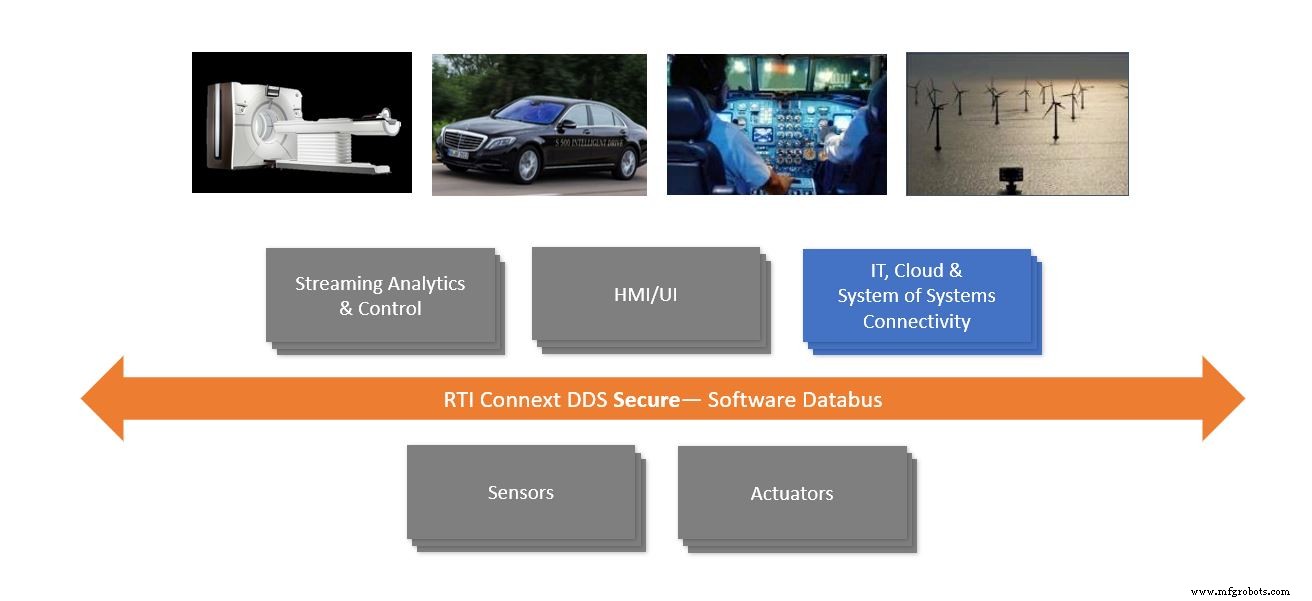
Hierarchical data buses are common. The following diagram illustrates a multi‑level bus managed by RTI Connext.
\n\n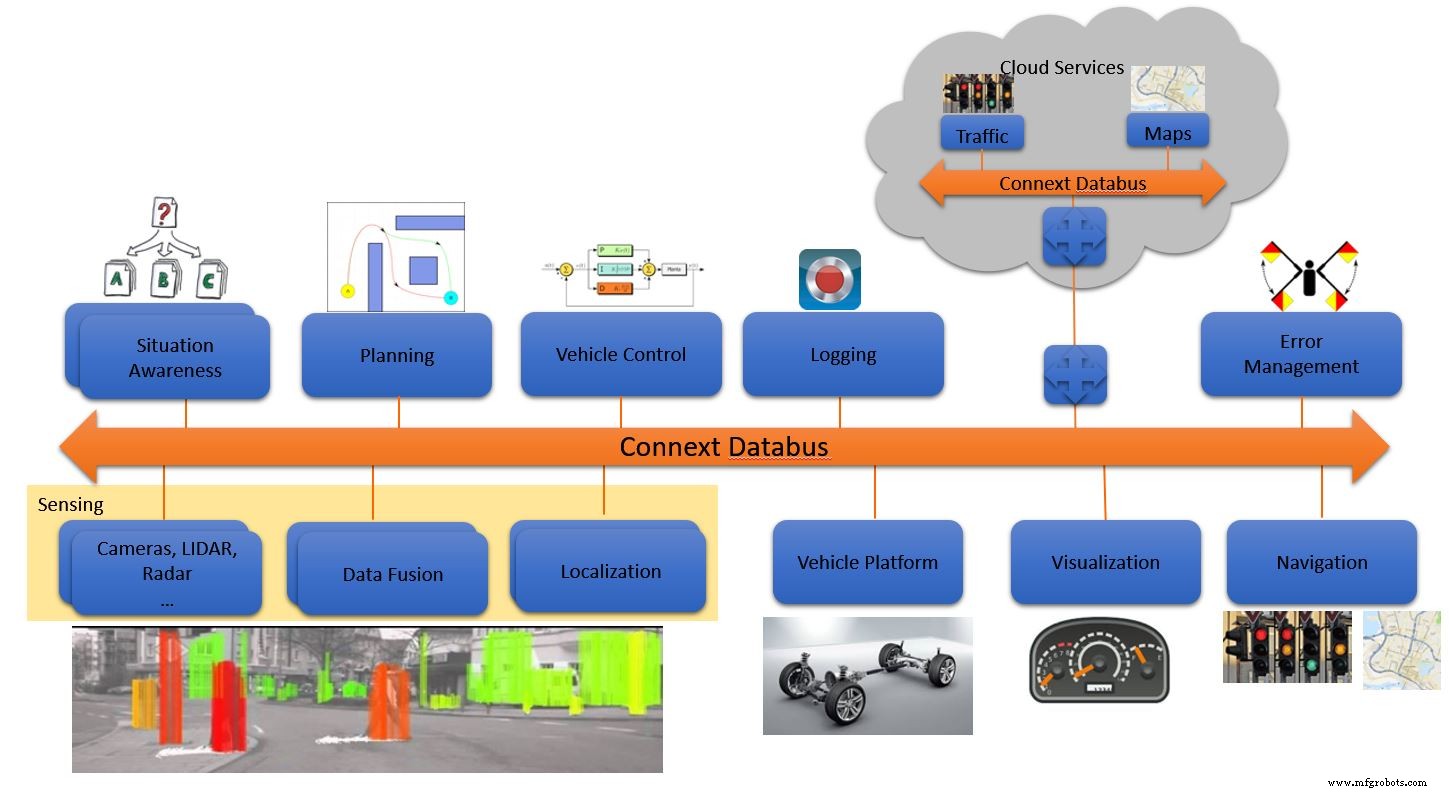
Safety Through Certification
\n\nSoftware drives most of an autonomous system’s behaviour, yet flawless code is unrealistic. Rigorous testing is required. In aviation, the Federal Aviation Administration uses DO‑178 to certify software reliability. Meeting DO‑178 can cost approximately $100 per line of code and demands extensive documentation.
\n\nUsing pre‑certified components—such as RTI’s safety‑certifiable DDS databus—reduces both cost and time‑to‑market. RTI was the first vendor to release a safety‑critical databus built on DDS, providing the foundation for compliant autonomous solutions.
\n\nSecurity in an Open World
\n\nTraditional vehicles had limited external connectivity, making them difficult to hack. Autonomous systems, however, rely on continuous data exchange, opening new attack vectors. A compromised link could allow a malicious actor to tamper with braking or steering commands.
\n\nStandard TLS protects the channel, but if an attacker gains access to that channel, they obtain all transmitted data. A more granular approach is needed. The DDS Security Standard offers distributed access control: each participant is granted only the permissions it requires, preventing a single point of failure. Data on the bus can be cryptographically authenticated, and any message that fails policy checks is discarded.
\n\nRTI Connext DDS Secure implements the OMG DDS Security specification with built‑in plugins for authentication, access control, cryptography, and logging. Security is configured outside the application code, eliminating the need to rewrite logic for protection.
\n\nBuilding Tomorrow’s Autonomous Systems Today
\n\nThe landscape of mobility is evolving rapidly. With the tools and standards provided by RTI Connext, developers can confidently build the autonomous systems of the future—secure, safe, and fully integrated.
\n\nThis blog post reflects my recent presentation, “Meeting Integration, Safety and Security Challenges in Autonomous Systems Software,” at AUVSI Xponential.
\n\nLearn More:
\n\n- \n
- Autonomous Vehicle Production \n
- What is DDS? \n
- Connext DDS Pro \n
- Connext DDS Micro \n
- Connext DDS Cert \n
Internet of Things Technology
- How IoT Is Mitigating Security Risks in the Oil & Gas Industry
- Strengthening IIoT Asset Tracking: Proven Security Practices
- Evaluating IT Risk: Strategies, Frameworks, and Best Practices for Business Protection
- Navigating Security Challenges in Next‑Generation 5G and IPv6 Networks
- Data Integration in 2024 and Beyond: Trends Shaping the Future
- IIoT Trends & Challenges: Data Overload, Manufacturing Shifts, and the Skills Gap
- Embedded Systems & System Integration: Modern Architecture & Connectivity
- Overcome IoT Data ETL Challenges to Boost ROI
- Enhancing Industrial Performance: Overcoming Monitoring Challenges with IoT & Analytics
- Overcoming Edge Computing Challenges: Proven Strategies for Real-Time Data Processing