



Could IoT Innovation Halt the 2050 Global Food Crisis?
The United Nations warns that, unless action is taken, the world will hit a tipping point for food security by 2050 due to escalating waste and inefficiencies across the supply chain. In Ireland, Jeremy Cowan reports on companies that are partnering to turn the tide.
Jason Kay, Chief Commercial Officer of IMS Evolve, a specialist in IoT solutions for cold‑chain logistics, cautions that the crisis will not be confined to developing nations. Even mature economies will face shortages within a generation if the status quo continues.
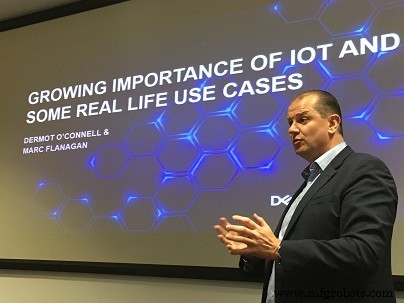
Last Thursday, Dell EMC hosted a select group of European analysts and journalists at its IoT Lab in Limerick, Ireland, showcasing how its edge‑computing technology is transforming sectors from transport and agriculture to banking, wind energy, and smart cities.
The cold‑chain industry—responsible for delivering temperature‑controlled food—faces a series of obstacles: outdated infrastructure, underutilised data, and limited visibility into asset conditions. These issues lead to significant waste and quality loss.
For context, the UN estimates that the world currently produces enough food to feed 12 billion people, yet only 6 billion can be adequately supplied. “We must make cold‑chain data actionable, and that often means processing it at the edge rather than relying solely on cloud solutions,” says Kay.
Where is the Inefficiency?
Intense competition and price compression have not alleviated inefficiencies. According to Kay, the supply chain is built on margins of error across retail, distribution, production, and storage. The industry clamours for automation and digitisation, but investment hesitancy—paralleling concerns that Amazon faced when acquiring Whole Foods—has stifled progress.
IMS Evolve addresses this by embedding processing and memory capacity directly where it is needed. By moving data processing to the network edge, close to sensors, manufacturers and processors can maintain ingredient consistency, while integrating data from every stage to optimise quality, cost, and profitability. The goal is a unified view of the cold chain that cuts waste and elevates shelf‑stock quality.
What’s Holding Up the Improvements?
Market inertia stems from the high cost of establishing relationships within the food sector. Kay cites Chipotle as an example: “If a single incident jeopardises public health, market capitalisation can plummet overnight. IoT enables us to democratise the food chain—predictive maintenance, digital twins, and quality monitoring—all without manual intervention.”
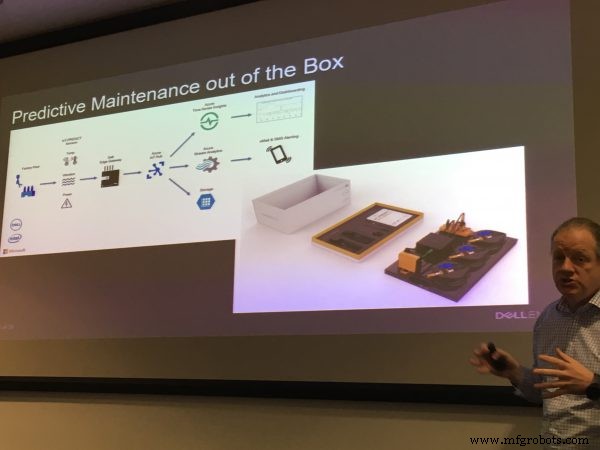
For edge‑based analytics, Dell EMC’s Edge Gateway 5000 offers rugged construction and flexible connectivity—including cellular, Zigbee, and Bluetooth—ensuring reliable data capture even when operators cannot monitor screens in real time.
Clients such as Tesco supermarkets have reported a 49 % reduction in stock loss, a 30 % drop in customer complaints, and a 40 % decrease in reactive maintenance calls thanks to IMS Evolve’s platform.
Historically, retailers struggled to pinpoint issues and locations, leaving them risk‑averse. Yet the integration of comprehensive monitoring systems has reshaped the landscape. For instance, Tesco cut its UK call‑centre workforce from 90 to just a handful of remote analysts in Bangalore.
When asked whether these IoT solutions could extend to pharmaceuticals or medical supplies, Kay emphasised that the technology is already trusted by food clients: “We provide a reliable data platform that can be adapted across industries where safety and traceability are paramount.”
For further insight into Dell EMC’s IoT strategy, see Dell EMC finally finds its mojo in IoT with edge computing for security, cold chain and transport.
Internet of Things Technology
- How Design Thinking Unlocks IoT Monetization for Manufacturers
- IoT-Driven Supply Chain Management: Real-Time Asset Tracking & Fleet Optimization
- Revolutionizing Logistics: How IoT Drives Supply Chain Efficiency
- How IoT Drives Climate Action: Turning Connectivity into Carbon Savings
- GE Digital’s Industrial IoT Revival: Partnerships, Edge Innovation, and Closing the Transformation Gap
- Harnessing IoT to Protect the Planet: Proven Success Stories
- Zest Labs Leverages IoT and Blockchain to Revolutionize Fresh Food Supply Chains
- How Food Businesses Can Leverage IoT: 4 Proven Strategies
- Leveraging IoT to Empower Heavy Equipment Operators: Boost Efficiency & Safety
- Harnessing IoT for Smarter, More Efficient Supply Chain Management