



Additive Manufacturing’s Next Chapter: Empowering Sustainable Choices
For three decades, additive manufacturing (AM) has evolved from a niche curiosity to a transformative force across industries. The COVID‑19 pandemic proved its value by enabling rapid, local production of critical supplies when global supply chains faltered. As we enter the fourth decade of 3D printing, the question is not just what we can make, but how we can make it sustainably.
Making Things Differently to Make a Difference
At Materialise, we believe that AM’s true value lies in empowering people to choose better. In this new era, there are two fundamental decisions: 1) Challenge the status quo by doing things differently, and 2) Commit to sustainability.
The pandemic highlighted the fragility of centralized mass‑manufacturing. Decentralized AM proved it could deliver essential medical devices and everyday goods faster, cheaper, and locally. Beyond speed, AM frees designers from traditional constraints, allowing them to focus on solving problems rather than meeting production limits.
What Can We Do to Make AM More Sustainable?
Sustainability is the second critical choice. AM is often touted as a greener alternative because it is additive and generates less waste. A Materialise survey found that 85% of manufacturers consider 3D printing more sustainable than conventional methods. However, a recent Life‑Cycle Analysis (LCA) by BASF and Materialise, evaluating the production of one million pairs of midsoles, showed that for large, identical runs, traditional manufacturing currently has a lower climate impact than 3D printing.
This finding underscores the urgency of radical innovation rather than incremental tweaks. By reimagining designs and embracing new technologies, companies can create opportunities where AM truly excels in sustainability.
Empowering the Choice for Sustainability
Materialise’s Bluesint PA12 exemplifies how we can enhance AM’s environmental performance. This laser sintering powder allows up to 100% re‑used material, dramatically boosting resource efficiency. In 2021 alone, several Laser Sintering machines will run on Bluesint PA12, targeting the reuse of more than five tons of powder that would otherwise be waste.
Planting the Seeds of Radical Innovation
Looking ahead, a post‑COVID world offers a unique window to build a healthier, more sustainable future. By integrating AM into this broader vision, we can accelerate the shift toward responsible manufacturing and unlock new possibilities for design, materials, and supply chains.
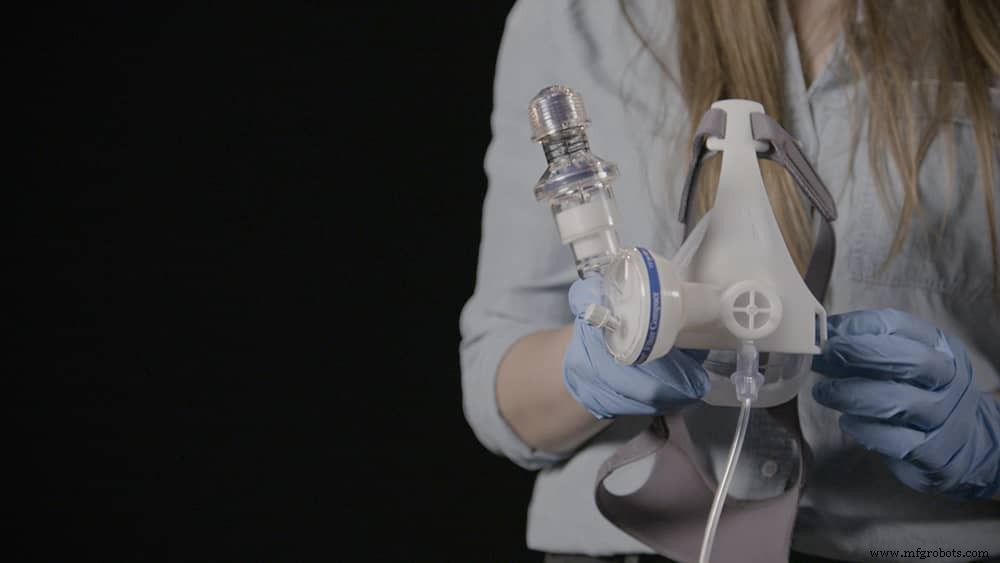
The Passive NIP is a Materialise solution that serves as a viable alternative to ventilators.
3D printing
- Introducing the Certified Machinery Lubrication Engineer (MLE) – A New Industry Benchmark
- Schaeffler Leads Innovation in Industrial-Scale Hydrogen Production
- IoT: Driving the High Street’s Digital Renaissance
- Edge Computing: Unlocking Real-Time Data, Boosting Efficiency, and Driving New Revenue
- Rethinking Smart Manufacturing for the New Normal: Data‑Driven Strategies for Resilience
- Master E3.DatabaseEditor L1 – Build Your Own Optimized E3.series Database
- Transforming Supply Chains: Customer Experience as the New Competitive Edge
- Building Resilient Supply Chains for Tomorrow’s Challenges
- Elisabeth Brinton Explains How Microsoft’s Cloud for Sustainability Drives Manufacturing Efficiency
- Choosing New vs. Used Machinery: A Smart Investment Guide