



14 Insightful Quotes to Transform Your Understanding of Intelligent Automation
This is a guest post by Siyong Liu, general manager at CFB Bots. CFB Bots is an official UiPath partner.
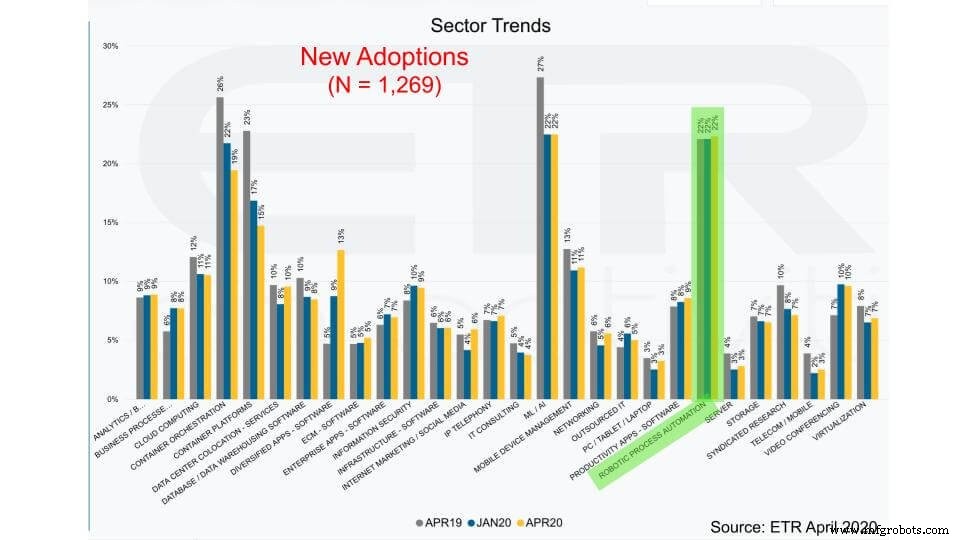
According to a Gartner press release, robotic process automation (RPA) was the fastest growing segment of the global enterprise software market in 2018. More recently, research by Dave Vellante, co-CEO of SiliconANGLE Media, highlighted RPA as the technology most commonly adopted by enterprises across the survey period of April 2019 to 2020, alongside machine learning (ML) and artificial intelligence (AI).
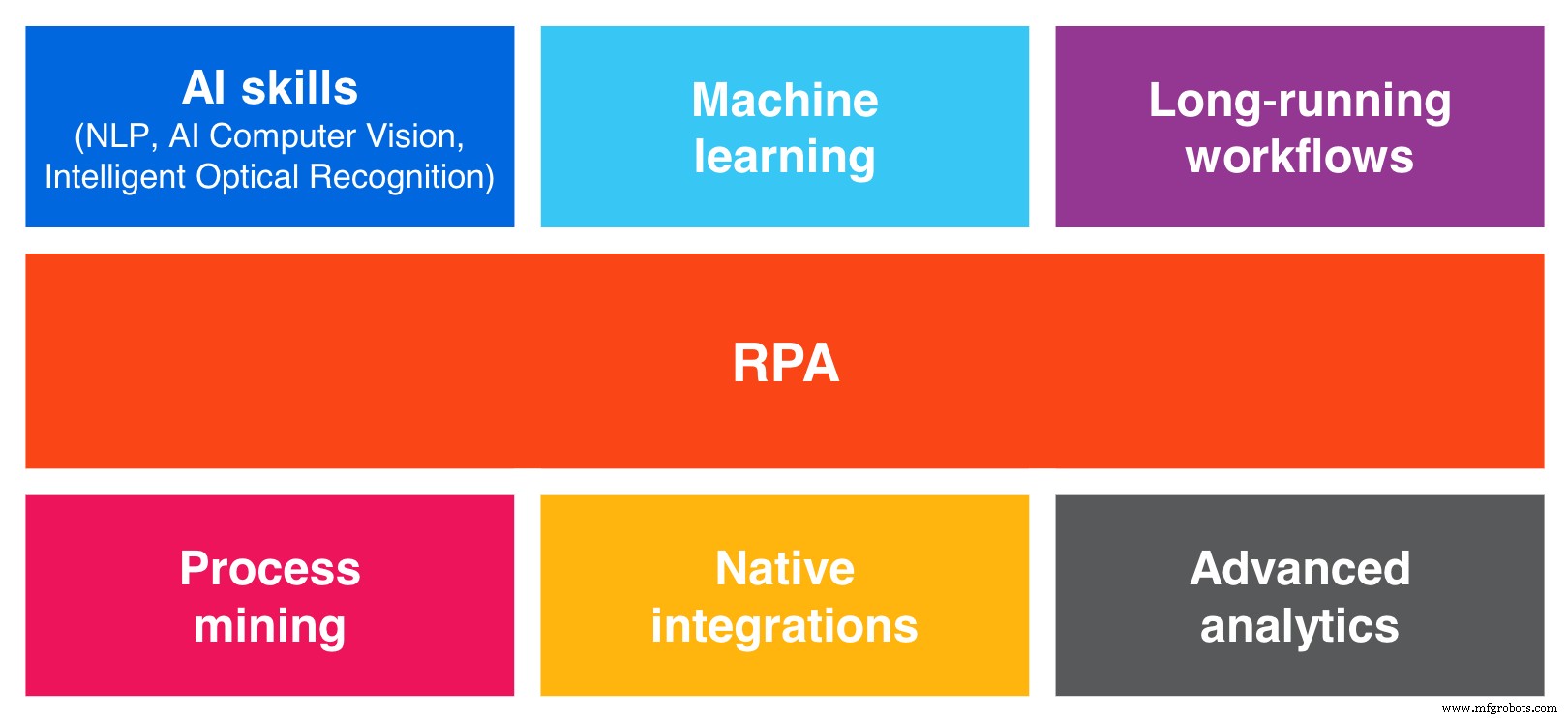
Previously, the combination of RPA, ML, and AI was collectively known as intelligent process automation (IPA), though more recently the combination of automation technologies is being referred to as hyperautomation (represented in the graphic below).
Yet, for a technology that has generated so much hype and investment dollars, the results have been mixed for organizations. For example, the 2019 Deloitte Global RPA Survey found that scaling RPA remains a major hurdle and only 3% of surveyed organizations had scaled beyond 50 software robots. And a 2017 EY study found that 30-50% of initial RPA projects fail.
Notwithstanding these hiccups, our point of view remains that we are entering an ‘automation first’ era led by citizen developers. Back at the dawn of the personal computing era, Bill Gates famously declared his ambition to put a desktop computer in every home and office. Similarly, at CFB Bots, we share the UiPath vision of a world where there is 'a robot for every person.'
To help you in your own RPA journey, we have put together the top 14 quotes that will change the way you think about automation. Happy reading!
On process selection
Many marketers have promoted RPA software as a tool for achieving the quick wins, i.e. automating existing processes "as is." While this approach might work, based on our experience, optimizing the processes prior to automation usually leads to superior outcomes.
This typically involves reengineering business process, harmonizing processes across business units and geographies, process simplification and the like, as well as the accompanying change management. Remember, humans are creatures of habit! We enjoy routines and predictability and many a times, a process is performed in a certain manner purely out of habit, even though circumstances might have changed.
Automating the right processes enables organizations to thrive; automating the wrong processes only speeds up their demise.
As enterprises rush to digitize their processes and automate them, many are confounded by what seems to be a deceptively simple question – which are the right processes for RPA? There is no doubt that this is an extremely important question to answer.
Related read: 5 Factors in Choosing Which Processes to Automate
According to SSON, the poor choice of process for initial pilot (e.g. too complex, too many exception paths, etc.) is the leading root cause for failure to meet customers’ expectations.
On change management
Change management—otherwise known as the elephant in the RPA room.
If an employee’s job mainly involves performing mundane and menial tasks, it is natural that he or she views RPA with a sense of trepidation or automation anxiety. The corollary is that there will be a “conflict of interest” when they are asked to participate in RPA projects, particularly as a subject matter expert to help ‘train’ the software robots that will soon be handling some of their tasks.
This is one of the reasons why automation has to be a C-suite initiative. It is perfectly fine to crowdsource ideas from your employees (i.e. bottom-up innovation), but there has to be executive sponsorship in the first place. Two important areas which the sponsor needs to focus on are stakeholder communications and employee reskilling/upskilling.
At the end of the day, employees are simply looking for an equitable distribution of the gains from automation.
On employee experience
According to the State of Play: Employee Experience in Singapore report by Qualtrics, a whopping 40% of employees say they don't look forward to going to work in the morning (versus the 29% who say they do). This is undoubtedly a key reason why productivity in Singapore remains persistently low.
Going deeper, the research uncovered key drivers of the desire to go to work. After confidence in the company's leadership, the next most important factor for employees is the ability to try out new things in their jobs. Intuitively, this makes a lot of sense. Employees are humans after all, and they do get bored if they are performing the same mundane, repetitive work day in and day out.
In this age of digitalization and automation, it is high time that we take the robots out of humans.
To learn more, claim your complimentary copy of the Reboot Work bundle to receive an in-depth white paper and two new e-books that outline how software robots make people happier and businesses more productive.
On automation anxiety
Machines are great. Humans? Even better.
But only if we free them up from the mundane and drudgery so that they can focus on the extraordinary. After all, an investment in automation is ultimately an investment in people.
Again, the emergence of disruptive technologies like RPA, machine learning (ML), and AI is fueling automation anxiety, understandably so. Perhaps ironically, the group that stands to benefit the most from technology are often the most resistant to change.
Need proof? According to a Forrester Research study commissioned by UiPath, 57% of surveyed companies reported better employee engagement after implementing RPA.
While automation anxiety about any robotics initiative is understandable, it is clear that such employee apprehension is often misplaced. In this regard, change management is vital. Organizing employee town halls, showcasing employee testimonials, offering upskilling/reskilling opportunities, etc. are some means to address employees’ concerns about RPA.
There is no sunset industry, only sunset thinking. In the ‘automation first’ era, every employee, from the CEO to the janitor, needs to adopt an automation first, digital-first mindset. Put another way, it is vital that we disrupt ourselves before we get disrupted by others.
Notwithstanding automation anxieties, according to McKinsey & Company, less than 5% of all jobs can actually be fully automated using currently available technologies. On the other hand, approximately 60% of all jobs have at least 30% of constituent activities that can be automated.
On automation benefits
When it comes to automation, many executives placed too much attention on full-time equivalent (FTE) reduction and removing costs. On the other hand, the ability to ensure regulatory compliance and to instill good governance with digital workers have often been overlooked when organizations discuss the benefits of process automation.
Some of the other benefits that we have observed in our customers include:
Transforming the operating paradigm from being manpower intensive to technology centric
Improving employee engagement by automating employees' mundane, menial tasks
Flexibility to scale up and down the robotic operations depending on business conditions (e.g. seasonality)
Increasing speed to market as the software robots execute tasks instantaneously
RPA is not a zero-sum game. When applied meaningfully, RPA has the potential to achieve the “triple-win” for shareholders, customers and employees.
On the future of work
In a capitalist society, businesses look to lower their input costs, of which labor is a critical component (especially for services-oriented economies). Lest we get complacent, we need to bear in mind that this digital disruption is going to impact most, if not all industries.
Watch the webinar: Forrester on the Impact of Automation and the Future of Work
On Industry 4.0
We are on the cusp of a new age of digitalization and automation. This is driven by two trends: the popularity of low or no code platforms and the rise of citizen developers.
In the fourth Industrial Revolution, digital administrative and clerical tasks in front, middle, and back offices will be automated the way industrial robotics automated production on the shop floor.
And as the focus of automation shifts from manufacturing to services, this digital workforce revolution is going to dramatically transform the services industry, bringing about an unprecedented level of efficiency and effectiveness.
On laws of automation
At CFB Bots, we have our own three laws of automation:
The purpose of RPA robots is to augment the existing human workforce.
Human managers are responsible for the actions of the RPA robots.
The learning and development needs of an RPA robot are no less than that of a human employee.
Happy automating!
Automation Control System
- NEVS' Revolutionary Car‑Sharing Initiative in Trollhättan: A New Era of Mobility
- ABB Forecasts 2022 Trends Reshaping Robotic Automation
- How Formic is Revolutionizing Robotics & Automation Integration in Modern Facilities
- The Age of Intelligent Automation: Key Insights for Modern Businesses
- 6 Essential Strategies to Scale Intelligent Automation Effectively
- Transform Manufacturing Workflows with Innovative Mobile Apps
- RPA: Driving Intelligent Automation in Healthcare
- The Rise of Intelligent Automation: Transforming Workplace Efficiency
- Industry 4.0: Redefining Big Data Management for the New Industrial Revolution
- Automation and Robotics: Redefining the Future of Industry