



Labor vs Automation: How Robotics Drives Bottom‑Line Growth
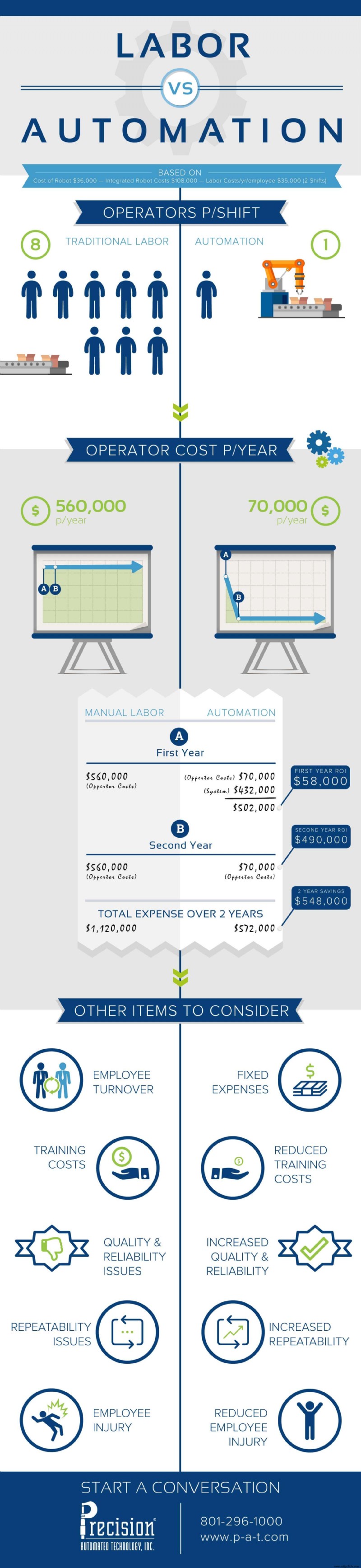
We’ve done some extensive research to help illustrate a comparison of traditional manual labor vs automation in the infographic below. We illustrate this example by comparing a production application where the traditional solution to production is adding people to increase output. We compare it to the opportunity of integrating an automated solution and the potential for payback or the Return on Investment (ROI). In this scenario, our customer was using 8 production workers x 2 shifts per day to meet their production goals. This was challenging in a tight labor market and our customer was frequently faced with a shortage of labor. This turnover was creating many challenges, including repetitive training, decreased productivity, decreased quality, and low employee morale. Precision Automated Technology proposed an automated solution. This solution would only require a single production worker per shift. The automation included a robot, tooling, conveyors and the full system installed and integrated on the customer’s floor. The automation solved the challenges with their labor shortage, training and quality. In addition, the customer could re-allocate their labor force to other areas in the plant and discontinued the use of temporary labor. Subsequently, the customer decreased their operating costs, increased productivity and enhanced reliability. These factors all contributed to a higher Return on Investment (ROI) and dramatically lower turnover. We helped the customer understand and justify the cost of a new system, something that is often overlooked due to the fear of the initial expense. It was discovered that the annual cost per production worker was $35,000/year. They were using 8 workers/shift, 2 shifts/day. This equaled a significant amount at $560,000/year. This is just the labor expense and does not consider other costs related to a loss in production capacity, training, injury, etc. We proposed a total system cost to automate the process at $432,000. The new system still requires one operator/shift to monitor and replenish materials. The cost of this labor is 1 worker at $35,000/year, 2 shifts/day = $70,000/year. Their first-year expense for the system would be $432,000 plus $70,000, totaling $502,000. This translates to a first year ROI of $58,000 ($560,000 labor – $432,000 system price – $70,000 operators). This scenario gets more exciting when you look at the second year of ownership. Now only having to cover costs of $70,000 in operator costs, the ROI becomes $490,000 during the second year. If this customer chose to not automate their labor expenses, it would have totaled $1,120,000. With the successful installation of automation their total expenses are $572,000. This is a savings of $548,000 over two years. Finally, in working with the customer we established a relationship of trust and partnership. This is critical in the successful implementation of automation, customers know their process and we know automation. By working closely with the customer our engineers understood the customer’s needs and requirements, incorporating them into the system. With these features now added to the system, the customer has increased reliability, availability, and flexibility of the production line while significantly reducing operating costs. Precision welcomes the opportunity to talk to you about your needs and challenges. It is a no risk opportunity to discuss and see if we can help you recognize similar savings in your operation. Automation is on the rise, supported by the latest data from Robotics Industries Association (RIA).
Please contact Precision Automated Technology to review and discuss automation in your operation.
 Download Infographic PDF
Automation Control System
- Unlocking Efficiency: The Proven Benefits of Warehouse Automation
- Accelerating Vaccine Development: How Automation Speeds Production
- Build a Winning Automation CoE Team: Identify & Empower Champions
- Maximize Profits with Demolition Excavators: Efficient Processing Strategies
- Accelerate DevOps with Workload Automation: Boost Speed, Cut Redundancy, Deliver Quality Faster
- Accelerate Profits by Optimizing Manufacturing Operations
- Choosing the Right Robotics Automation Partner for Your Business Success
- How Badger Sheet Metal Works’ In‑House Powder Coating Elevates Efficiency and Bottom Line
- Installing Automation in Your Production Line: A Step-by-Step Guide
- Boost Pump Efficiency: Proven Strategies to Reduce Energy Costs and Improve Performance