



Understanding MQTT: How the Lightweight IoT Messaging Protocol Works
In the world of IoT, a sensor’s ability to send data to a remote device is often powered by MQTT—a lightweight, low‑bandwidth publish/subscribe protocol. If the terminology of publishers, subscribers, or brokers feels unfamiliar, this guide will clarify how messages travel, why MQTT is efficient, and how you can experiment with it in real time.
What Is MQTT?
MQTT, or Message Queuing Telemetry Transport, is a set of rules that enables devices to exchange information over the internet or a local network. Designed for low‑power, limited‑bandwidth environments, MQTT uses tiny messages and an event‑driven approach, transmitting data only when a device needs to share or receive new information.
Each device can act as a publisher (sending data) and a subscriber (receiving data). Unlike many protocols, MQTT does not route messages directly between devices; instead, all communication passes through a central entity known as a broker.
MQTT Brokers and Clients
Clients—whether they publish, subscribe, or both—communicate solely with the broker. Think of the broker as a customs officer at a border: it receives every incoming package and directs it to the correct destination. This decoupling keeps the network scalable and simplifies device design.
Popular brokers include:
- Mosquitto – a free, open‑source broker that runs locally on Windows, Linux, or macOS.
- EMQX – an open‑source broker with advanced clustering features.
- Hosted options such as HiveMQ Cloud and CloudMQTT provide managed, cloud‑based brokers.
How MQTT Works
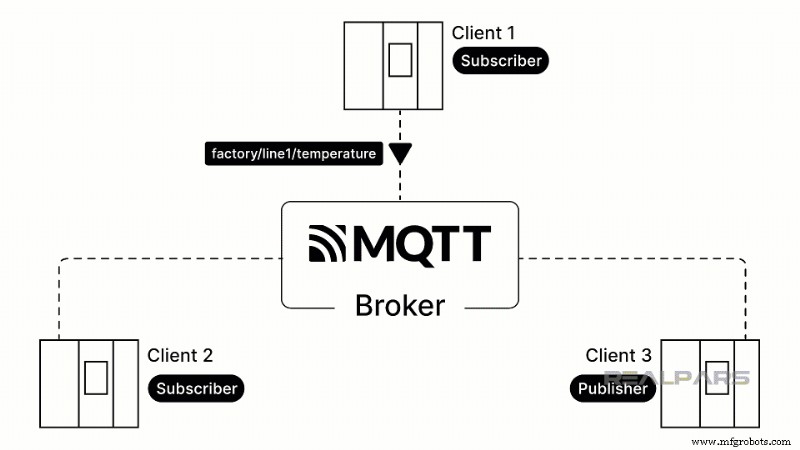
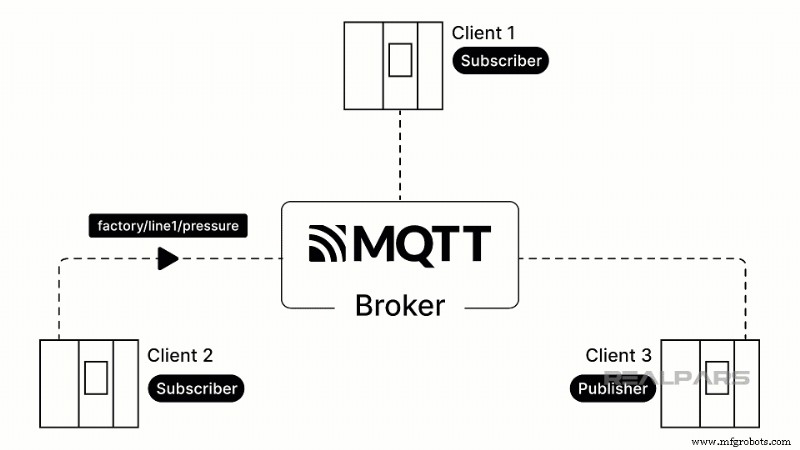
The broker sits at the heart of every MQTT operation. Publishers send messages to the broker on a specific topic. Topics are hierarchical strings separated by forward slashes (e.g., factory/line1/temperature). Only clients that subscribe to that topic receive the message.
This topic-based routing means:
- A publisher can send a single message to multiple subscribers without duplication.
- Subscribers can listen to multiple topics from various publishers simultaneously.
- Unsubscribed clients never receive irrelevant data, conserving bandwidth.
Illustrative Example
Consider a factory floor with a temperature and a pressure sensor. Both sensors publish to distinct topics:
- Temperature topic:
factory/line1/temperature– payload:25.3°C - Pressure topic:
factory/line1/pressure– payload:18.7psi
Subscriber 1, interested only in temperature, receives the first payload. Subscriber 2, focused on pressure, receives the second. The broker handles the routing automatically.
Typical Publish Command
On a local Mosquitto broker, you can publish a message via the command line:
mosquitto_pub -h localhost -t retain/topic -m "Take a hike"
Here:
-h localhost– the broker’s address.-t retain/topic– the topic name.-m "Take a hike"– the payload that any subscribed client will receive.
Graphical clients such as MQTT Explorer and MQTTX provide user‑friendly interfaces for publishing and subscribing, making experimentation straightforward even for beginners.
Wrap‑Up
MQTT’s publish/subscribe model, powered by brokers and topics, delivers a simple, efficient, and scalable way for IoT devices to communicate. Mastering these core concepts unlocks powerful applications across manufacturing, smart homes, and beyond.
Automation Control System
- Kirigami‑Based Robot Grippers Safely Handle Egg Yolks
- IAM Robotics and Tompkins Robotics Unveil Advanced Automated Order Fulfillment Solution
- Top Plastics Industry Themes of 2021: Sustainability, Automation, and 3D Printing
- Choosing the Right Controller: PLC, PAC, DCS, or IPC Explained
- Automating Vertical Operations: The Ideal Moment for All Shops
- How Automation Boosts Business Efficiency and Growth
- Ford Pilots Boston Dynamics Quadruped Robots to Boost Manufacturing Efficiency
- Enhance Production Efficiency & Quality with Automated CNC Machine Control
- Murata Machinery USA Showcases Cutting-Edge Manufacturing Technology at North American Event
- Yushin Showcases Smarter, Collaborative Robots Driving Industry 4.0 at NPE