



The Crucial Role of Pressure in Abrasive Waterjet Cutting
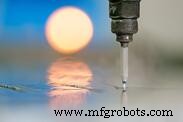 As the 20th century inched towards its close, a very novel concept came into being for use in metal fabrication. Up until the 1980s, water had generally been regarded as a useful substance in industrial settings, largely for its cleaning or cooling properties. No one really thought of water as something that could rival the power a good saw, or a welding torch in terms of penetrating and cutting materials.
And yet, in the 1980s, that’s exactly what happened. That clear, harmless fluid that was used for many different purposes both personally and professionally underwent a radical transformation. When channeled through the right kind of technology, a stream of water turned from something used for pleasant showers into an incredible kinetic force capable of making clean, precise cuts through metal.
Now, in the 21st century, the use of waterjets, especially abrasive waterjets, is a well understood, widely used industrial technology. And the secret to the success of this new technique is all about physics and the use of pressure.
The Rise of Water
When waterjets first made their debut in the 1980s, they were cruder, less powerful tools that got the job done, but were also in competition with other emerging technologies of the time, such as plasma cutters. However, technologies like welders and plasma cutters, while effective, required a comprehensive infrastructure in order to work. Depending on the type of tool used, an arsenal of gases and electrical equipment were required to use these pieces of equipment, and the side-effects of usage were residuals like intense heat, blinding light and fumes that were a health risk if inhaled.
A waterjet, on the other hand, posed none of these threats. As with a flame, the only danger a waterjet presented to bystanders was making direct contact with the water itself while it was cutting. For certain industrial jobs that only required movement on two axes, a waterjet proved to be an efficient solution for cutting and assembly line tasks. But it was initially limited by one physics-related factor; the pressure.
Pressure=Speed
A waterjet works because of an extremely advanced pump system. When the technology first arrived, the pressure required to effectively cut was advanced incrementally. In 20 years of usage, the pressure threshold managed to reach about 60,000 psi. In the last decade, however, better research and technology had yielded faster, larger results, and the latest waterjets can now reach 90,000 psi.
The reason that pressure is so critical to the operation of a waterjet is that this force can then be translated into the velocity the water moves at. The higher pressure, the faster the velocity and the narrower and more precise the cutting and control of the waterjet may be. Add an abrasive component, which is what abrasive waterjets do, and the cutting power of this technology increases even more.
More Velocity Means More Efficiency
The abrasive component used in abrasive waterjets is most commonly garnet. When added to a high velocity water stream, it increases power and efficiency, but within certain limits. Being a physical stream, water can only hold so many particles of garnet, and the velocity at which the water travels has an effect on how much abrasive is required.
This means that if an abrasive waterjet achieves optimal pressure, that translates into a high enough speed to require fewer abrasives to do the job. That means increased efficiency, more cost effectiveness, and reduced waste of resources. At 90,000 psi, this pressure level is sufficient to the vast majority of tasks required in an industrial setting.
Now the real challenge is optimizing this technology to make it even more conducive to specific industrial needs. The power is now there, and finding ways to increase it might be a case of overkill. But finding smarter, more customized ways to apply that power for different uses can yield even more efficient and impressive results.
Industrial Technology
- Tracing the Evolution of Waterjet Cutting: From Ancient Roman Engineering to Modern Precision Technology
- Abrasive Water Jet Machining: Precision Cutting for Modern Manufacturing
- Waterjet Cutting Explained: Precision, Versatility, and Performance
- Abrasive Waterjet Machining: Principles, Applications, and Industry Impact
- Determining the Ideal Waterjet Cutting Pressure for Optimal Performance
- Discover the Advantages of Waterjet Cutting: Precision, No Heat, and Versatility
- Pure vs. Abrasive Waterjet Cutting: Understanding the Key Differences
- Expert Waterjet Cutting Services for Custom Signs
- 10 Key Advantages of Waterjet Cutting for Your Business
- The Essential Role of Electric Water Pumps in Reliable Water Supply