



Understanding the Distinctions: Machine, Machine Tool, and Cutting Tool Explained
In the context of manufacturing or mechanical engineering, three terms, namely machine, machine tool and cutting tool have different significance. Basically machine is any device that reduces human effort in doing a task. By formal definition, a machine is an assembly of mechanisms that are clustered together in such a way that it can perform certain operations by utilizing electrical, mechanical, hydraulic and/or pneumatic power. So a machine is mostly power driven and tends to provide mechanical advantage (MA) so that it can reduce human intervention for performing a task.
How machine differs from machine tool?
In manufacturing, especially in machining or metal cutting domain, machine is not exactly same with machine tool. A machine can be referred as machine tool if it has few characteristics. When a machine possesses following characteristics, it is termed as machine tool. It is worth mentioning that all five conditions must be satisfied in order to refer a machine as machine tool.
- It must be power driven (human operated machines are not machine tools).
- It must be non-portable (portability irrespective of size).
- It must have sufficient value (value in terms of capability and performance, not on the basis of cost).
- It can perform more than one type of machining or metal cutting operations.
- It utilizes a cutting tool to shear off excess materials from workpiece.
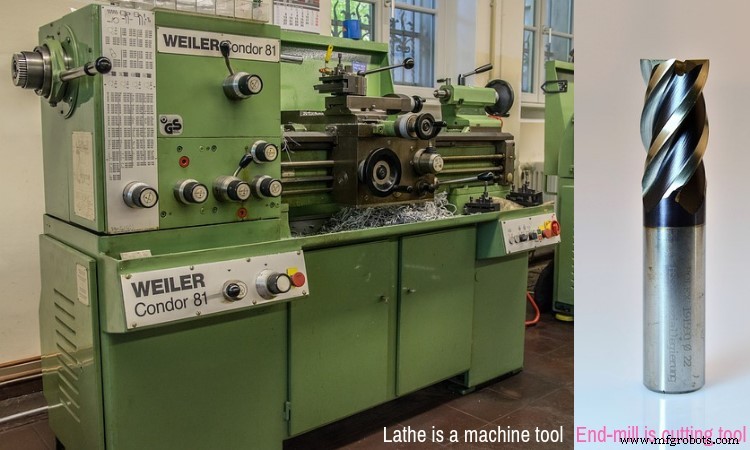
Examples of machine tool: A lathe is most common example for a machine tool as it overwhelmingly satisfies all of the above conditions. Metal cutting lathe is driven by electrical motor; it is not operated by human power. It is also non-portable (as compared to a hand drill, which is not a machine tool) and has sufficient value. It can also perform a large number of machining operations including straight turning, taper turning, internal turning, center drilling, facing, thread cutting, knurling, grooving, parting, etc. Moreover, all these operations are performed with the help of a sharp edged cutting tool. Thus lathe can be safely considered as a machine tool. Other examples include milling, grinding, drilling and boring machine tools.
All machine tools are machine but not vice versa
Only those machines which satisfy all of the above mentioned five conditions are considered as machine tools. So if a machine fails to satisfy any one of the above conditions then that machine cannot be considered as a machine tool.
For example, a hand drill is portable and thus it is not a machine tool even though it is a machine. However, an industrial drill press can be considered as a machine tool. Therefore, all machine tools are basically machines but all machines are not machine tools. Similarly, a motorized vehicle or a desktop computer cannot be a machine tool as it cannot perform metal cutting operation. Thus the concept of machine tool is usually restricted within the domain of manufacturing.
What is cutting tool? How it differs from machine tool?
A cutting tool, also called a cutter, is a small wedge shaped and sharp edged device that is mounted on the machine tool to perform machining or metal cutting operation. During machining, excess layer of material is gradually removed from the workpiece in the form of chips with the help of cutting tool. So cutting tool compresses a thin layer of material on workpiece to shear it of (or to cut that layer), whereas machine tool holds the cutting tool.
Apart from rigidly mounting the cutting tool, the machine tool also mounts the workpiece and provides all necessary relative motions for smooth cutting action. A synchronous motion between the cutter and workpiece is indispensable necessary to efficiently and swimmingly remove material from work surface.
Scientific comparison among machine, machine tool and cutting tool is presented in this article. It can be concluded that cutting tool actually shears off the excess material from workpiece, while machine tool helps rigidly mounting the cutting tool, workpiece and other necessary accessories and at the same time imparts intended motions. Lathe is one machine tool; while, single point turning tool (SPTT), drill, milling cutters, etc. are cutting tools.
Industrial Technology
- Robots vs. Machines: Understanding Their Distinct Roles in Modern Technology
- Single-Point vs. Multi-Point Cutting Tools: Key Differences Explained
- Rake vs. Flank: Understanding Cutting Tool Surface Differences for Optimal Machining
- Rake vs. Clearance Angles: How They Shape Cutting Tool Performance
- Cutting Tools vs. Grinding Wheels: Understanding Their Key Differences
- Edge vs. Nose Radius in Cutting Tools: What You Need to Know
- Mastering Lathe Machine Operations & Cutting Tool Selection
- Orthogonal vs. Oblique Cutting: Key Differences Explained
- NC vs CNC Machines: Key Differences Explained
- Shaper vs Planer: Key Differences Explained