



Orthogonal vs. Oblique Cutting: Key Differences Explained
Today we will discuss about difference between orthogonal and oblique cutting. What is Orthogonal Cutting? What is Oblique Cutting? Metal cutting or commonly known as machining, is the most common phenomenon used in manufacturing industries. Every product, big or small, undergoes a machining process to get final product. So the knowledge of basic types of metal cutting are most important. If we talk about metal cutting two terms comes in our mind orthogonal and oblique. These both are the metal cutting mechanism which is purely depending on the feed angle and cutting direction of tool.
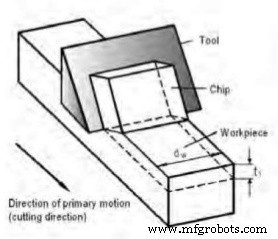 |
| Orthogonal Cutting |
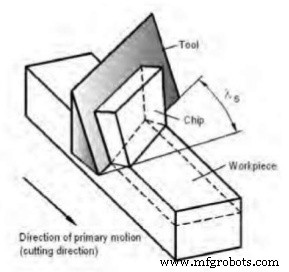 |
| Oblique Cutting |
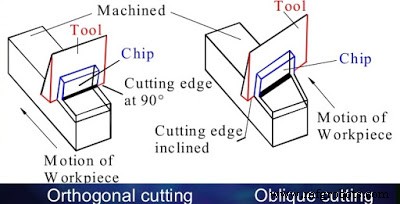
Difference between Orthogonal cutting and Oblique cutting:
| S. No. | Orthogonal Cutting | Oblique Cutting |
| 1. | The cutting angle of tool make right angle to the direction of motion. | The cutting angle of tool foes not make right angle to the direction of motion. |
| 2 | The chip flow in the direction normal to the cutting edge. | The chips make an angle with the normal to the cutting edge. |
| 3. | In orthogonal cutting only two components of force considered cutting force and thrust force which can be represent by 2D coordinate system. | In oblique cutting three component of force are considered, cutting force, thrust force and radial force which cannot represent by 2D coordinate. It used 3D coordinate to represent the forces acting during cutting, so it is known as 3D cutting. |
| 4. | This tool has lesser cutting life compare to oblique cutting. | This tool has higher cutting life. |
| 5. | The shear force act per unit area is high which increase the heat developed per unit area. | The shear force per unit area is low, which decreases heat develop per unit area hence increases tool life. |
| 6. | The chips flow over the tool. | The chips flow along the sideways. |
Understanding Tool Wear: Flank, Crater, and Nose Wear Mechanisms
Understanding Casting Defects: Types, Causes, and Proven Remedies
Manufacturing process
- Single-Point vs. Multi-Point Cutting Tools: Key Differences Explained
- Rake vs. Flank: Understanding Cutting Tool Surface Differences for Optimal Machining
- Understanding the Distinctions: Machine, Machine Tool, and Cutting Tool Explained
- Welding vs Brazing: Key Differences Explained for Better Metal Joining
- Up vs Down Milling: Key Differences Explained
- Soldering vs. Brazing: Understanding the Critical Differences
- Horizontal vs Longitudinal Turning: Key Differences Explained
- End Mills vs Keyway Mills: Key Differences & When to Use Each
- Brazing vs Soldering: Key Differences Explained
- 2‑Stroke vs 4‑Stroke Engines: Key Differences Explained