



Welding vs Brazing: Key Differences Explained for Better Metal Joining
Today we will discuss about difference between welding and brazing. In my last post we have discussed about welding vs brazing vs brazing. We know that these both are jointing processes but used in different condition. The knowledge of both processes is required to better efficiency of joint.
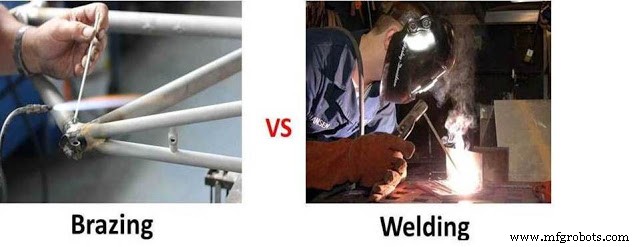
Welding and brazing denote the common joining processes used in metal industries. The main and basic difference between these two processes is that Welding used to join metal above the melting temperature but brazing use to join metal below the melting temperature. These process can be differentiate according to following aspect in tabular form.
|
S. No. |
Welding |
Brazing |
| 1. | It is the jointing process in which both piece of work piece melted together with or without application of filler material | Brazing is the joining process in which work piece is heated below its melting temperature and the joint is made by use of filler material known as braze. |
| 2. |
Temperature of welding is above the melting point of work piece. It is almost 3600oC
. |
It is done much below the melting temperature which is almost 600oC. |
| 3. | The properties of base metal may change after joining. | The properties of base metals remain same after joining. |
| 4. | It forms strongest joint. | These joints are weaker than welding. |
| 5. | The use of filler metal is not compulsory in welding. | Filler metal is used compulsory in brazing. |
| 6. | The work piece must be clean before welding. | The work piece should clean but it is not compulsory. |
| 7. | It mostly used to join similar metals. | It is mostly use to join dissimilar metal. |
| 8. | It is best suitable to join large assembly. | It is best suited for join small assembly. |
| 9. | Welded joints can withstand with high temperature. | These joints cannot withstand with high temperature. |
These are key difference between these two joining processes, welding and brazing. If you have any query regarding this article, ask by commenting. Thanks for reading it.
Mastering Thread Cutting on a Lathe: Step-by-Step Procedure
Arc Welding vs. Gas Welding: Key Differences Explained
Manufacturing process
- MIG vs. TIG Welding: Key Differences and Applications
- TIG vs A‑TIG Welding: Key Differences Explained
- Understanding the Differences: A-TIG vs FB-TIG Welding Techniques
- Joining vs Welding: Key Differences Explained
- Arc Welding vs. Gas Welding: Key Differences Explained
- MIG vs. TIG Welding: Key Differences Explained
- Soldering vs. Brazing: Understanding the Critical Differences
- Welding vs. Soldering: Key Differences Explained
- Welding vs Brazing: Key Differences in Joining Techniques
- Brazing vs Soldering: Key Differences Explained