



C vs Java: A Comprehensive Comparison of Features, History, and Applications
What is C?
C is a procedural programming language created by Dennis Ritchie at Bell Labs in 1972. Designed to write system software, it blends low‑level hardware control with high‑level abstraction, earning its reputation as a middle‑level language. Its compact syntax and powerful pointer support make it ideal for firmware, operating systems, and embedded systems.
In this guide you will learn:
- What C is
- What Java is
- Historical milestones of C
- Historical milestones of Java
- Key differences between C and Java
- Features of C
- Features of Java
- Applications of C
- Applications of Java
- Advantages of C
- Advantages of Java
- Disadvantages of C
- Disadvantages of Java
What is Java?
Java is a platform‑independent, object‑oriented language that emerged from Sun Microsystems in 1995 (later acquired by Oracle). It is engineered for network‑centric applications and can run on virtually any device, from servers to mobile phones.
Key Differences
- C is procedural; Java is object‑oriented.
- C is a middle‑level language; Java is high‑level.
- Java provides built‑in multithreading; C requires external libraries.
- C supports pointers; Java does not expose raw pointers.
- Memory management is manual in C; Java automates it with garbage collection.
- C offers call‑by‑value and call‑by‑reference; Java only uses call‑by‑value.
- Dynamic allocation in C uses
malloc; Java uses thenewkeyword.
History of C
Key milestones:
- 1967 – BCPL (Basic Combined Programming Language).
- 1970 – B by Ken Thompson.
- 1972 – C by Dennis Ritchie at Bell Labs.
- 1989 – ANSI standardization.
- 1990 – ISO approval.
History of Java
Key milestones:
- Initially named OAK, designed for portable devices; later rebranded.
- 1995 – Sun renamed it Java, targeting the burgeoning Web.
- 2009 – Oracle acquired Sun Microsystems.
Differences at a Glance
Below is a concise side‑by‑side comparison:
| C | Java | |
|---|---|---|
| Paradigm | Procedural | Object‑Oriented |
| Release | 1972 | 1995 |
| Language Level | Middle‑level | High‑level |
| Variable Declaration | Start of block | Anywhere |
| Memory Management | Manual (malloc, free) | Automatic GC |
| Threading | Not native | Built‑in |
| Pointers | Supported | Not supported |
| Method Overloading | No | Yes |
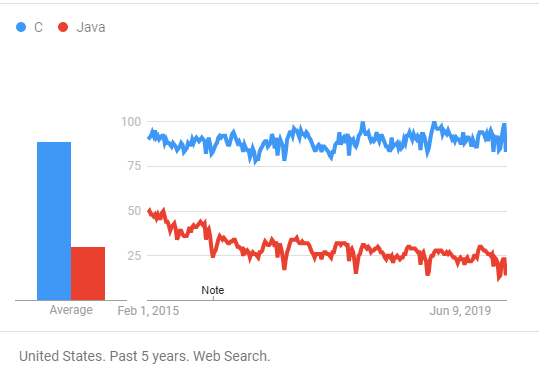
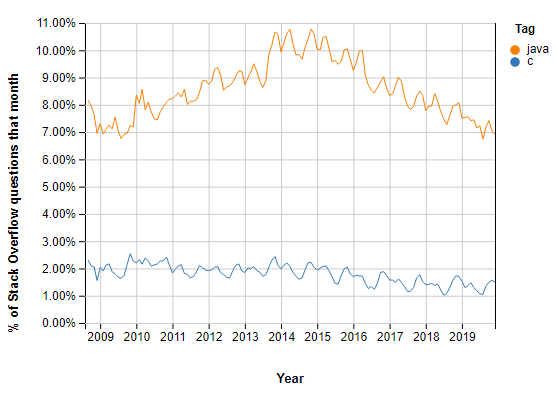
| Salary (US) | $104,051 | $104,710 |
| TIOBE Rank | 2 | 1 |
Features of C
- Easy to learn with a small keyword set.
- Structured and efficient, producing high‑performance binaries.
- Portable across platforms via standardized compilers.
- Foundation for many modern languages and systems.
Features of Java
- Write once, run anywhere—platform independence.
- Robust object‑oriented architecture.
- Built‑in multithreading and automatic memory management.
- Designed for distributed and networked computing.
Applications of C
- Operating systems, device drivers, and embedded firmware.
- Compilers and interpreters for other languages.
- Database engines (e.g., MySQL), browsers (Chromium), and IoT firmware.
- Desktop applications requiring low‑level control.
Applications of Java
- Android mobile apps.
- Enterprise back‑end services and middleware.
- Scientific computing and big‑data analytics.
- Server‑side technologies such as Apache Tomcat and JBoss.
Advantages of C
- Fast compilation and execution.
- High portability and low runtime overhead.
- Clear syntax conducive to learning other languages.
- Extensible, serving as the building block for many systems.
- Efficient use of memory and resources.
Advantages of Java
- Extensive documentation and a large developer community.
- Rich ecosystem of third‑party libraries and frameworks.
- Strong support for modular, reusable code.
- Built‑in multithreading and garbage collection simplify development.
- Excellent cross‑platform performance.
Disadvantages of C
- No native support for object‑oriented concepts.
- Manual memory management can lead to bugs and security issues.
- No namespaces, constructors, or destructors.
- Runtime type checking is absent.
- Limited error detection during compilation.
Disadvantages of Java
- Just‑In‑Time (JIT) compilation may introduce startup latency.
- Higher memory consumption compared to lower‑level languages.
- Lack of pointer arithmetic limits low‑level programming.
- Garbage collection timing is not controllable, affecting real‑time performance.
C vs. C++: Key Differences & When to Choose Each
While vs. Do‑While Loops: Clear Comparison with Practical Examples
C Language
- Structures vs. Unions in C: A Practical Guide
- C# vs C++: A Clear Comparison of Features, Performance, and Use Cases
- C vs. C++: Key Differences & When to Choose Each
- Java vs. C#: 10 Key Differences Explained
- Python vs JavaScript: Key Differences, Features, and When to Choose Each
- Python vs Ruby: A Comprehensive Comparison of Features, Advantages, and Use Cases
- Joining vs Welding: Key Differences Explained
- Welding vs Brazing: Key Differences Explained for Better Metal Joining
- Up vs Down Milling: Key Differences Explained
- Soldering vs. Brazing: Understanding the Critical Differences