



Optimizing Thermal Management: Advanced Heat Sink PCB Design

Heat Sink PCB
PCB design is a complicated process requiring close attention to a range of potential issues. Designers must analyze every feature of a board to ensure optimal functionality, from the physical constraints to the electrical interactions between components to signal loss. One of these features is thermal management, which is essential for ensuring the longevity and functionality of a PCB.
There are many ways to achieve optimal thermal management and remove excess heat from a PCB, including selecting appropriate cooling methods. One of these methods is attaching a heat sink. This article will explain what heat sinks are, their unique advantages and challenges and how to select heat sinks for PCBs.
What Is a Heat Sink in a PCB?
A heat sink is a part with a large surface area consisting of thermally conductive metal. This heat sink is typically attached to printed circuit board components, including power transistors and switching devices. The purpose of this part is to absorb and dissipate heat.
PCB heat sinks work through the principle of conduction. In this principle, heat transfers from areas of high thermal resistance to areas of low thermal resistance, and areas of high heat to areas of low heat. Because heat sinks are made of aluminum or copper, which both have excellent thermal conductivity and low thermal resistance, the heat will naturally move from PCB components to the heat sink.
The process works as follows:
- A PCB component generates heat, which naturally moves from the component to the heat sink through the principle of conduction.
- From there, heat is dissipated over the large surface area of the heat sink.
- The heat transfers to the surrounding area across the surface area of the heat sink. Many heat sinks feature fins — rectangular pin-like features that stick out perpendicularly to the PCB surface — that help maximize surface area and help transfer the heat from the heat sink to the surrounding air.
Heat Sink Applications
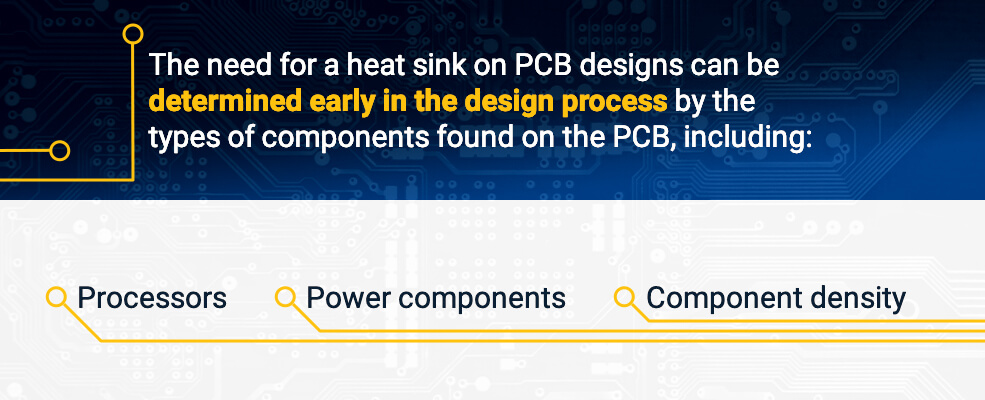
Since heat sinks are a necessity for PCB applications that handle large amounts of power, they may generate more heat than the average PCB. Designers will choose to use a heat sink if they discover that a PCB prototype shows a thermal profile with hot spots and high-temperature areas. However, the need for a heat sink on PCB designs can be determined early in the design process by the types of components found on the PCB, including:
- Processors: PCBs that include processors, such as CPUs, GPUs and MPUs, will often require heat sinks to assist with thermal management and help maintain error-free longevity.
- Power components: PCBs with power components tend to have greater thermal management needs. Some examples of components that fall into this category include power amplifiers, power regulators, power ICs and power supplies.
- Component density: A PCB may also require a heat sink for thermal management if it has a high component density, as that may result in greater heat production than an average PCB.
Specific industries may also tend to employ heat sinks more often than others. For example, military applications will tend to use heat sinks in PCB designs to help ensure long-term functionality.
The Advantages of a Heat Sink
These parts have a wide range of benefits, including:
- Thermal management: The primary advantage of a heat sink is its ability to improve thermal management in a PCB design. These parts are excellent at solving numerous heat dissipation and cooling problems.
- Longevity: PCB heat sinks are long-lasting, not needing replacement after long-term use. Additionally, their use can help improve the longevity of a PCB through proper thermal management.
- Low cost: Most heat sinks are low-cost, providing an economical solution to thermal management in PCB designs.
- Low weight: Many heat sinks are made of copper or aluminum, which provide excellent thermal resistance without adding significant weight to the board.
The Challenges of a Heat Sink
While heat sinks offer multiple benefits for PCB thermal management, there are significant challenges they present in PCB design. Some of the most prominent challenges presented with heat sinks on PCBs include:
- Mechanical attachment difficulties: PCB heat sinks have mechanical attachments, such as push pins and z-clips, that require anchors to be drilled into the board, leaving damage if the design needs later alternations.
- Non-mechanical attachment difficulties: An adhesive or epoxy non-mechanical attachment presents a high risk of damaging a device during removal due to mechanical stress. Additionally, applying non-mechanical attachments is difficult due to the low flow properties of thermal adhesives and epoxies — these attachments must be perfect and free of air pockets to achieve optimal thermal management, but achieving that requires pressure that may break the board.
- Detaching requirements: Another complex problem for PCB heat sinks is the fact that the heat sink must be removable. In the event someone needs to service the board, they must be able to remove the heat sink without damaging the board. That’s particularly tough for attachments using adhesives.
Tips for Choosing the Right Heat Sink Attachment
Adding a heat sink to a PCB will impact design, especially the ability of the design to be reworked without damage. When looking for the right heat sink attachment for a PCB, consider several factors:
- Thermal requirements: Before considering heat sinks, you need to know the thermal design profile (TDP) of the PCB components and their optimal operating temperatures. This information will indicate a component’s power consumption and how much thermal management is needed to keep it operational.
- Space requirements: Determine how much space is available for a heat sink in the design. These parts come in a range of sizes and designs, so it’s essential to know the availability of space for a heat sink in a PCB design.
- Heat sink design: Once you know the limitations and requirements of the PCB design, you should think about the varying designs of heat sinks. These variables include material properties and dimensional features, such as the size of the heat sink, the number of fins on it and spacing between the fins.
- Mounting technique: Finally, consider how the heat sink needs to be attached to the PCB. Depending on the specific heat sink and the requirements of the design, you may choose a mechanical or non-mechanical attachment technique. Either way, closely consider the unique drawbacks of each attachment technique.
Contact Millennium Circuits Today
As a highly effective, low-cost passive thermal transfer tool, heat sinks can serve many purposes for PCB design. If you’re looking to implement a design using a heat sink, Millennium Circuits Limited can help.
Millennium Circuits Limited supplies engineers with high-quality PCBs. No matter your industry, our selection of PCB technologies ensures you have a reliable and functional PCB at the core of your devices. Contact MCL today to learn more about our products and capabilities.
Industrial Technology
- Heat Pump Technology: Design, Manufacturing, and Future Trends
- Choosing High‑Temperature PCB Laminates for Reliable Performance
- Choosing the Right PCB Thickness: Standards, Design, and Manufacturing Factors
- Comprehensive Guide to PCB Temperature Management
- Effective PCB Heat Management: Techniques for Optimal Thermal Performance
- 10 Proven Techniques to Maximize PCB Trace Current Capacity and Heat Dissipation
- Understanding LED Heat Sinks: Why They Matter for Optimal Performance
- Heat Sinks Explained: Key Insights & Types for Optimal Cooling
- Optimizing PCB Internal Thermal Dissipation Through Advanced Thermal Modeling
- Designing High‑Power PCBs for High‑Temperature Environments