



TIG vs MIG Welding Explained: Types, Differences, and Key Advantages
In this article, we are discussing TIG and MIG welding. The difference between the TIG and MIG welding is that MIG uses continuous feeding wire, and TIG uses welding rods that slowly feed them into the welding place.
What is TIG and MIG welding?
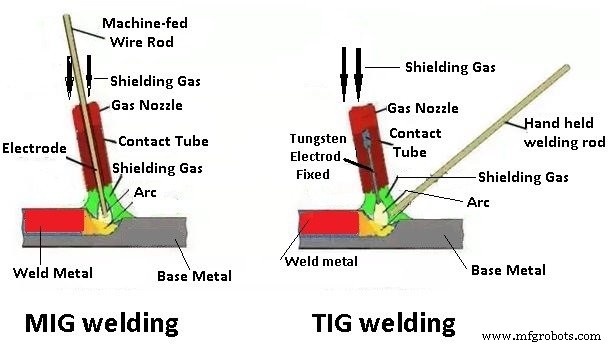
Both TIG and MIG welding uses an electric arc to make the weld. With the help of MIG welding, you can weld a variety of materials such as stainless steel, mild steel, and aluminum. On the other hand, tig welding is more commonly used for thinner gauge materials.
Read more: What is welding and how it works? [Explained with Pictures]
Watch Slideshow Of This Post:
Let’s discuss both TIG and MIG welding one by one.
Tungsten Inert Gas Arc Welding (TIG)
TIG welding the TIG stands for tungsten inert gas arc welding, from the American welding society it is also known as (GTAW). The TIG stands for tungsten inert gas welding. This welding process is also called gas welding.
It is a welding process, in which heat is produced by an electric arc ignited between a base metal (workpiece) and the non-consumable tungsten electrode.
TIG welding uses a tungsten electrode because tungsten has a high melting point. When we tig weld electrode gets hot but it doesn’t melt we say that is a non-consumable electrode. The non-consumable electrode doesn’t mean it lasts forever that just means that it doesn’t melt and become a part of the weld.
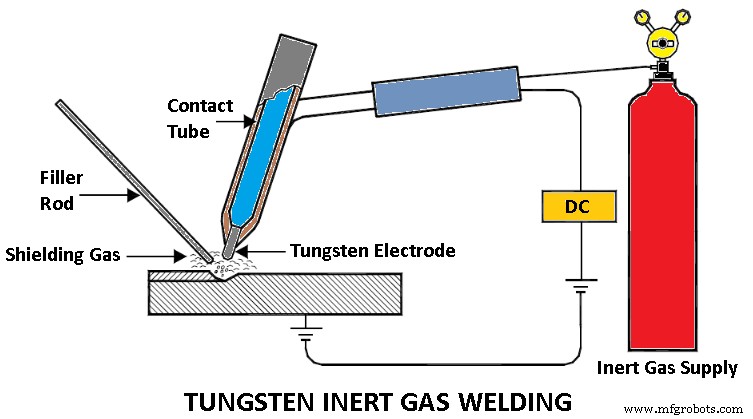
- The weld pool is shielded by an inert gas (Helium, Argon, Nitrogen) protecting the molten metal from atmospheric contamination.
- For most metal, the current is direct current or DC.
- The heat generated by the arc melts the workpiece edges and joins them.
- In tig welding, you can control the amount of heat by pressing a foot pedal or thumbwheel on the torch.
- If required filler rod may be used.
- It produces a high-quality weld of most of the metals.
- Flux is not used in the process.
Advantages of Tungsten Inter Gas Arc Welding
- In tig welding, the weld composition is close to that of the parent metal.
- Weld structure is of high quality.
- Slag removal is not required (on slag).
- thermal distortions of workpieces are minimal due to the concentration of heat in the small zone.
Disadvantages of Tungsten Inter Gas Arc Welding
- Low welding rate.
- Tig welding is comparatively expensive.
- To tig weld, a highly skilled operator is required.
Read more: What is Underwater Welding and types of Underwater welding?
Metal Inter Gas Arc Welding (MIG)
MIG welding is an arc welding process. MIG stands for metal inert gas welding. This MIG welding process is also known as gas metal arc welding (GMAW) you might also call wire welding.
In this welding, a thin wire acts as the electrode which is fed from a spool mounted on a gun through a flexible tube and it comes out of the nozzle on the welding gun or torch. The wire is fed continuously when the trigger on the welding gun is pulled.
An electric arc forms between this wire electrode and the workpiece and heats both metals above their melting point these metals mix together and solidify to join the workpieces into a single piece. The metal in these parts to be joined calls as the base metal. Here the metal that comes from the melting wire electrode is called filler metal.
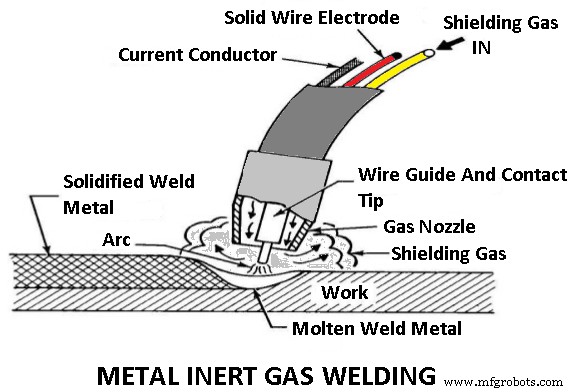
MIG welding uses filler metal to the joint. Because the wire electrode melts as it’s being used. These types of electrodes are called a consumable electrode.
- It is the arc welding process, in which the weld is shielded by an external gas such as argon, helium, CO2, and argon+oxygen.
- It is having consumable electrode wire, with the chemical composition similar to that of the parent material, is continuously fed from a spool to the arc zone.
- The arc heats and metals both the workpieces edges and the electrode wire.
- The fused electrode material is supplied to the surfaces of the workpieces, fills the weld pool and forms joint.
- Due to automatic feeding fo the filling wire (electrode) the process is referred to as a semi-automatic.
- The operator can control only the torch positioning and speed.
Advantages of MIG welding
- The continuous weld may be produced (no interruptions)
- High level of operators skill is not required.
- Slag removal is not required (on the slug).
Disadvantages of MIG welding:
- Expensive and non- portable equipment is required.
- The outdoor application is limited because of the effect of wind, dispersing the shielding gas.
Difference Between TIG and MIG Welding
Following are the main difference between TIG and MIG welding:
- No flux is required in both cases.
- TIG uses a non-consumable electrode whereas MIG user consumable electrode.
- In TIG welding zone is shielded by Helium.
- Various gas mixtures used in TIG are argon, Helium, argon-helium, Argon H2 & Argon CO2.
- TIG and MIG are used in automatic manufacturing, shipbuilding, aircraft and electrical engineering.
Conclusion
So now, we hope that we have cleared all your doubts about TIG and MIG welding. If you have still any doubts about “TIG and MIG welding” you can contact us or ask in the comments.
That’s it thanks for reading. If you like our article then please share it with your friends. If you have any questions about any topic you can ask in the comment section.
Subscribe to our newsletter to get notification of our new posts.
Industrial Technology
- MIG vs. TIG Welding: Choosing the Right Technique for Your Project
- MIG vs. TIG Welding: Key Differences and Applications
- TIG vs A‑TIG Welding: Key Differences Explained
- MIG Welding Explained: What It Is and How to Master the Process
- Laser Welding Explained: Techniques, Types, and Industrial Applications
- Resistance Welding Explained: Types, Processes, and Advantages
- Welding Ventilation Explained: Types, Benefits & Practical Examples
- MIG vs. TIG Welding: Key Differences Explained
- MIG vs. TIG Welding: Which Process Best Fits Your Project
- TIG vs. MIG Welding: Key Differences and How to Choose the Right Technique