



The Fourth Industrial Revolution: Tracing Its Origins and Evolution in the 21st Century
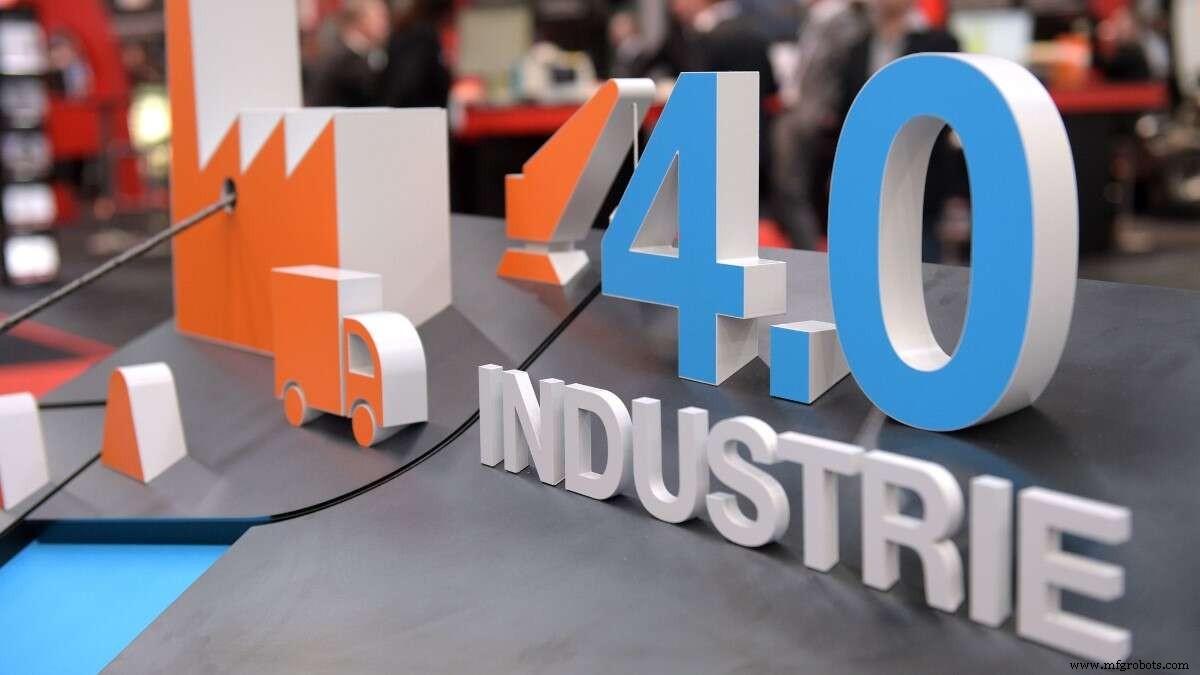
The term “Industrie 4.0”, shortened to I4.0 or simply I4, originated in 2011 from a project in the German government’s high-tech strategy, promoting the digitalization of manufacturing.
In their bestselling book “Why Nations Fail: The Origins of Power, Prosperity, and Poverty,” American economists Daron Acemoglu and James Robinson argue that “World inequality today exists because during the 19th and 20th centuries some nations were able to take advantage of the Industrial Revolution and the technologies and methods of organization that it brought while others were unable to do so.”
The origins of Industry 4.0
In 2011, the Bundesministerium für Bildung und Forschung (German Federal Ministry of Education and Research) asked the industry and academia to define proposals for the manufacturing industry’s creative disruption. The aim was for the German industry to have the chance to play an active role in shaping the fourth industrial revolution.
In 2013, the German Academy of Science and Engineering (Acatech) presented a research plan and implementation recommendations developed at the ministry’s urging. This was built on the “National Roadmap for Embedded Systems.”
In the words of Henning Kagermann, Chairman of the Acatech Board, “The factory of the future combines unprecedented flexibility with optimal resource utilisation. Industrie 4.0 offers Germany the chance to strengthen further its position as a manufacturing location, manufacturing equipment supplier, and IT business solutions supplier.”
Furthermore, the German initiative’s main goals were the foundation for the European Union “Digital Agenda,” adopted by the European Commission as part of the Europe 2020 goals, and evolved into the “Industry 4.0 Digital Agenda.” Today is one of Europe’s seven flagship projects, responsible for 5% of the EU GDP, with a market value of €660 billion annually.
Henrik von Scheel, one of the German Digital Revolution masterminds and originator of Industry 4.0, argues: “In essence, the centerpiece of Industry 4.0 is the people – not technology. Ever since the first caveman shaped a flint, humanity has defined itself by the ability to equip itself with tools to manage its environment. The Industry 4.0 era will be no different. Compared with previous industrial revolutions, the 3rd and the 4th revolution have evolved at an exponential rate rather than a linear pace,” and “the 4th industrial revolution brings the fusion of the digital, the physical and the virtual world, and is the most significant structural change of the past 250 years. In its scale, scope, and complexity, the transformation will be unlike anything humankind has ever experienced before. It is disrupting every industry and economy in every country.”
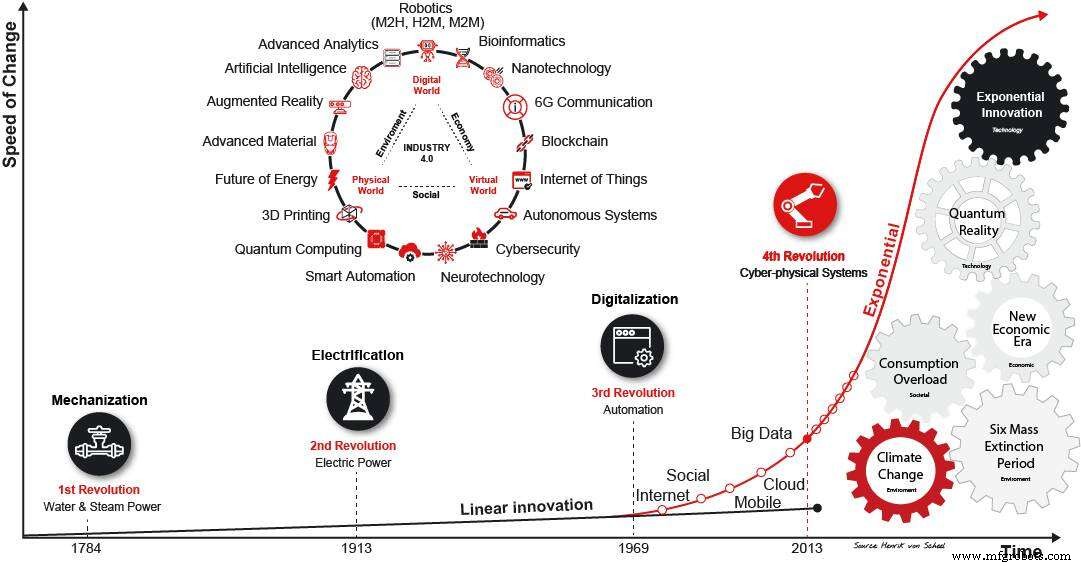
Picture courtesy of Henrik von Scheel
The internet of things, edge computing, AI, machine learning, and 3D printing created the critical junction to enable Industry 4.0
While the foundations of the current technology necessary for Industry 4.0 started in the last 30 years of the last century, the exponential growth of connectivity, data collection and processing, and computing power did not happen until the last twenty years.
The birth of the Internet of Things (IoT), replacing the previous limited M2M connections, and the arrival of fast wireless connectivity with 4G networks enabled the possibility of deploying millions of sensors.
Furthermore, edge computing and machine learning are now being used to collect, process, and make split-second decisions, enabling further automation, predictive maintenance, and sustainable productivity.
Also, new manufacturing technologies such as 3D printing are forging new ways to quickly produce new parts, introduce new materials, and reduce costs of production and logistics.
All these technologies and innovation have been fundamental during the current pandemic, where production has been maintained, and in some cases resumed, using the advanced technologies we have today.
In the following chapters of this series, we will evaluate the different technologies and building blocks and the challenges and threats the 4th industrial revolution brings.
Industrial Technology
- The Fourth Industrial Revolution: How Industry 4.0 Is Reshaping Manufacturing
- Embrace the Fourth Industrial Revolution: Your Guide to the Future (Free eBook)
- Industry 5.0: Human‑Centric, Sustainable, and Resilient Innovation for the Future of Manufacturing
- Fusion 360: Driving Innovation in the Fourth Industrial Revolution
- How Globalization and Industry 4.0 Are Transforming International Business
- Industry 5.0: Redefining Manufacturing for the Future
- Big Data: The Driving Force of the Fourth Industrial Revolution
- Industry 4.0: How Digital Transformation Is Revolutionizing Manufacturing
- Understanding the Fourth Industrial Revolution: Transforming Modern Manufacturing
- The Fourth Industrial Revolution: Transforming Industry with Smart Automation