



Industry 5.0: Human‑Centric, Sustainable, and Resilient Innovation for the Future of Manufacturing
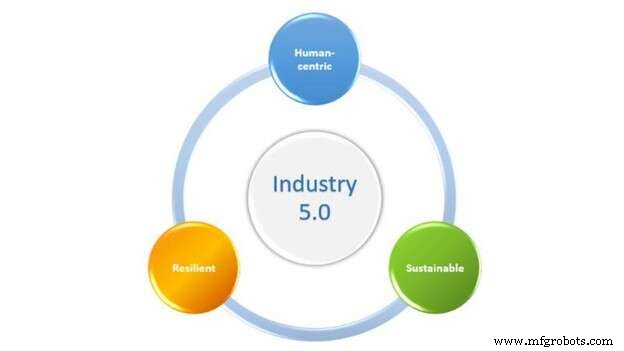
“Industry 5.0 recognizes the power of industry to achieve societal goals beyond jobs and growth to become a resilient provider of prosperity by making production respect the boundaries of our planet and placing the well-being of the industry worker at the center of the production process.” European Commission position paper.
The concept of Industry 5.0 is not an evolution of Industry 4.0, nor a replacement of it. It is a complementary approach to the digital industrial revolution. It aims to move the focus from a purely technological process to revolutionize existing industries to use technology to address the human and environmental challenges we face in the 21st century.
Industry 4.0 focuses on productivity using technology; Industry 5.0 adds the human and sustainability approaches.
Industry 4.0 describes how manufacturers will use technology to cope better in a changing world and economy. It is primarily a techno-economic vision, indicating how more general technological advancements, often originated in non-industrial contexts, will be brought to bear on industrial value chains and how they will change industry’s economic position.
Since its birth ten years ago, Industry 4.0 has been focusing on technology-driven methods for increasing the efficiency and productivity of different industries, taking less into consideration the principles of social fairness and sustainability.
While enabling and deploying the latest technologies across most industries is paramount to stay competitive, focusing on innovation and optimizing industrial output is not enough. A narrow approach to industrial output and profit is becoming increasingly untenable and fails to account correctly for environmental and the costs for society.
Globalization, climate change, and the production and supply chain challenges we are experiencing now have taught us that technology alone is not the solution to address current world problems. Covid-19 has highlighted the need to reevaluate current working methods and approaches. We need to invest in automation, digitalization, and artificial intelligence, but not forgetting sustainability and the human factor.
That’s why the European Union started a new approach, based on the Industry 4.0 revolution, adding the concepts of circular economy, human-centric technology, sustainability, and resiliency.
“Industry 5.0 is characterized by going beyond producing goods and services for profit. It shifts the focus from the shareholder value to stakeholder value and reinforces the role and the contribution of industry to society. It places the well-being of the worker at the center of the production process and uses new technologies to provide prosperity beyond jobs and growth while respecting the production limits of the planet. It complements the existing “Industry 4.0″ approach by specifically putting research and innovation at the service of the transition to a sustainable, human-centric and resilient European industry.” European Commission.
Elements pertinent to Industry 5.0 are already part of major Commission policy initiatives
- Adopting a human-centric approach for digital technologies, including artificial intelligence.
- Upskilling and reskilling European workers, particularly on digital skills.
- Modern, resource-efficient, and sustainable industries and transition to a circular economy.
- A globally competitive and world-leading industry, speeding up investment in research and innovation.
For example, Industry 5.0 does not distinguish between “blue-collar” and “white-collar” workers. In this regard, the lines between different types of roles, positions, and status of workers are blurred.
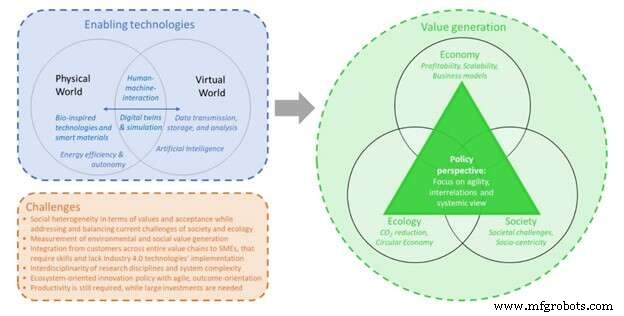
Also, the European Union has defined a list of technologies to support the concept of Industry 5.0:
- Human-centric solutions and human-machine-interaction technologies that interconnect and combine the strengths of humans and machines.
- Bio-inspired technologies and smart materials that allow materials with embedded sensors and enhanced features while being recyclable.
- Real time based digital twins and simulation to model entire systems.
- Cyber safe data transmission, storage, and analysis technologies that are able to handle data and system interoperability.
- Artificial Intelligence, e.g., to detect casualties in complex, dynamic systems, leading to actionable intelligence.
- Technologies for energy efficiency and trustworthy autonomy, as the technologies mentioned earlier, will require large amounts of energy.
While some voices are arguing that Europe needs to accelerate industrial automation to be able to compete in the global market, and there is a clear European consensus and policies on investment in new technologies, to forget the other aspects of the impact on society and the environment would be disastrous in the near future.
Mariya Gabriel, European Commissioner for Innovation and Research, says, “Innovation shows no signs of slowing down. European industry continuously needs to innovate to stay competitive. Now more than ever, we need to invest in the future, to overcome the economic challenges posed by the coronavirus crisis, and to establish a ‘new normal’ with a more competitive, more sustainable, and greener European industry. […] We are at the beginning of this transition. Success depends on the widest possible engagement and action of all stakeholders.”
Industrial Technology
- Industrial IoT: Key Building Blocks Driving Industry 4.0
- Navigating Challenges and Seizing Opportunities in the Aerospace Industry
- How Automation is Driving a Quiet Revolution in Fashion
- Industry 4.0 vs Industry 5.0: What’s Changing and Why It Matters
- The Fourth Industrial Revolution: Tracing Its Origins and Evolution in the 21st Century
- Fusion 360: Driving Innovation in the Fourth Industrial Revolution
- How Globalization and Industry 4.0 Are Transforming International Business
- Industry 5.0: Redefining Manufacturing for the Future
- Understanding the Fourth Industrial Revolution: Transforming Modern Manufacturing
- Industrial Robot Arms Revolutionizing the Meat Industry