



Step‑by‑Step Guide: Wiring Lights in Parallel for Reliable Home Power
How to connect Lights Points in Parallel ?
The common household circuits used in electrical wiring installation are (and should be) in parallel. Mostly, switches, Outlet receptacles and light points etc are connected in parallel to maintain the power supply to other electrical devices and appliances through hot and neutral wire in case if one of them gets fail.
In our today basic electrical wiring tutorial, we will show that how to wire lights in parallel?
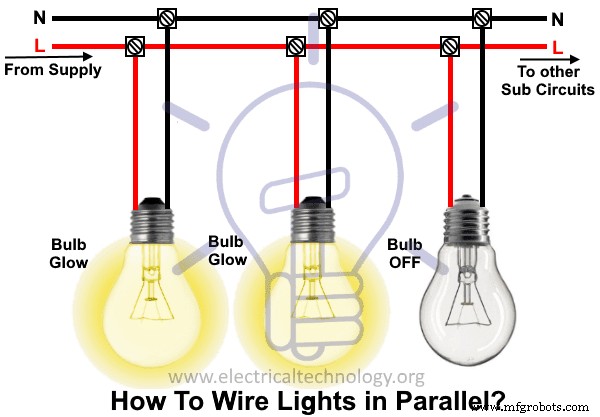
In the above fig, it is clearly shows that all the light bulbs are connected in parallel i.e. each bulb connected through separate Line (also known as Live or Phase) and Neutral wire.
In parallel circuit, adding or removing one lamp from the circuit has no effect on the others lamps or connected devices and appliances because the voltage in parallel circuit is same at each point but the flowing current is different. Any number of lighting points or load can be added (according to the circuit or sub-circuit load calculation) in this kind of circuit by simply extending the L and N conductors to other lamps.
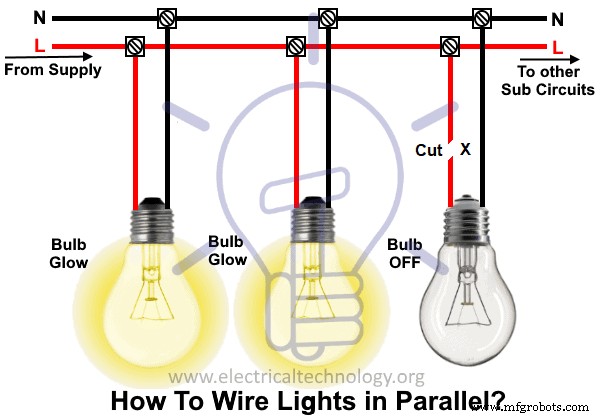
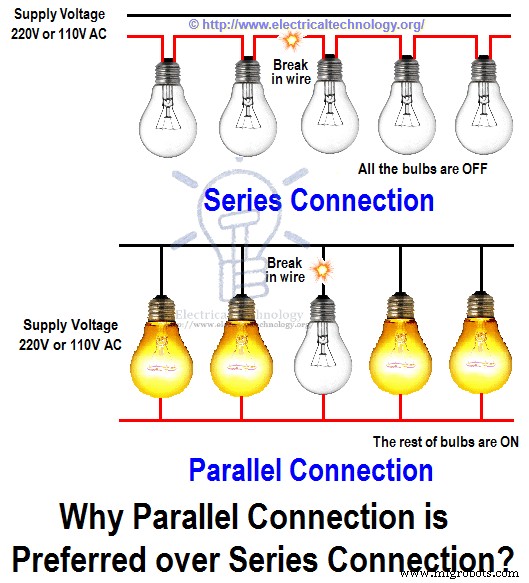
As each lamp or Bulb is connected between Line L and Neutral N separately, if one of the light bulb gets faulty, the rest of the circuit will work smoothly as shown in fig below. Here, you can see there is a cut in the line wire connected to lamp 3, so the bulb is switch OFF and the rest circuit is working properly i.e. bulbs are glowing.
Also, if we control each lamp by single way (SPST=Single Pole Single Through) switch in parallel lighting circuit, We will be able to switch ON / OFF each bulb from from separate switch or if we switch OFF a bulb, the rest lighting points won’t affected as is it happens only in series lighting connection where all the connected load would be disconnected if we close the switch.
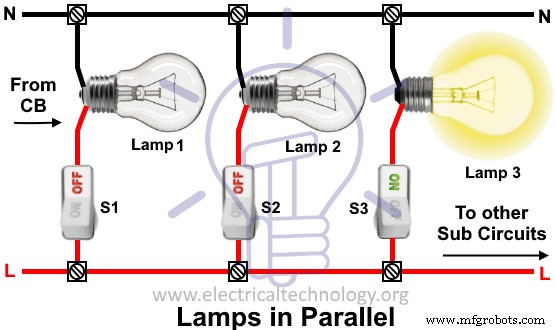
How to Control Light Bulb from Single Way Switch in Parallel Lighting?
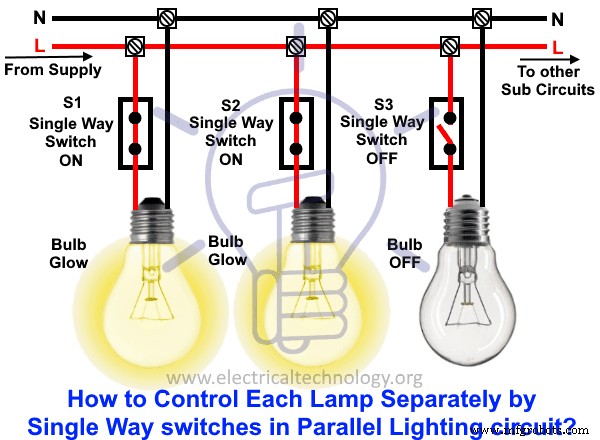
In below fig, We have controlled three light bulbs from three separate single way switches connected in between line and neutral wires. The first two bulbs are glowing as the switches are at ON position while the third one bulb is switched OFF.
Advantages of Parallel Lighting Circuit:
- Each connected electrical device and appliance are independent from others. This way, switching ON / OFF a device won’t affect the other appliances and their operation.
- In case of break in the cable or removal of any lamp will not break the all circuits and connected loads, in other words, other lights/lamps and electrical appliances will still work smoothly.
- If more lamps are added in the parallel lighting circuits, they will not be reduced in brightness (as it happens only in series lightning circuits). Because voltage is same at each point in a parallel circuit. In short, they get the same voltage as the source voltage.
- It is possible to add more light fixture and load points in parallel circuits according to future need as far as the circuit is not overloaded.
- Adding additional devices and components wont increase the resistance but will decrease the overall resistance of the circuit especially when high current rating devices are used such as air conditioner and electric heaters.
- parallel wiring is more reliable, safe and simple to use.
Disadvantages:
- More size of cable and wire is used in parallel lighting wiring circuit.
- More current needed when additional light bulb added in the parallel circuit.
- Battery runs out quicker for DC installation.
- The parallel wiring design is more complex as compare to series wiring.
Good to know:
- Switches and fuses must be connected through line (Live) wire.
- Connecting electrical devices and appliances like fan, outlet, light bulbs etc in parallel is a prefer way instead of series wiring.
- Parallel or series-parallel wiring method is more reliable instead of series wiring.
Warning:
- Electricity is Our Enemy, if you give it a chance to kill you, Remember, they will never miss it. Please read all caution and instruction while doing this tutorial in practical.
- Disconnect the power source before servicing, repairing or installing electrical equipments.
- Never try to work on electricity without proper guidance and care.
- Work with electricity only in presence of those persons who has good knowledge and practical work and experience who know how to deal with electricity.
- Read all instruction and cautions and follow them strictly.
- Doing your own electrical work is dangerous as well as illegal in some areas.Contact the licensed electrician or the power supply company before practicing any change in electrical wiring connection.
- The author will not be liable for any losses, injuries, or damages from the display or use of this information or if you try any circuit in wrong format. So please! Be careful because it’s all about electricity and electricity is too dangerous.
Related basic home electrical wiring installation tutorials:
- How To Wire Switches In Series?
- How To Wire Switches in Parallel?
- How To wire Lamps in Series?
- What is the objection to have lamps in a house-lighting circuit connected in series?
- Introduction to Series, Parallel and Series-Parallel Connections
- Series, Parallel and Series-Parallel Connection of Batteries
- Difference Between Series and Parallel Circuit – Comparison
Industrial Technology
- Parallel Circuit Fundamentals: Voltage, Resistance, and Current Rules
- Parallel Resistor–Capacitor AC Circuits: Analysis, Impedance, and Ohm’s Law
- Guide to Wiring Lights in Series: Steps, Tips, and Best Practices
- Wire Two Switches in Parallel to Control a Single Light
- Control Individual Lamps with Independent Switches in a Parallel Lighting Circuit
- Installing an AFCI Breaker: Complete Wiring Guide for Single‑Phase Systems
- Step‑by‑Step Guide: Wiring GFCI Circuit Breakers for 1‑ to 4‑Pole Systems
- Installing a GFCI Outlet: Step‑by‑Step Wiring Guide & Circuit Diagrams
- Step-by-Step Guide: Wiring Batteries in Parallel with Solar Panels & UPS for Reliable Power
- How Many Lights Can Fit on a Single Circuit Breaker? Expert Guide for 15A, 20A & 10A Circuits