



9 Essential Milling Types Every Machinist Should Master
Here’s a quick, simple and visual way to see the most commonly used end mills in today’s machining and their basic application in this must-see infographic.
Designed with cutting teeth on the face and edge of the body, end mills are intended to cut metal in several directions. While they might look similar to drills, different end mill types function in distinct and specific ways. They are used in applications for profile milling, tracer milling, shape milling, face milling and plunging. Think: Cutting out the sides of a given material including steel, aluminum, titanium and hybrid, composite materials, such as carbon-fiber reinforced polymer, which is used in many aerospace applications.
Certain end mill types are manufactured for specific diameters, lengths, flutes and protective coatings. These coatings include titanium nitride, titanium carbonitride, titanium aluminum nitride, aluminum titanium nitride and zirconium nitride.
The variety of end mill coatings work with the spectrum of metal used in today’s machining. Coatings help make tools last longer—and often allow tools to be run at much higher spindle rates than uncoated tools.
Another key aspect of end mills are their unique flute design. MSC, on its “Tech Essentials End Mills” page, describes them as:
“Flutes feature grooves or valleys that are cut into the body of the tool. A higher number of flutes increases the strength of the tool and reduces space or chip flow. End mills with less flutes on the cutting edge will have more chip space, while end mills with more flutes will be able to be used on harder cutting materials.”
If you are new to end mills, here’s a quick, visual way to know the most commonly used end mills in today’s machining. It’s certainly not all of them—but it’s a great place to start.
Expand Expand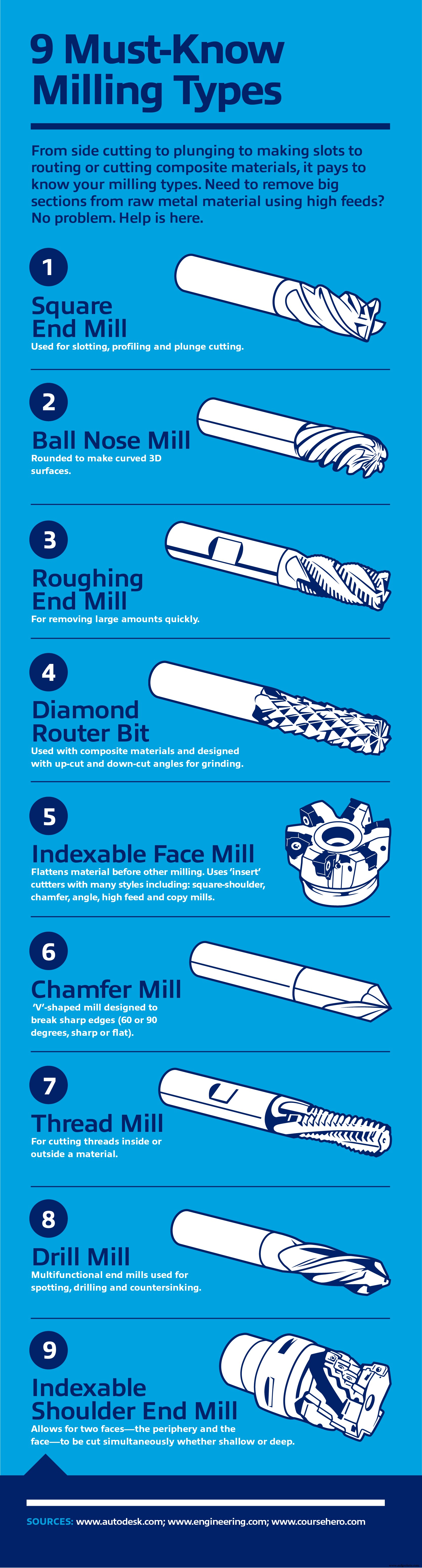
Spotlight on Tooling
Here are the top articles on the choice of tools and productivity on Better MRO:
Milling Techniques to Improve Metal Removal Rate
8 Facts You May Not Know About … Milling Titanium
Aerospace in Focus: Drilling and Milling CFRP Composites
IMTS 2018 VIDEO: Success—High-Feed Milling Cuts Machining Time by 78%
How to Maximize Throughput and Part Quality When Threading
How to Maximize Machine Productivity: Chip Thinning
Video: How to Measure a Milling Machine for a DRO Unit
The Right Tooling Helps Today’s Metrics and Tomorrow’s Machinists
Optimizing Tool Life: The Effect of Lead Angles on Turning Operations
What other end mills do you use? Share your experience in the forum [registration required].
Industrial Technology
- Comprehensive Guide to Buying a Used CNC Milling Machine
- Mastering CNC Milling: A Comprehensive Guide for Precision Machining
- Explore 15 Essential Milling Machine Types for Precision Metalwork
- Understanding Rolling Mills: Types, Processes, and Applications
- Discover the Key Types of Milling Machines for Metal Machining
- Comprehensive Guide to Milling Cutters: Types & Applications
- Understanding Milling Machines: Definition, Process & Types
- CNC Milling Services: Precision, Speed, and Complex Shape Solutions
- Exploring the Varieties of CNC Milling Operations
- Types of Milling Machines: Choosing the Right Tool for Your Project