



Understanding Electrical Switches: Types, Functions, and Applications
While switches are foundational to electrical systems, a deep understanding of their types is essential for the chapters that follow—those that examine the mechanical switch‑based digital logic of earlier technology.
Studying switch‑driven circuits alongside solid‑state logic gates simplifies both concepts and lays the groundwork for mastering Boolean algebra, the mathematical backbone of digital logic.
What Is an Electrical Switch?
An electrical switch is a device that interrupts or completes the flow of electrons in a circuit. It behaves as a binary element—either fully “closed” (on) or fully “open” (off). The chapter explores the various switch categories that exist today.
Learn the Different Types of Switches
The simplest switches consist of two conductors brought together by an actuating mechanism. More sophisticated switches incorporate electronic circuitry that responds to physical stimuli such as light or magnetic fields.
Regardless of complexity, a switch ultimately presents two connection terminals that are either joined by an internal contact or left apart.
Switches intended for manual operation are known as hand switches, and they come in several common variants:
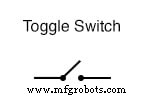
Toggle Switches
Toggle switches are actuated by a lever that can be positioned in one of two or more discrete stances. A typical household light switch is a classic example.
Most toggle switches hold their lever in any selected position; others incorporate a spring that returns the lever to a default “normal” position, enabling momentary operation.
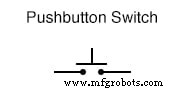
Pushbutton Switches
Pushbutton switches are two‑position devices that are actuated by pressing and releasing a button. Most include a spring that restores the button to its “out” position for momentary operation.
Some pushbuttons latch on or off with each press, while others stay depressed until manually released. The latter often feature a mushroom‑shaped button for ergonomic push‑pull action.
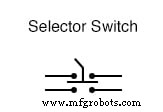
Selector Switches
Selector switches use a rotary knob or lever to choose one of several positions. Like toggle switches, they can either remain in the chosen position or employ a spring return for momentary use.
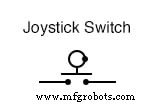
Joystick Switches
A joystick switch is actuated by a lever that can move in multiple axes. One or more internal contacts open or close depending on the lever’s direction—and sometimes on how far it is moved.
The circle‑and‑dot notation in the switch symbol indicates the required lever motion. Joystick hand switches are widely used for crane and robotic control.
Some switches are specifically designed to be actuated by machine motion rather than by human hand. These are called limit switches because they are used to stop a machine when a component reaches a predetermined limit.
Limit Switches
Limit switches closely resemble rugged toggle or selector hand switches, but their levers are driven by a machine part. A small roller bearing on the lever tip protects against wear from repeated contact.
Proximity Switches
Proximity switches detect the approach of a metallic part via magnetic or high‑frequency electromagnetic fields.
Basic models use a permanent magnet to actuate a sealed switch when a metal piece comes within about one inch. More advanced types employ a coil energized with a high‑frequency current; the presence of metal changes the current magnitude, triggering the circuit.
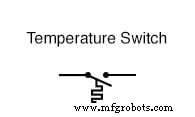
The electronic variant is shown by the diamond‑shaped box around the symbol. A non‑electronic proximity switch uses the same symbol as a lever‑actuated limit switch.
Optical proximity switches use a light source and photodetector. The beam is interrupted or reflected by the machine part, allowing the switch to sense position. These are also valuable in safety interlocks to detect personnel in hazardous zones.
The Different Types of Process Switches
In industrial settings, switches that respond to physical process variables are indispensable. They can trigger alarms when parameters drift or shut down equipment to prevent damage.
Speed Switches
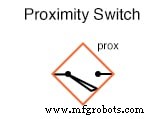
Speed switches measure shaft rotation using centrifugal weights or non‑contact optical/magnetic sensors.
Pressure Switches
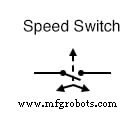
Pressure switches actuate via a piston, diaphragm, or bellows that translate gas or liquid pressure into mechanical force.
Temperature Switches
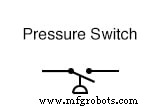
A common temperature sensor is the bimetallic strip—a thin sheet of two metals with different thermal expansion rates. As temperature changes, the strip bends, actuating the switch.
Other designs use a brass bulb filled with liquid or gas linked to a pressure‑sensing element. Heating the bulb expands the contents, increasing pressure and triggering the switch.
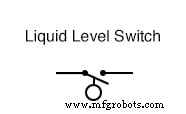
Liquid Level Switch
Liquid level switches can use a floating element that contacts a switch when the liquid rises to a preset height. If the liquid conducts electricity, a pair of probes can bridge the gap, and a relay is triggered by the small current that flows.
Level detection for solids—such as grain or feed—often employs a paddle wheel or tuning‑fork sensor that detects the absence of motion when the bin reaches the set level.
Liquid Flow Switch
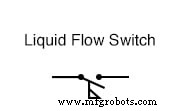
A flow switch installed in a pipe monitors flow rate by a paddle or vane that is driven by the fluid. Other variants are differential‑pressure switches that sense the pressure drop across a built‑in restriction.
Nuclear Level Switch
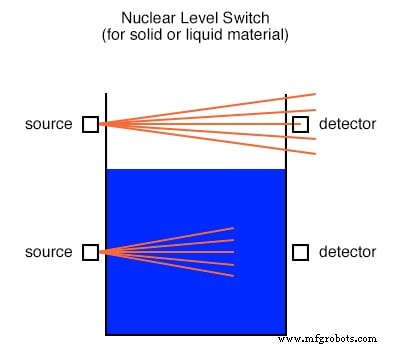
A nuclear level switch consists of a weak radioactive source and a detector positioned across the vessel’s diameter. As material builds up above the source, radiation attenuation reduces the detector signal, triggering a relay to indicate level.
Because the source and detector are external to the vessel, no physical intrusion is required, and the radiation used is safe for personnel.
All Switches Have Multiple Applications
There is rarely a single “perfect” switch for any job; each type offers trade‑offs in durability, response time, and suitability for the environment. Selecting the right switch is key to reliable operation.
REVIEW:- A switch is an electrical device, usually electromechanical, used to control continuity between two points.
- Hand switches are actuated by human touch.
- Limit switches are actuated by machine motion.
- Process switches are actuated by changes in some physical process (temperature, level, flow, etc.).
RELATED WORKSHEETS:
- Switches Worksheet
Industrial Technology
- Understanding Membrane Switches: Design, Function, and Benefits
- Circuit With a Switch: A Practical Guide to Basic Electrical Circuits
- Commutating Diode Experiment: Suppressing Inductive Kickback with a Neon Lamp
- Resistor Types Explained: From Potentiometers to Thermistors
- Hand‑Actuated Switches: Types, Symbols, and Applications
- Process‑Actuated Switches: How They Work and When They Change State
- Mastering the C# Switch Statement: Syntax, Examples & Best Practices
- Understanding Variables in C#: Types, Storage, and Usage
- Mastering Limit Switches: A Comprehensive Guide for Safety and Efficiency
- Understanding Proximity Switches: How They Detect and Control Motion