



Designing Reliable Switch Contacts: Materials, Types, and Protection Strategies
A switch’s primary function is to reliably connect and disconnect two conductors on command. The elements that make and break this electrical path are called contacts. While the underlying principle can be as simple as a lever forcing two copper wires together, a truly dependable switch design demands careful material selection, precise mechanical guidance, and protection against environmental and electrical stresses.
Contact Materials and Performance
Industrial contacts are usually made from a silver or silver‑cadmium alloy. These metals retain their conductivity even when exposed to surface corrosion or oxidation, ensuring low contact resistance over time. Gold-plated contacts offer the best corrosion resistance and a very low wetting current—the minimum current needed to keep the surface clean—making them ideal for low‑current, high‑reliability applications. However, gold’s limited current‑carrying capacity and susceptibility to cold welding at high forces mean it is often reserved for specialized switches.
Regardless of alloy, contacts are mounted on a precise guide that ensures a square, even contact area. This geometry maximizes reliability and minimizes resistance, which is critical when the switch must carry large currents.
Factors Limiting Switch Contact Ampacity
Switch contacts can handle currents ranging from a few amperes to several thousand amperes. Their maximum load is constrained by:
- Heat generated during conduction
- Arcing energy when contacts open or close
- Voltage present across open contacts, which can cause spark gaps
In corrosive or explosive atmospheres, the risk of contact degradation or accidental arcing increases dramatically, making sealed contacts a preferred choice.
Sealed‑Contact Switches
Sealed contacts eliminate direct exposure to the surrounding air, protecting against corrosion, flammable vapors, and mechanical contamination. Two common sealed‑contact technologies are mercury switches and magnetic reed switches.
Mercury Switches
A mercury switch is a sealed glass bulb containing liquid mercury. Tilting the bulb brings the mercury into contact with internal metal probes, closing the circuit. Because mercury is an excellent conductor and remains liquid at room temperature, the switch offers reliable operation in hazardous environments. Typical ratings are limited to a few amperes and up to 120 V due to the small size of the bulb and the toxic nature of mercury, which requires careful handling and disposal.
Magnetic Reed Switches
Reed switches house two thin ferromagnetic reeds inside a sealed tube. When an external magnetic field is applied—usually by a permanent magnet moved by an actuator—the reeds snap together, closing the circuit. Reed switches are more vibration‑resistant than mercury switches because no liquid is involved, but they typically handle lower currents and voltages. They are widely used in sensor applications and safety interlocks.
Snubber Circuits for Arc Suppression
Alternating‑current (AC) arcs extinguish more readily than direct‑current (DC) arcs because the AC waveform repeatedly reverses polarity. DC switching, especially across inductive loads, can generate high‑voltage spikes that sustain a robust arc. A snubber circuit—a series combination of a capacitor and resistor—parallel to the contacts absorbs the voltage surge and limits arcing:
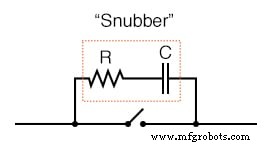
The capacitor quickly charges, counteracting the voltage spike, while the resistor limits the discharge current when the contacts close again. Engineers must balance the benefits of reduced wear against the risk of a failed snubber that could short the circuit at all times. Automotive ignition systems routinely employ this approach, where the lifespan of distributor points depends directly on the condition of the associated condenser.
Wetting Current: The Minimum for Contact Health
Paradoxically, a tiny amount of periodic arcing can keep contacts clean by preventing corrosion build‑up. If a mechanical switch operates below its wetting current, the contacts may become dirty and resistive, leading to premature failure. The wetting current is usually well below the switch’s maximum rating, but for very low‑current circuits—such as digital logic interlocks—gold‑plated contacts are recommended because they maintain conductivity with minimal current.
Key Takeaways
- Switch contacts are critical components that must be made from corrosion‑resistant alloys and precisely guided.
- Mercury and reed switches provide sealed‑contact solutions for hazardous or corrosive environments.
- DC switching subjects contacts to more severe arcing than AC; snubber circuits mitigate this effect.
- Maintaining at least the wetting current ensures long‑term contact reliability, especially in low‑current applications.
RELATED WORKSHEETS:
- Switches Worksheet
Industrial Technology
- Why Tungsten Contacts Power Reliable Electrical Appliances
- Circuit With a Switch: A Practical Guide to Basic Electrical Circuits
- Commutating Diode Experiment: Suppressing Inductive Kickback with a Neon Lamp
- Understanding Electrical Switches: Types, Functions, and Applications
- Understanding Normal Positions and Contact Sequences in Process Switches
- Eliminating Contact Bounce in Mechanical Switches
- Understanding Digital Logic Functions: OR, AND, NOT, and Beyond
- Optimizing Ohmic Contacts on p‑GaAs Nanowires for Low‑Resistance, High‑Reliability Devices
- Key Factors in Designing Contactor Contacts
- Expert Guide to Electronic Relay Switch Circuits: NPN, PNP, and N/P Channel Designs