



Designing Wattmeters: Leveraging Dynamometer Movements for Accurate Power Measurement
In an electrical circuit, power equals voltage multiplied by current; therefore, a wattmeter must measure both parameters to deliver accurate readings.
Electrodynamometer Movement
A dedicated meter movement designed for power measurement is known as a dynamometer movement. It shares similarities with D’Arsonval or Weston movements, featuring a lightweight moving coil that drives the pointer. Unlike those classic designs that rely on a permanent magnet to generate the magnetic field, a dynamometer employs a stationary coil to provide that field.
In a dynamometer, the moving coil is energized by the circuit’s voltage, while the stationary coil is powered by the circuit’s current. A typical wiring diagram looks like this:
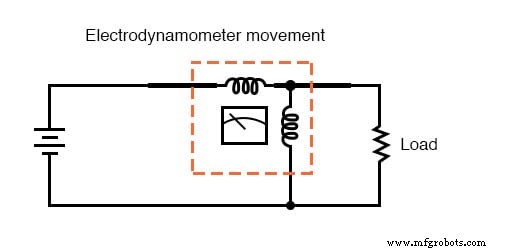
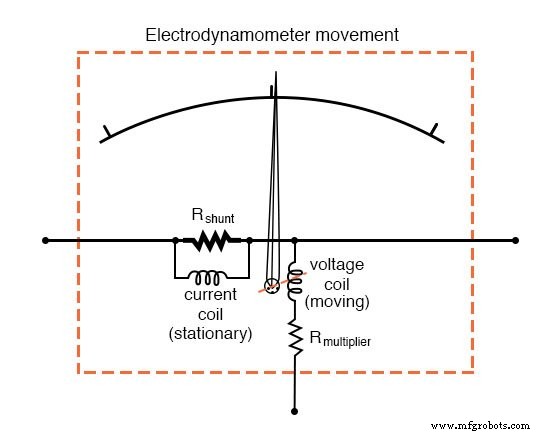
The horizontal coil measures load current, and the vertical coil measures load voltage. The moving voltage coil is usually connected in series with a range resistor to limit the full‑load voltage applied to it, and the stationary current coil may be paired with precision shunt resistors to divide the load current around it.
When building custom dynamometers, the stationary coil can be constructed from heavier wire without compromising meter response, often eliminating the need for precision shunts.
REVIEW:
- Wattmeters frequently employ dynamometer movements, which use both voltage and current coils to move the needle.
Industrial Technology
- Exploring Voltage Addition with Series Battery Connections
- Voltage Divider Lab: Design, Measurement, and Kirchhoff’s Voltage Law Verification
- Thermoelectricity: Understanding Thermocouples and the Seebeck Effect
- Using Commutating Diodes to Protect Inductive Loads
- Tachogenerators: Precision Speed Measurement for Industrial Motors and Equipment
- Understanding Mutual Inductance and Transformers: Principles, Applications, and Key Concepts
- Understanding AC Waveforms: Sine Waves, Frequency, and Oscilloscope Basics
- High‑Voltage PCB Design: Materials, Safety, and Best Practices
- Comprehensive Guide to Designing Substation Grounding and Earthing Systems
- Mastering Air-Core Inductor Design: A Complete Guide