



Thermoelectricity: Understanding Thermocouples and the Seebeck Effect
Parts and Materials
- Length of bare (uninsulated) copper wire
- Length of bare (uninsulated) iron wire (or aluminum if unavailable)
- Candle
- Ice cubes
Cross‑References
Lessons In Electric Circuits, Volume 1, Chapter 9: “Electrical Instrumentation Signals”
Learning Objectives
- Illustrate how a thermocouple functions and its practical purpose.
Schematic Diagram
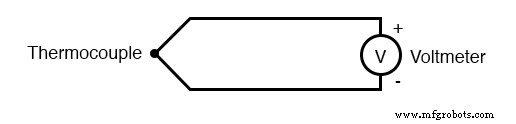
Illustration
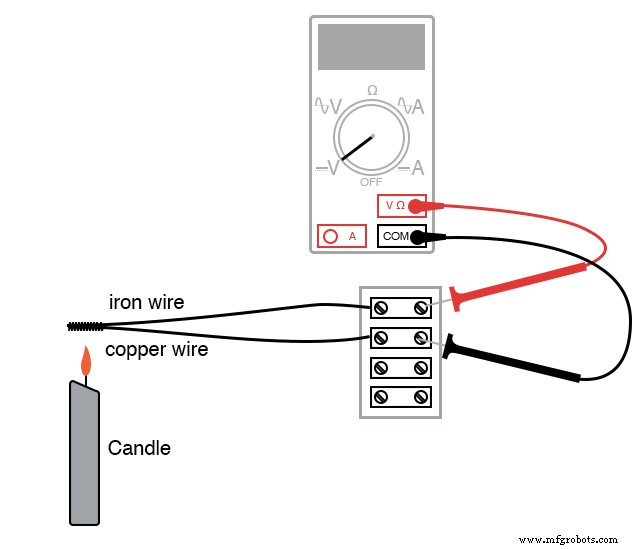
Experiment Instructions
1. Twist one end of the iron wire to one end of the copper wire. Connect the free ends to a terminal strip. Set a voltmeter to its most sensitive range and connect it to the strip terminals. The meter should read almost zero voltage.
2. This assembly is a thermocouple, a device that generates a voltage proportional to the temperature difference between its junction (the twisted tip) and the reference points on the strip. When the tip temperature equals the strip, the voltage is zero.
3. Light a candle and insert the twisted tip into the flame. Observe the voltmeter: a positive voltage should appear. Remove the tip, allow it to cool, and confirm the voltage returns to near zero.
4. Touch the tip to an ice cube. Record the voltage; note whether it is larger or smaller than the flame reading and whether its polarity reverses. Then warm the tip by holding it between your fingers and watch the voltage trend toward zero.
5. The experiment demonstrates the Seebeck effect—the generation of a voltage due to a temperature gradient along a conductor. Thermocouples leverage this principle; the voltage is the difference between the Seebeck voltages of the two dissimilar metals.
Scientific Background
A thermocouple consists of two different metals joined at one end. When the junction experiences a temperature difference relative to the other ends, each metal develops its own Seebeck voltage. The measured voltage is the difference between these two voltages:
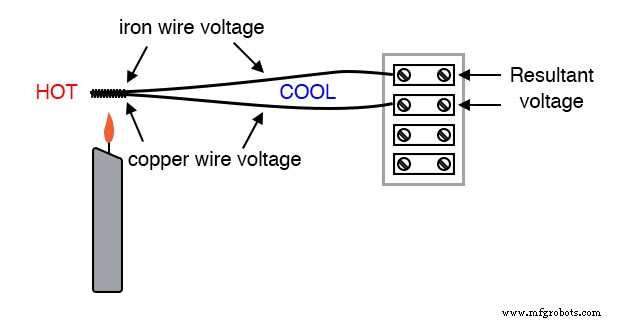
Because the relationship between temperature difference and voltage is repeatable and largely linear, thermocouples are widely used as reliable temperature sensors. By selecting different metal pairs, one can tailor the measurable temperature range.
Industrial Technology
- Exploring Voltage Addition with Series Battery Connections
- Voltage Divider Lab: Design, Measurement, and Kirchhoff’s Voltage Law Verification
- Potentiometric Voltmeter: Precise Voltage Measurement with Minimal Loading
- Build a Potato Battery: A Step‑by‑Step Guide to DIY Electrochemical Power
- Low‑Voltage AC Power Supply: Phase‑Shift Circuit Components & Best Practices
- Tachogenerators: Precision Speed Measurement for Industrial Motors and Equipment
- Understanding AC Waveforms: Sine Waves, Frequency, and Oscilloscope Basics
- The Thermometer: From Galileo’s Thermoscope to Modern Digital Sensors
- AuGe12: Premium Gold-Based Soft Solder Alloy
- Rhenium: The Ultra‑High‑Density Metal for Filaments and Refractory Applications