



Thermocouples: Harnessing the Seebeck Effect for Accurate Temperature Measurement
Seebeck Effect
The Seebeck effect is a cornerstone of modern temperature instrumentation. When two dissimilar metals are joined, a small voltage develops across the junction that is directly proportional to the temperature difference along the wires. This voltage, known as the Seebeck voltage, is most easily observed with a simple two‑metal junction and forms the basis of thermocouple operation.
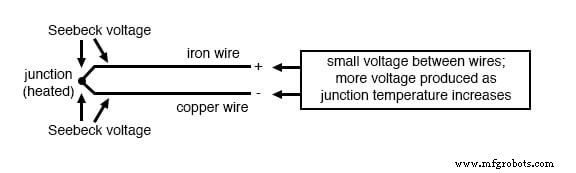
Because the relationship between temperature and Seebeck voltage is nearly linear, measuring the voltage produced by a heated junction allows us to calculate the exact temperature of that junction. This electric method of temperature measurement is highly reliable and widely used in industry.
Thermocouples
A thermocouple is a device that combines two dissimilar metals to measure temperature. Instrumentation‑grade thermocouples use high‑purity metals to ensure a stable, predictable temperature/voltage relationship.
Typical Seebeck voltages are small—often only a few tens of millivolts across a wide temperature range—making precise measurement challenging. Additionally, any junction between dissimilar metals produces a temperature‑dependent voltage, which introduces complications when connecting the thermocouple to a voltmeter.
Measurement Junction
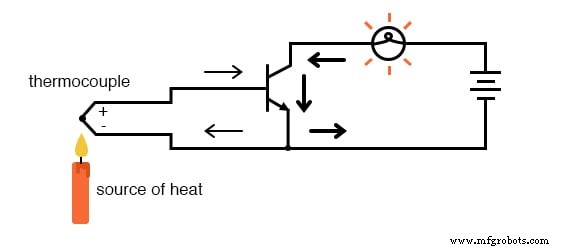
The junction where the thermocouple meets the measuring instrument is called the measurement junction. Because this connection often involves dissimilar metals (such as copper), a second temperature‑dependent voltage is generated. The voltmeter reads the voltage difference between the measurement junction and the reference junction, not the absolute voltage at the measurement point.
Reference Junction
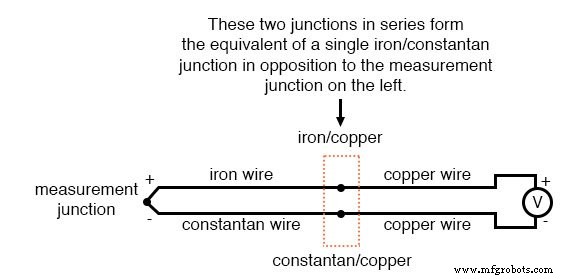
The second junction—where the thermocouple wires meet the instrument’s copper leads—is known as the reference or cold junction. Its temperature must be known to correct the measurement. In many applications, the reference junction is located near the instrument to simplify compensation. For high‑temperature measurements, the reference can be placed far away and its temperature measured by a separate, robust sensor that can survive the harsh environment.
Reference Junction Compensation
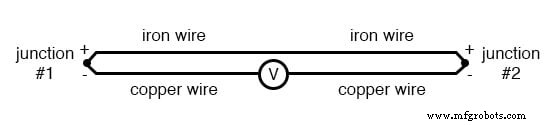
Compensation is typically performed with a dedicated circuit that measures the reference junction’s temperature and generates a counter‑voltage to neutralize its effect. Although this adds complexity, the approach is essential because the thermocouple itself cannot survive the extreme temperatures of many industrial processes.
Current Flow and Voltage Accuracy
The Seebeck voltage is fixed by temperature, but the resulting current depends on the circuit resistance. In practice, a thermocouple circuit is designed to draw virtually no current, ensuring minimal voltage drop along the thermocouple wires. Any voltage drop—especially in the millivolt range—can cause significant measurement errors.
Early thermocouple meters employed null‑balance potentiometers to eliminate current flow. Modern instruments use low‑noise semiconductor amplifiers that preserve the junction voltage while drawing negligible current.
Thermopile
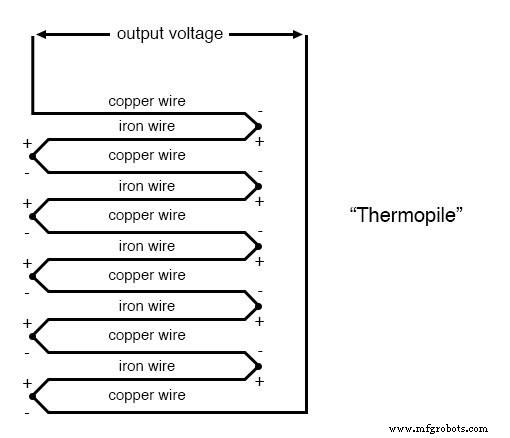
By connecting many thermocouple junctions in series, a thermopile can generate substantial voltage and current. Each hot/cold pair contributes its Seebeck voltage, and the total output is the sum of all pairs.
Peltier Effect
When a thermopile carries current, heat is transferred from the hot side to the cold side—a phenomenon known as the Peltier effect. This effect underlies thermoelectric cooling and heating devices.
Measuring Average Temperatures
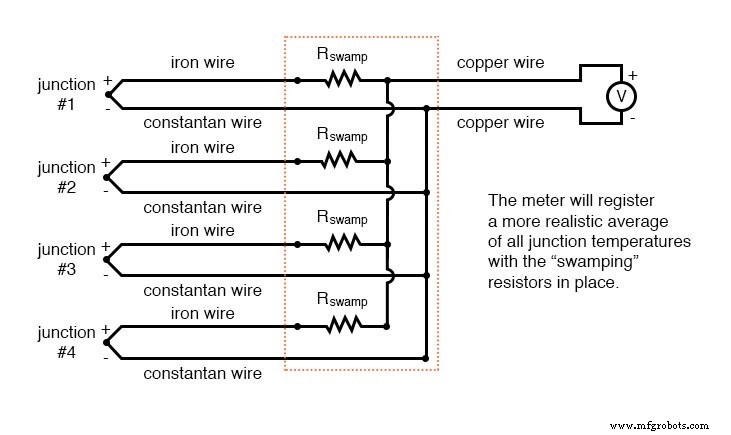
Connecting multiple thermocouples in parallel averages their voltages, yielding the mean temperature across several points. However, accurate averaging requires equal wire resistances; otherwise, longer wires introduce higher resistance and reduce their influence on the average.
To equalize branch resistances, high‑value “swamping” resistors can be added to each thermocouple line. These resistors dominate the branch resistance, minimizing the impact of wire length differences.
Practical Considerations
Because thermocouple voltages are so low, all connections must be clean and secure. The reference junction should remain close to the measuring instrument to facilitate accurate compensation. Despite these constraints, thermocouples remain the most robust and widely used method for industrial temperature measurement.
Key Takeaways
- The Seebeck effect produces a voltage proportional to the temperature of a dissimilar‑metal junction.
- Every thermocouple circuit has a measurement junction (at the point of interest) and a reference junction (typically at the instrument).
- Opposing thermocouple junctions can generate a voltage proportional to the temperature difference; a series of such junctions forms a thermopile.
- Current flowing through a thermopile transfers heat from hot to cold junctions—the Peltier effect.
- Parallel thermocouples can provide an average temperature, but equal resistances (or swamping resistors) are essential for accurate averaging.
- Maintaining near‑zero current and secure connections is critical for precise thermocouple measurements.
Industrial Technology
- Thermoelectricity: Understanding Thermocouples and the Seebeck Effect
- Understanding the PN Junction: From Structure to Diode Behavior
- Understanding Junction Diodes: From Crystal Detectors to Modern Silicon Devices
- Understanding Bipolar Junction Transistors: Structure, Operation, and Amplification
- Temperature Coefficient of Resistance: How Temperature Alters Conductivity
- The Thermometer: From Galileo’s Thermoscope to Modern Digital Sensors
- Bearing Temperature Chart: Ideal Operating Ranges & Lubrication Guidelines
- Precision Bearing Temperature Sensor – Accurate Detection & Monitoring
- AuGe12: Premium Gold-Based Soft Solder Alloy
- Rhenium: The Ultra‑High‑Density Metal for Filaments and Refractory Applications