



Low‑Voltage AC Power Supply: Phase‑Shift Circuit Components & Best Practices
PARTS AND MATERIALS
- Low-voltage AC power supply
- Two capacitors, 0.1 µF each, non-polarized (Radio Shack catalog # 272-135)
- Two 27 kΩ resistors
I recommend ceramic disk capacitors because they are insensitive to polarity (non-polarized), inexpensive, and durable. Avoid capacitors with any kind of polarity marking, as these will be destroyed when powered by AC!
CROSS-REFERENCES
Lessons In Electric Circuits, Volume 2, chapter 1: “Basic AC Theory”
Lessons In Electric Circuits, Volume 2, chapter 4: “Reactance and Impedance—Capacitive”
LEARNING OBJECTIVES
- How out-of-phase AC voltages do not add algebraically, but according to vector (phasor) arithmetic
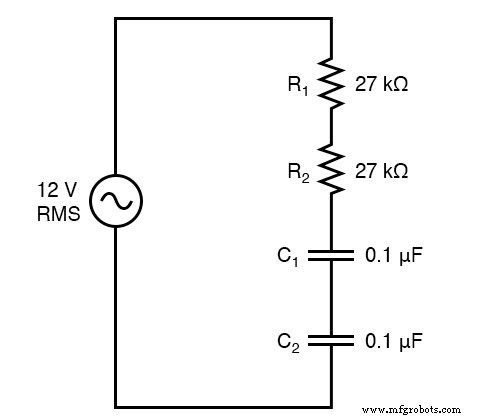
SCHEMATIC DIAGRAM
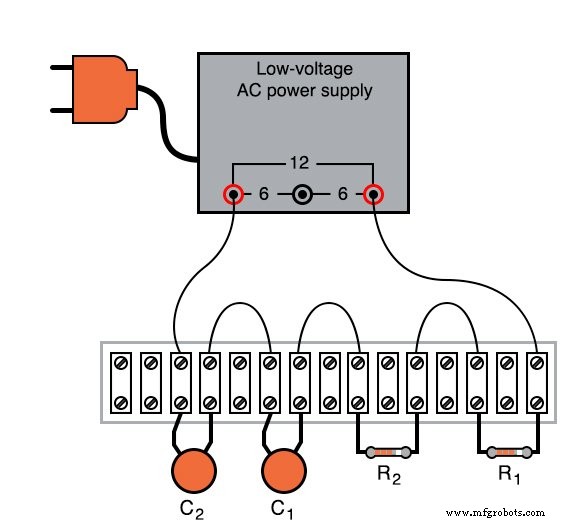
ILLUSTRATION
INSTRUCTIONS
Build the circuit and measure voltage drops across each component with an AC voltmeter. Measure total (supply) voltage with the same voltmeter. You will discover that the voltage drops do not add up to equal the total voltage. This is due to phase shifts in the circuit: voltage dropped across the capacitors is out-of-phase with voltage dropped across the resistors, and thus the voltage drop figures do not add up as one might expect. Taking phase angle into consideration, they do add up to equal the total, but a voltmeter doesn’t provide phase angle measurements, only amplitude.
Try measuring voltage dropped across both resistors at once. This voltage drop will equal the sum of the voltage drops measured across each resistor separately. This tells you that both the resistors’ voltage drop waveforms are in-phase with each other since they add simply and directly.
Measure voltage dropped across both capacitors at once. This voltage drop, like the drop measured across the two resistors, will equal the sum of the voltage drops measured across each capacitor separately. Likewise, this tells you that both the capacitors’ voltage drop waveforms are in-phase with each other.
Given that the power supply frequency is 60 Hz (household power frequency in the United States), calculate impedances for all components and determine all voltage drops using Ohm’s Law (E=IZ ; I=E/Z ; Z=E/I). The polar magnitudes of the results should closely agree with your voltmeter readings.
COMPUTER SIMULATION
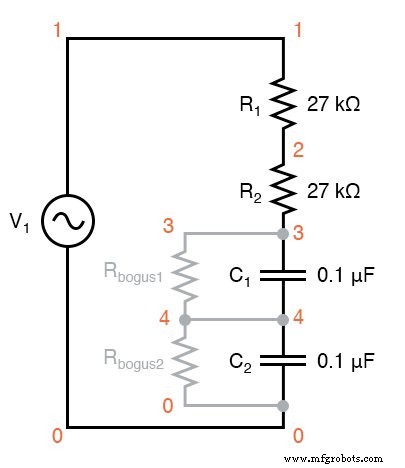
Schematic with SPICE node numbers:
The two large-value resistors Rbogus1 and Rbogus1 are connected across the capacitors to provide a DC path to ground in order that SPICE will work. This is a “fix” for one of SPICE’s quirks, to avoid it from seeing the capacitors as open circuits in its analysis. These two resistors are entirely unnecessary in the real circuit.
Netlist (make a text file containing the following text, verbatim):
phase shift v1 1 0 ac 12 sin r1 1 2 27k r2 2 3 27k c1 3 4 0.1u c2 4 0 0.1u rbogus1 3 4 1e9 rbogus2 4 0 1e9 .ac lin 1 60 60 * Voltage across each component: .print ac v(1,2) v(2,3) v(3,4) v(4,0) * Voltage across pairs of similar components .print ac v(1,3) v(3,0) .end
RELATED WORKSHEET:
- AC Power Worksheet
- AC phase Worksheet
Industrial Technology
- Exploring Voltage Addition with Series Battery Connections
- Voltage Divider Lab: Design, Measurement, and Kirchhoff’s Voltage Law Verification
- Thermoelectricity: Understanding Thermocouples and the Seebeck Effect
- Potentiometric Voltmeter: Precise Voltage Measurement with Minimal Loading
- Build a Potato Battery: A Step‑by‑Step Guide to DIY Electrochemical Power
- Voltage Regulator Experiment with a 12‑Volt Zener Diode
- Tachogenerators: Precision Speed Measurement for Industrial Motors and Equipment
- Understanding AC Waveforms: Sine Waves, Frequency, and Oscilloscope Basics
- Understanding AC Phase Shift: How Waveforms Lead and Lag
- Vector Addition and AC Voltage Superposition: A Practical Guide