



Demonstrating Sound Cancellation with Speaker Phase Reversal
Sound Cancellation Experiment
Components and Materials
- Low‑voltage AC power supply
- Two identical woofer‑type speakers
- Two 220 Ω resistors (to limit power to each speaker)
For best results, use matching speakers enclosed in standard speaker cabinets. The resistors prevent over‑driving the drivers when the AC supply is connected.
Cross‑References
Lessons In Electric Circuits, Vol. 2, Chap. 1: Basic AC Theory
Learning Objectives
- Illustrate how phase shift can cause constructive or destructive interference between waves
- Highlight the role of speaker phasing in stereo audio systems
Schematic Diagram
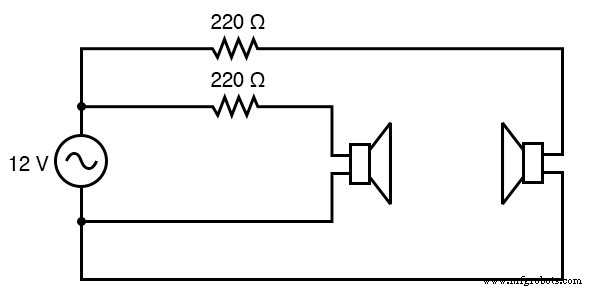
Illustration
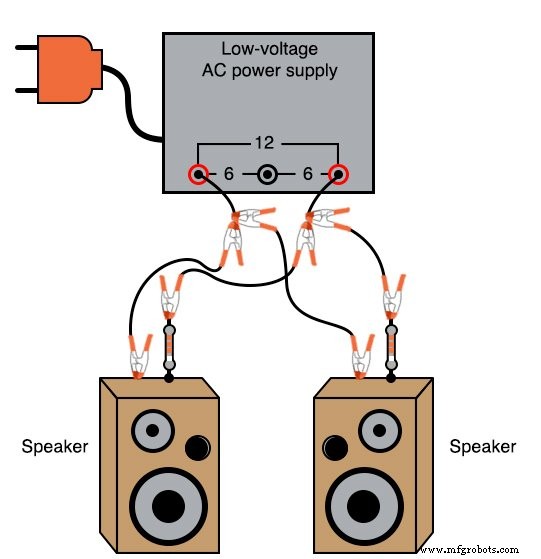
Instructions
- Connect each speaker to the AC supply through a 220 Ω resistor. This resistor controls the power delivered to the driver.
- Generate a low‑frequency tone at 60 Hz and verify that both speakers emit the sound.
- Place the speakers one to two feet apart, facing each other, and listen to the 60 Hz tone.
- Reverse the polarity (swap the positive and negative leads) on one speaker only. Compare the perceived volume.
- Repeat the polarity swap back and forth, noting how the sound level changes.
Reversing one speaker’s connections inverts its phase. When the two waves are in phase, they reinforce each other and the tone is louder. When they are 180° out of phase, they cancel, producing a noticeable drop in volume. This principle applies to all wave phenomena—acoustic, electrical, water, light—and is the basis of active noise‑cancellation technology.
In a multi‑speaker stereo system, proper phasing ensures that sound waves add constructively rather than partially canceling, maximizing overall loudness. While AC systems lack a fixed “polarity,” the relative wiring sequence still affects performance.
Noise‑cancellation systems capture ambient noise, generate an inverted copy, and superimpose the two signals. For steady‑frequency noise, cancellation is straightforward. For broadband, random noise, advanced signal‑processing is required to produce the precise opposite waveform in real time.
Industrial Technology
- Understanding Standing Waves and Resonance in Transmission Lines
- Xylophone: From Ancient African Origins to Modern Orchestral Perfection
- The Art and Process of LP Record Production
- Graphene‑Based Loudspeakers and Earphones: Ultra‑Low‑Power, High‑Fidelity Sound
- Nanostructured Electron Cloak: MIT Breakthrough for Invisible Electron Transport
- Sound-Activated 8-LED Light Display
- Audio Data Transmission with Arduino Nano 33 BLE Sense
- Acoustic‑Wave‑Driven Droplet Transport for Rewritable Lab‑on‑a‑Chip Devices
- SoundWatch: Smart Alerts That Empower the Deaf & Hard-of-Hearing
- 4 Proven Strategies to Reduce Noise and Vibration in Compressor Rooms