



Xylophone: From Ancient African Origins to Modern Orchestral Perfection
Background
The xylophone is a staple of the percussion section in orchestras and numerous ensemble settings worldwide. Its bright, metallic tone and distinctive wooden bars make it a captivating instrument for listeners. The marimba, a close relative, shares the same basic construction—wooden keys mounted on a frame above resonator tubes—but produces a warmer, more resonant sound.
Both instruments consist of wooden bars tuned to specific pitches. When a player strikes a bar with a mallet, the vibration travels through the resonator tubes, amplifying the sound. The xylophone typically offers two to four octaves, with the highest note matching piano key C‑88. The marimba spans 2½ to 4½ octaves, peaking at C‑76, one octave lower than the xylophone. While the xylophone is primarily used for coloristic effects, the marimba often takes on a solo role, its wide range allowing it to emulate the texture of an entire orchestra.
Performance technique is critical. The player faces the instrument, standing upright and holding one mallet in each hand. The mallets are gripped between the thumb and the first joint of the index finger; the wrist moves the mallet up and down while the palm faces outward. The left hand’s bar range is approached by stepping slightly left, the right hand’s higher range by stepping right, and the player always returns to center. Notes are struck in the center of the bar for the clearest tone, while flats and sharps are played along the edges.
Choosing the right mallet is essential to shape the xylophone’s voice. Players typically use rubber mallets of medium, hard, or extra‑hard hardness. The mallet head material—rubber, plastic, or tightly woven wool—affects brightness and sustain. A matched grip, identical in both hands, allows for smooth, controlled rebound and prevents fatigue.
The bars resemble a piano’s black and white keys. Striking the middle of each bar yields the best tone; fast passages often use the bar’s edges. Avoiding the section where the bar contacts the frame prevents dead notes. As a player’s skill grows, they can vary the strike location to alter volume and timbre.
History
The xylophone’s origins trace back independently to Africa and Asia. Early instruments used wooden bars mounted on hollow gourds, which served as resonators. For centuries, makers struggled to tune wooden bars, often arranging them in ladder‑like formations and using willow mallets with spoon‑shaped heads.
African xylophonists produced a wide array of instruments, some plucked or suspended around the player’s neck. Resonators ranged from wooden boxes to clay pots and ground pits. Membranes—sometimes spider cocoons or cigarette paper—were placed between bars to add a buzzing quality. In southeastern Africa, the Chopi people perform with ensembles of up to six xylophones of varying sizes.
In the 17th century, Africans brought the xylophone to Central America, where it evolved into the marimba. Today the marimba is a national symbol of Guatemala and remains popular across Mexico and Central America. A key tuning technique, the “arcuate notch,” involves carving a gentle arch on the underside of each bar to achieve precise pitch.
The trough xylophone, native to Indonesia and Southeast Asia, remains in use—especially in Java. Its bars are set across a sloping wooden box; interchangeable bars allow musicians to adjust the instrument’s range for different repertoire. This model is favored for teaching due to its versatility.
European xylophones emerged in the 15th century, likely influenced by the dulcimer. By the 19th century, the folk instrument had expanded to four rows of bars. Western composers began writing for it in the mid‑1800s, with Hans Christian Lumbye’s 1873 “Traumbilder” marking the first known score. Subsequent composers—Camille Saint‑Saëns, Manuel de Falla, Aram Khachaturian, and Igor Stravinsky—integrated the xylophone into symphonic and ballet works, expanding its expressive possibilities.
The 1960s saw a resurgence of interest. István Lang’s 1961 xylophone concerto and Toshiro Mayuzumi’s 1965 concertino highlighted the instrument’s potential. The xylorimba, an early 20th‑century variant with extended range, appeared in Alban Berg’s 1915 “Three Pieces for Orchestra” and Roberto Gerhard’s 1963 “Hymnody.”
Raw Materials
High‑quality orchestral xylophones begin with rosewood bars. While synthetic bars can be used for teaching models, true xylophones require rosewood for its resonant properties. Resonators are crafted from aluminum tubing, sourced from specialty metal fabricators. Felt, synthetic, rubber, or wooden pads support the bars at the nodal points.
The frame may be metal or wood, depending on the intended use. Student and marching‑band models often feature particle‑board frames for durability and easy repair, whereas professional instruments are built from fine hardwood and finished with stain or varnish.
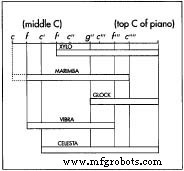 The ranges of various percussion instruments.
The Manufacturing Process
- Design: A schematic determines size, range, and finish. Traditional designs limit variation, so choices focus on bar length, resonator size, and frame aesthetics.
- Bar Production: Rosewood billets are aged for ~two years, then cut to lengths from 30–70 cm, tapering from bass to treble. Each bar measures 3.8 cm wide and 2.5 cm thick. Holes are drilled at the support ends, and the arcuate notch is carved in stages—rough tune, check, refine, finalize—until the pitch is perfect. Bars are then sanded, polished, stained, and varnished.
- Resonator Fabrication: Aluminum tubes are cut to a taper that mirrors the bar length distribution. The tubes are not acoustically critical—resonators are closed off—so the focus is on uniform diameter and smooth finish. Each tube is fitted with a stop at the lower end to match its bar.
- Frame Construction: The outer perimeter is built from hardwood or metal, finished to complement the bars. Supports are bolted to the frame; the instrument may have lockable casters or rubber feet.
- Assembly: Bars are fitted over resonators and secured with screws at the nodal points. Resonators are riveted and suspended, ensuring precise alignment.
- Mallet Production: Mallets consist of a stick (bamboo, rattan, birch, or fiberglass) and a head (hard rubber, plastic, or wool). The internal core is tightly wound cord, providing durability and consistent impact. Xylophone players select from medium, hard, or extra‑hard mallets based on repertoire and personal technique.
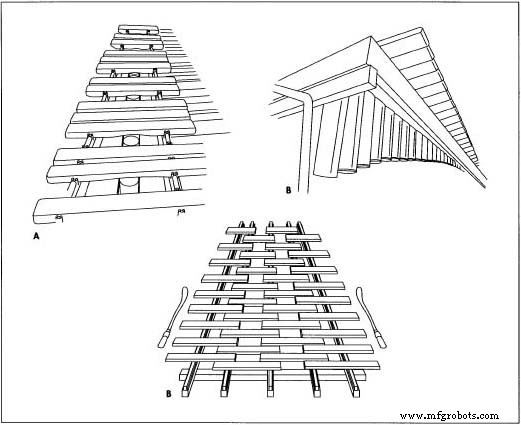 A. Keys. B. Resonators. C. An example of a four-row xylophone.
Quality Control
Xylophone artisans possess woodworking expertise comparable to cabinet makers. Every step—from bar tuning to frame assembly—is governed by strict quality standards. The iterative tuning process is the cornerstone of craftsmanship, ensuring each instrument delivers a flawless pitch and tone.
Byproducts / Waste
Manufacturers offer a range from piccolo to bass models, and often produce related percussion instruments. Because rosewood is valuable, waste is minimal; only shavings and small end scraps remain. Aluminum scrap is recycled. The process involves limited hazardous materials, with safety glasses mandatory and chemical use (stain, varnish) kept within safe handling protocols.
The Future
While the xylophone remains a staple in orchestral percussion, its repertoire and prominence are constrained by tradition. The marimba’s recent surge in popularity—driven by Latin, jazz, and contemporary percussive genres—suggests a growing audience for xylophone music. Continued exploration of new compositions and techniques will likely enhance its role as a unique voice within the orchestral palette.
Manufacturing process
- Demonstrating Sound Cancellation with Speaker Phase Reversal
- The Art and Process of LP Record Production
- Sound Sensors: How They Work & Practical Applications
- Graphene‑Based Loudspeakers and Earphones: Ultra‑Low‑Power, High‑Fidelity Sound
- Sound-Activated 8-LED Light Display
- Audio Data Transmission with Arduino Nano 33 BLE Sense
- Arduino Sound Sensor with LED Indicators and LCD for Real-Time Sound Level Monitoring
- Arduino Nano 33 BLE Sound Spectrum Visualizer: Real-Time Audio Display
- SoundWatch: Smart Alerts That Empower the Deaf & Hard-of-Hearing
- 4 Proven Strategies to Reduce Noise and Vibration in Compressor Rooms