



Sound Sensors: How They Work & Practical Applications
Sound‑driven security incidents—from gunshots to glass breaking—are on the rise. Integrating a sound sensor with video cameras can transform passive surveillance into an active threat‑response system. By detecting acoustic events in real time, the system can trigger alerts, lock doors, or notify authorities—reducing reaction time and potential damage.
What Is a Sound Sensor?
A sound sensor is an electronic module that converts acoustic vibrations into an electrical signal. It is commonly used for triggering switches, monitoring environmental noise, or adding an audio‑based trigger to a security system. Many models allow the user to adjust sensitivity, making them versatile for both quiet and loud environments.
The core of the module is a miniature microphone that feeds its signal into a buffer, a peak detector, and an amplifier. The processed voltage is then sent to a microcontroller or digital logic for further action.
Typical sound sensors can measure noise levels in decibels (dB) across the 3 kHz‑6 kHz band—the range most audible to humans. Android apps such as Decibel Meter can validate readings from these modules.
Pin Configuration
The module features three pins:
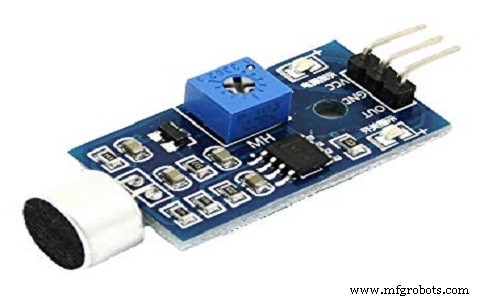
- Pin 1 (VCC): 3.3 V–5 V DC
- Pin 2 (GND): Ground
- Pin 3 (DO): Output (analog voltage)
Working Principle
Like the human ear, the sensor uses a diaphragm coupled to a magnet and coil. When sound waves hit the diaphragm, the magnet moves relative to the coil, inducing a current. This electrical signal is then conditioned by the internal circuitry before being output as a voltage that reflects sound intensity.
Features
- Intuitive to connect—no complex circuitry required.
- Provides a clean analog output suitable for microcontrollers.
- Easy integration with logic circuits or digital converters.
Specifications
- Operating voltage: 3.3 V–5 V
- Operating current: 4–5 mA
- Voltage gain: 26 dB (V=6 V, f=1 kHz)
- Microphone sensitivity: 48–52 dB (1 kHz)
- Impedance: 2.2 kΩ
- Frequency response: 16–20 kHz
- Signal‑to‑noise ratio: 54 dB
Applications
Sound sensors are a staple in DIY and commercial projects alike. Pairing them with an Arduino or Grove sensor shield gives a device “ears” that can measure ambient noise or detect specific acoustic cues.
Common use cases include:
- Activating lights or alarms on a whistle or clap.
- Securing homes or offices with audio‑triggered locks.
- Detecting gunshots or breaking glass in real time.
- Spy circuitry that responds to hidden acoustic triggers.
- Robotics where sound cues guide behavior.
- Smartphone apps that log or analyze environmental noise.
- Ambient sound recognition for adaptive audio systems.
- Audio amplification feedback loops.
- Basic sound‑level monitoring (approximate dB).
In summary, a sound sensor is a low‑cost, reliable module that translates acoustic events into actionable signals. Its analog output, straightforward wiring, and robust specifications make it ideal for security, automation, and interactive projects.
Sensor
- How Distance Sensors Work and Their Key Applications
- Virtual Sensors: How They Work and Key Applications
- Voltage Sensors: How They Work & Key Applications in Modern Power Systems
- Lambda (Oxygen) Sensor: Function, Operation, and Key Automotive Applications
- Image Sensors: Types, Operation, and Practical Applications
- Gyroscope Sensors: How They Work and Their Key Applications
- Flame Sensors: How They Work and Key Applications in Fire Safety
- Humidity Sensors: How They Work and Key Applications
- Rain Sensors Explained: How They Work & Key Applications
- Laser Sensors Explained: Working Principles & Industrial Applications