



Flame Sensors: How They Work and Key Applications in Fire Safety
A flame sensor is a highly sensitive detector that monitors for the characteristic light emitted by combustion. Operating within the 760 nm to 1100 nm wavelength range, it can identify flames from a distance of up to 100 cm and with a detection angle of 600 °, making it ideal for safety‑critical applications such as fire alarms, gas leak detection, and industrial process monitoring.
What Is a Flame Sensor?
Flame sensors are designed to rapidly detect and respond to the presence of fire or flame. Their quick response times and high accuracy surpass those of conventional heat or smoke detectors, enabling prompt activation of alarm systems, gas shut‑off valves, or fire suppression equipment. Commonly installed in industrial boilers, gas pipelines, and residential heating systems, they serve as a first line of defense against accidental ignition.
Working Principle
Most flame sensors use an infrared (IR) detection mechanism. The sensor emits a narrow IR beam that is reflected by a flame’s incandescent particles. Because flames emit strongly in the 760–1100 nm range, the sensor can distinguish fire from other light sources. Importantly, the IR method allows the sensor to operate effectively even when covered by dust, oil, or water vapor, maintaining reliable detection in harsh environments.
Flame Sensor Module
The typical module features a compact 3 cm × 1.6 cm PCB and four pins for integration with microcontrollers:
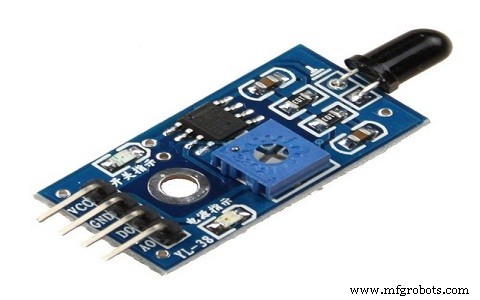
- Pin 1 – VCC (3.3 V to 5.3 V)
- Pin 2 – GND
- Pin 3 – AOUT (analog output)
- Pin 4 – DOUT (digital output)
Types of Flame Sensors
- IR single‑frequency
- IR multi‑spectrum
- UV flame detector
- UV/IR hybrid detector
Key Features & Specifications
- High photosensitivity and fast response time
- Adjustable sensitivity and accuracy
- Detection angle of 600 °
- Analog voltage output and digital switch output
- Operating voltage: 3.3 V – 5 V
- Power and status indicators built into the PCB
- Effective flame detection up to 0.8 m; higher intensity flames improve detection range
Applications
- Hydrogen and gas stations
- Industrial heating and gas turbines
- Fire detection and alarm systems
- Fire‑fighting robots
- Drying and dehumidification units
- Domestic heating and gas‑powered cooking appliances
In summary, flame sensors provide rapid, reliable detection of combustion, helping to mitigate fire risks in both industrial and residential settings. Their superior speed and accuracy make them indispensable in safety systems that demand immediate response to flame hazards.
Sensor
- How Distance Sensors Work and Their Key Applications
- Virtual Sensors: How They Work and Key Applications
- Voltage Sensors: How They Work & Key Applications in Modern Power Systems
- Lambda (Oxygen) Sensor: Function, Operation, and Key Automotive Applications
- Image Sensors: Types, Operation, and Practical Applications
- Gyroscope Sensors: How They Work and Their Key Applications
- Sound Sensors: How They Work & Practical Applications
- Humidity Sensors: How They Work and Key Applications
- Rain Sensors Explained: How They Work & Key Applications
- Laser Sensors Explained: Working Principles & Industrial Applications