



Rain Sensors Explained: How They Work & Key Applications
Water conservation has become a priority worldwide. One of the most cost‑effective tools for managing rainfall is the rain sensor—a simple device that alerts systems when precipitation is detected.
What Is a Rain Sensor?
A rain sensor is a switch‑type sensor that closes its circuit when water drops land on its conductive surface. The change in resistance caused by moisture triggers an output signal, allowing automated systems to respond immediately.
Rain Sensor Module
The module consists of a nickel‑coated conductive plate mounted on a small PCB. When raindrops bridge the plate’s two electrodes, a parallel resistance path forms, and an LM393 comparator on the board translates this change into analog or digital signals.
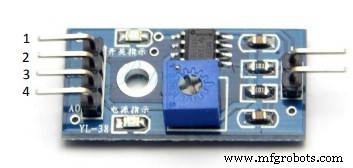
Because the sensor’s resistance drops when wet, the LM393 produces a clean digital output once the moisture level exceeds a set threshold. The analog output pin provides a voltage proportional to the amount of rain, useful for fine‑tuned irrigation control.
Pin Configuration
- VCC (Pin 1) – 5 V DC supply.
- GND (Pin 2) – Ground connection.
- DO (Pin 3) – Digital output (high/low).
- AO (Pin 4) – Analog output (voltage proportional to moisture).
Specifications
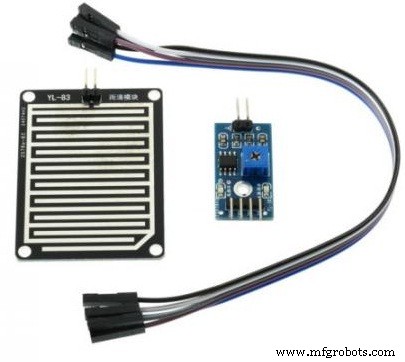
- Double‑sided construction for reliable conductivity.
- Corrosion‑resistant, long‑life nickel plating.
- Active area: 5 cm × 4 cm.
- Adjustable sensitivity via built‑in potentiometer.
- Operating voltage: 5 V.
- PCB dimensions: 3.2 cm × 1.4 cm.
- Bolt‑hole mounting for easy installation.
- LM393 comparator with wide supply range.
- Clean digital waveform and drive capability > 15 mA.
Applications
- Automated irrigation: shuts the system down during rainfall to prevent overwatering.
- Automotive: protects internal electronics and activates wipers based on real‑time rain detection.
- Satellite communications: triggers rain blowers on aerials to keep waveguides dry.
In summary, rain sensors provide a reliable, low‑cost way to detect precipitation and trigger appropriate actions—whether conserving water, protecting vehicles, or maintaining critical communication links. The LM393 comparator, at the heart of the module, ensures a fast, clean response to moisture changes.
What is the primary function of the LM393 comparator in a rain sensor?
Sensor
- How Distance Sensors Work and Their Key Applications
- Virtual Sensors: How They Work and Key Applications
- Voltage Sensors: How They Work & Key Applications in Modern Power Systems
- Lambda (Oxygen) Sensor: Function, Operation, and Key Automotive Applications
- Image Sensors: Types, Operation, and Practical Applications
- Gyroscope Sensors: How They Work and Their Key Applications
- Flame Sensors: How They Work and Key Applications in Fire Safety
- Sound Sensors: How They Work & Practical Applications
- Humidity Sensors: How They Work and Key Applications
- Laser Sensors Explained: Working Principles & Industrial Applications