



How Soil Moisture Sensors Work and Their Practical Applications
Soil moisture is a pivotal factor in irrigation and horticulture. It determines nutrient availability, influences plant transpiration and root development, and can create anaerobic conditions that favor pathogenic growth. Accurate soil moisture monitoring enables precise water management, leading to healthier crops and more efficient resource use.
What Is a Soil Moisture Sensor?
A soil moisture sensor is a device that measures the volumetric water content of soil. Traditional gravimetric methods—drying and weighing samples—are laborious; modern sensors infer moisture through dielectric constant, electrical resistance, neutron scattering, or water potential measurements. Calibration must account for soil texture, temperature, salinity, and conductivity, as these factors influence the sensor’s response.
The relationship between the sensor’s output and actual moisture varies with ecological conditions. In remote sensing and hydrology, microwave backscatter is also affected by soil moisture, providing an additional monitoring tool.
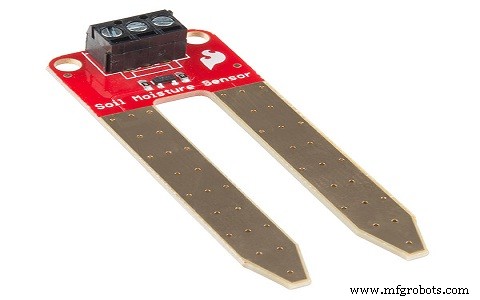
While most sensors provide volumetric water content, a subset—so-called soil water potential sensors—measure the energy status of water within the soil. Examples include gypsum block sensors and tensiometers.
Soil Moisture Sensor Pin Configuration
The FC‑28 module features four pins:
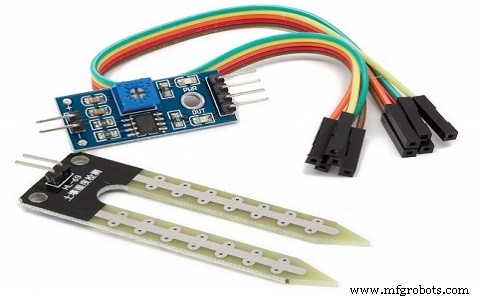
- VCC – power supply (5 V)
- A0 – analog output (voltage proportional to moisture)
- D0 – digital output (threshold‑crossing indicator)
- GND – ground
The module also incorporates a potentiometer to set a user‑defined moisture threshold. The LM393 comparator evaluates this threshold; when the sensed value crosses it, an LED toggles to provide visual feedback.
Working Principle
The sensor operates on the capacitance principle. As water—a high‑dielectric material—fills the soil pores, the overall dielectric permittivity of the sensor’s sensing area increases. This change in capacitance is translated into an analog voltage output, expressed as a percentage of full scale. The device is compact, low‑power (<20 mA), and suitable for continuous field monitoring.
Its simplicity and reliability make the FC‑28 ideal for educational demonstrations in environmental science, agriculture, biology, and horticulture labs.
Specifications
- Operating voltage: 5 V
- Maximum current draw: <20 mA
- Interface type: analog (with optional digital threshold)
- Operating temperature range: 10 °C – 30 °C
Soil Moisture Sensor Applications
- Precision agriculture (real‑time irrigation control)
- Landscape irrigation scheduling
- Research studies on plant–soil interactions
- DIY garden and greenhouse monitoring
In summary, soil moisture sensors quantify volumetric water content, empowering growers, researchers, and hobbyists to optimize water use and promote plant health. As a next step, consider exploring the different types of moisture sensors available—such as capacitive, resistive, tensiometric, and neutron‑based devices—to select the best fit for your specific application.
Sensor
- Blood Pressure Sensor: How It Works & Key Applications
- Voltage Sensors: How They Work & Key Applications in Modern Power Systems
- RVG Sensor: How It Works and Why It’s Transforming Dental Imaging
- Lambda (Oxygen) Sensor: Function, Operation, and Key Automotive Applications
- Image Sensors: Types, Operation, and Practical Applications
- Color Sensors: How They Work & Key Applications
- How Soil Moisture Sensors Work and Their Practical Applications
- Fingerprint Sensor Technology: Working Principles, Applications, and Arduino Integration
- Vibration Sensors: Principles, Types, and Industrial Applications
- How Oxygen Sensors Work and Their Key Applications in Automotive and Industrial Systems