



Understanding IMU Sensors: Functionality and Applications in Modern Tech
In robotics and many other fields, sensors are indispensable for interacting with the environment. Among them, the Inertial Measurement Unit (IMU) stands out for its ability to provide precise motion data, enabling sophisticated navigation and control systems.
What Is an IMU Sensor?
An IMU is an electronic device that measures a body’s linear acceleration, angular velocity, and, when equipped with a magnetometer, heading. It typically integrates a gyroscope, an accelerometer, and sometimes a magnetometer, allowing it to determine roll, pitch, and yaw in real time.
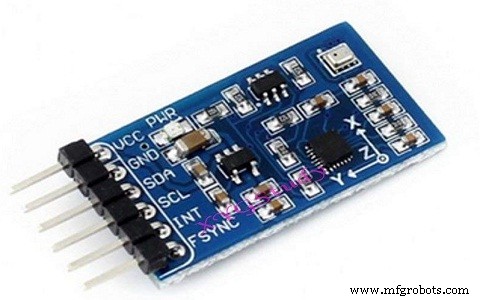
IMUs are core components in UAVs, spacecraft, autonomous vehicles, and handheld devices. Modern integrations allow IMUs to complement GPS, delivering reliable positioning even when satellite signals are weak or blocked.
Working Principle
The core of an IMU is its sensor triad:
- Accelerometer – Detects linear acceleration along three orthogonal axes.
- Gyroscope – Measures angular rate around the same axes.
- Magnetometer (optional) – Provides absolute heading by sensing the Earth’s magnetic field.
Data from these sensors are fused—often by a dedicated microcontroller or software algorithm—to produce stable estimates of orientation and velocity.
Typical Configurations
An IMU can be classified by the number of axes it measures:
- 6‑axis – 3‑axis accelerometer + 3‑axis gyroscope.
- 9‑axis – Adds a 3‑axis magnetometer for full heading support.
These units are often paired with sensor‑fusion firmware to form an Attitude Heading Reference System (AHRS), a term frequently used interchangeably with “IMU” in the industry.
Applications
IMUs are integral to a wide range of technologies:
- Satellite and spacecraft attitude control.
- UAV navigation and stabilization.
- Smartphone motion detection (gaming, AR/VR).
- Industrial robotics and automation.
- Vehicle dynamics and driver‑assist systems.
- Consumer wearables for activity tracking.
- Precision indoor positioning when GPS is unavailable.
With the growing demand for high‑accuracy positioning, IMUs are expected to play a pivotal role in emerging technologies such as LiDAR‑based mapping, autonomous navigation, and smart city infrastructure.
A wireless IMU (WIMU) transmits processed orientation data over radio, enabling real‑time motion capture in industrial robotics and sports analytics.
Sensor
- How Distance Sensors Work and Their Key Applications
- Voltage Sensors: How They Work & Key Applications in Modern Power Systems
- Lambda (Oxygen) Sensor: Function, Operation, and Key Automotive Applications
- Image Sensors: Types, Operation, and Practical Applications
- Gyroscope Sensors: How They Work and Their Key Applications
- Flame Sensors: How They Work and Key Applications in Fire Safety
- Sound Sensors: How They Work & Practical Applications
- Humidity Sensors: How They Work and Key Applications
- Rain Sensors Explained: How They Work & Key Applications
- Laser Sensors Explained: Working Principles & Industrial Applications