



Humidity Sensors: How They Work and Key Applications
Humidity is the amount of water vapor present in the air. It is expressed as relative or absolute humidity, each relevant in different contexts. In industrial and medical settings, maintaining humidity within specified limits is critical: excess moisture can cause equipment malfunctions, corrosion, and inaccurate sensor readings. Therefore, reliable humidity measurement is essential for safety, quality control, and process reliability.
What Is a Humidity Sensor?
A humidity sensor, commonly called a hygrometer, is a low‑cost, highly sensitive electronic device that quantifies atmospheric moisture. Depending on the metric it outputs, a sensor is classified as a relative‑humidity or absolute‑humidity device.
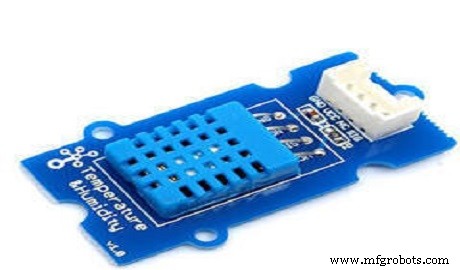
The sensor’s core technology falls into three families:
- Capacitive – uses a dielectric that changes its permittivity with moisture.
- Resistive – employs a hygroscopic material whose electrical resistance varies with humidity.
- Thermal‑conductivity – measures the amount of water vapor by its effect on thermal conductivity.
When selecting a sensor, key performance indicators include accuracy, linearity, reliability, repeatability, and response time.
Working Principle
Capacitive sensors place a moisture‑sensitive dielectric between two electrodes; the resulting capacitance change is translated into a humidity reading. Resistive sensors position a hygroscopic layer over electrodes; the layer’s resistance shifts as moisture content changes. Thermal‑conductivity sensors detect the change in heat transfer caused by water vapor, providing absolute humidity data.
Applications
Capacitive sensors are favored in HVAC controls, printing equipment, fax machines, weather stations, automotive cabins, food processing lines, and refrigeration systems due to their precision and low power consumption.
Resistive sensors, prized for their compact size and affordability, are common in residential climate control, industrial automation, and consumer electronics. Thermal‑conductivity sensors are essential in pharmaceutical manufacturing, food dehydration, and drying machinery, where accurate absolute humidity monitoring is mandatory.
Popular Models
The market offers a range of analog and digital sensors:
- DHT11 – low‑cost, basic analog output.
- DHT22 / AM2302 – improved accuracy and temperature range.
- SHT71 – digital I²C interface with high precision.
- SHT3X – versatile digital sensor with self‑calibration.
- SHTW2 – ultra‑compact module for space‑constrained designs.
- SHT85 – easy replaceability and extended temperature range.
Digital sensors infer humidity indirectly by measuring changes in resistivity or conductivity, then applying calibrated algorithms. The digital output simplifies integration with microcontrollers such as Arduino and Raspberry Pi, making them ideal for smart HVAC systems, environmental monitoring, and protecting sensitive electronics from moisture‑induced failure.
Choosing the right sensor depends on your application’s accuracy requirements, operating temperature, and environmental conditions.
Sensor
- How Distance Sensors Work and Their Key Applications
- Voltage Sensors: How They Work & Key Applications in Modern Power Systems
- Lambda (Oxygen) Sensor: Function, Operation, and Key Automotive Applications
- Image Sensors: Types, Operation, and Practical Applications
- Gyroscope Sensors: How They Work and Their Key Applications
- Flame Sensors: How They Work and Key Applications in Fire Safety
- Sound Sensors: How They Work & Practical Applications
- DHT11 Sensor: How It Works and Key Applications
- Rain Sensors Explained: How They Work & Key Applications
- Laser Sensors Explained: Working Principles & Industrial Applications